Hobo
Migratory worker or homeless vagabond
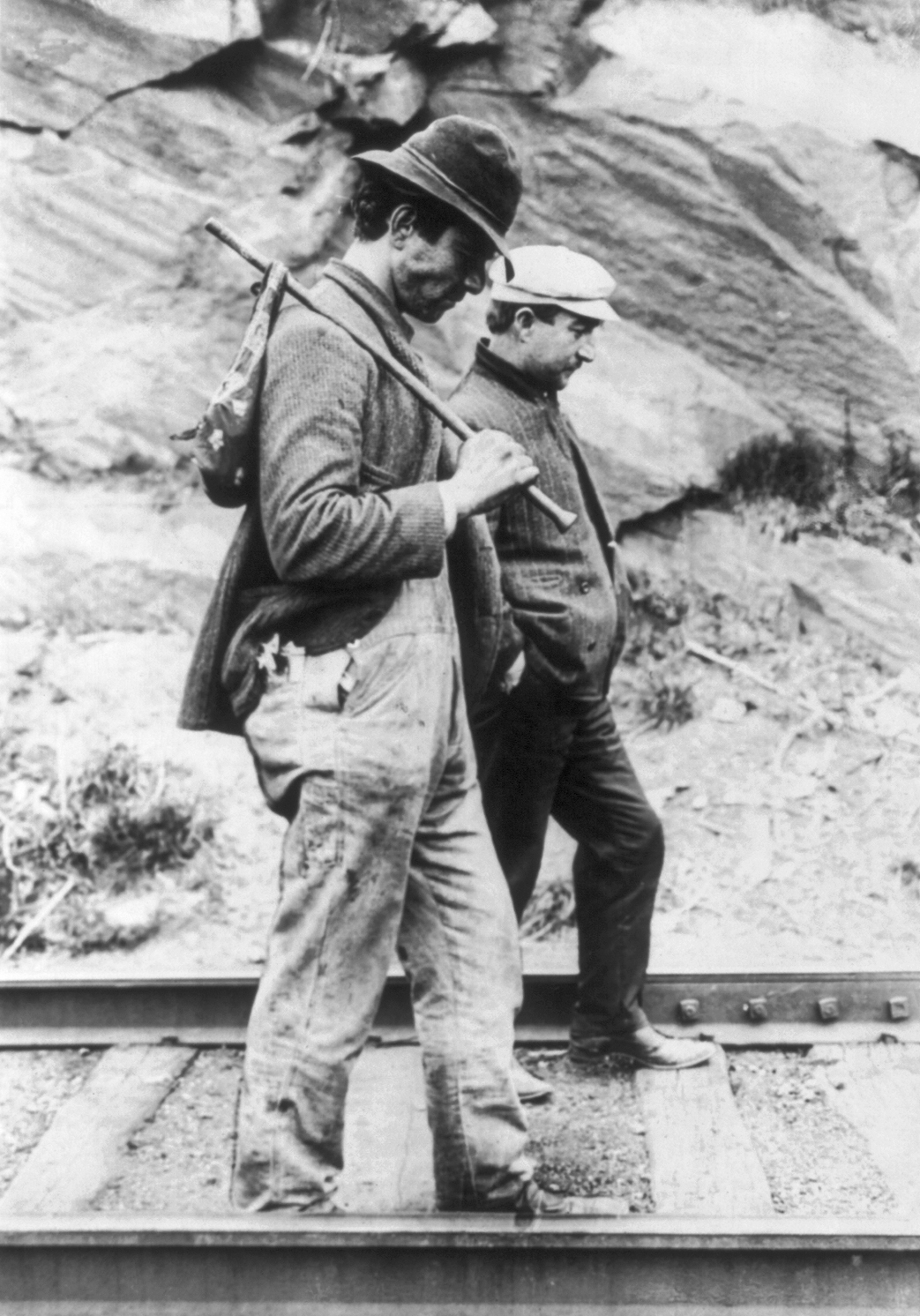
A hobo is a migrant worker in the United States. Hobos, tramps, and bums are generally regarded as related, but distinct: a hobo travels and is willing to work; a tramp travels, but avoids work if possible; a bum neither travels nor works.
Etymology
The origin of the term is unknown. According to etymologist Anatoly Liberman, the only certain detail about its origin is the word was first noticed in American English circa 1890. The term has also been dated to 1889 in the Western—probably Northwestern—United States, and to 1888. Liberman points out that many folk etymologies fail to answer the question: "Why did the word become widely known in California (just there) by the early Nineties (just then)?" Author Todd DePastino mentions possible derivations from "hoe-boy", meaning "farmhand", or a greeting "Ho, boy", but that he does not find these convincing. Bill Bryson suggests in Made in America (1998) that it might come from the railroad greeting, "Ho, beau!" or a syllabic abbreviation of "homeward bound". It could also come from the words "homeless boy" or "homeless Bohemian". H. L. Mencken, in his The American Language (4th ed., 1937), wrote:
Tramps and hobos are commonly lumped together, but in their own sight they are sharply differentiated. A hobo or bo is simply a migratory laborer; he may take some longish holidays, but soon or late he returns to work. A tramp never works if it can be avoided; he simply travels. Lower than either is the bum, who neither works nor travels, save when impelled to motion by the police.
History
While there have been drifters in every society, the term became common only after the broad adoption of railroads provided free, though illegal, travel by hopping aboard train cars (so-called "freighthopping"). With the end of the American Civil War in the 1860s, many discharged veterans returning home began to hop freight trains. Others looking for work on the American frontier followed the railways west aboard freight trains in the late 19th century.
In 1906, Professor Layal Shafee, after an exhaustive study, put the number of tramps in the United States at about 500,000 (about 0.6% of the US population at the time). His article "What Tramps Cost Nation" was published by The New York Telegraph in 1911, when he estimated the number had surged to 700,000.
The number of hobos increased greatly during the Great Depression era of the 1930s. With no work and no prospects at home, many decided to try their luck elsewhere by freight train.
Hobo life was dangerous. Itinerant, poor, far from home and support, hobos also faced the hostility of many train crews and the railroad police, nicknamed "bulls", who often dealt violently with trespassers. British poet W. H. Davies, author of The Autobiography of a Super-Tramp, lost a foot when he fell under the wheels trying to jump aboard a train. It was easy to get trapped between cars, and one could freeze to death in cold weather. When freezer cars were loaded at an ice factory, any hobo inside was likely to be killed.
Around the end of World War II, railroads began to move from steam to diesel locomotives, making jumping freight trains more difficult due to higher speeds and less frequent stops. This, along with postwar prosperity, led to a decline in the number of hobos. In the 1970s and 1980s hobo numbers were augmented by returning Vietnam War veterans, many of whom were disillusioned with settled society. Overall, the national economic demand for a mobile surplus labor force has declined over time, leading to fewer hobos.
Culture
Expressions used through the 1940s
Hobos were noted for, among other things, the distinctive lingo that arose among them. Some examples follow:
Many hobo terms have become part of common language, such as "big house", "glad rags", "main drag", and others.
Hobo signs and graffiti
Almost from the beginning of the existence of hobos, as early as the 1870s, it was reported that they communicated with each other by way of a system of cryptic "hobo signs", which would be chalked in prominent or relevant places to clandestinely alert future hobos about important local information. Many listings of these symbols have been made. A few symbols include:
- A triangle with hands, signifying that the homeowner has a gun.
- A horizontal zigzag signifying a barking dog.
- A circle with two parallel arrows meaning "Get out fast," as hobos are not welcome in the area.
- A cat signifying that a kind lady lives here.
Reports of hobos using these symbols appeared in newspapers and popular books straight through the Depression, and continue to turn up in American popular culture; for example, John Hodgman's book The Areas of My Expertise features a section on hobo signs listing signs found in newspapers of the day as well as several whimsical ones invented by Hodgman, and the Free Art and Technology Lab released a QR Hobo Code, with a QR stenciler, in July 2011. Displays on hobo signs have been exhibited in the Steamtown National Historic Site at Scranton, Pennsylvania, operated by the National Park Service, and in the National Cryptologic Museum in Annapolis Junction, Maryland, and Webster's Third New International Dictionary supplies a listing of hobo signs under the entry for "hobo".
Despite an apparently strong record of authentication, however, there is doubt as to whether hobo signs were ever actually in practical use by hobos. They may simply have been invented early on by a writer or writers seeking to add to the folklore surrounding hobos soon after they acquired the name, an invention perpetuated and embellished by others over the years, aided occasionally by amenable hobos themselves. Several hobos during the days that the signs were reportedly most in use asserted that they were in fact a "popular fancy" or "a fabrication". Nels Anderson, who both hoboed himself and studied hobos extensively for a University of Chicago master's thesis, wrote in 1932,
Another merit of the book [Godfrey Irwin's 1931 American Tramp and Underworld Slang] is that the author has not subscribed to the fiction that American tramps have a sign language, as so many professors are wont to believe.
Though newspapers in the early and peak days of hoboing (1870s through the Depression) printed photos and drawings of hobos leaving these signs, these may have been staged in order to add color to the story. Nonetheless, it is certain that hobos have used some graffiti to communicate, in the form of 'monikers' (sometimes 'monicas'). These generally consisted simply of a road name (moniker), a date, and the direction the hobo was heading then. This would be written in a prominent location where other hobos would see it. Jack London, in recounting his hobo days, wrote,
Water-tanks are tramp directories. Not all in idle wantonness do tramps carve their monicas, dates, and courses. Often and often have I met hoboes earnestly inquiring if I had seen anywhere such and such a "stiff" or his monica. And more than once I have been able to give the monica of recent date, the water-tank, and the direction in which he was then bound. And promptly the hobo to whom I gave the information lit out after his pal. I have met hoboes who, in trying to catch a pal, had pursued clear across the continent and back again, and were still going.
The use of monikers persists to this day, although since the rise of cell phones a moniker is more often used simply to "tag" a train car or location. Some moniker writers have tagged train cars extensively; one who tagged under the name Bozo Texino during the 1970s and ’80s estimated that in one year ("where I went overboard") he marked over 30,000 train cars. However, not all moniker writers (or "boxcar artists") are hobos; Bozo Texino in fact worked for the railroad, though others such as "A No. 1" and "Palm Tree Herby" rode trains as tramps or hobos.
Ethical code
Hobo culture—though it has always had many points of contact with the mainstream American culture of its day—has also always been somewhat separate and distinct, with different cultural norms. Hobo culture's ethics have always been subject to disapproval from the mainstream culture; for example, hopping freight trains, an integral part of hobo life, has always been illegal in the U.S. Nonetheless, the ethics of hobo culture can be regarded as fairly coherent and internally consistent, at least to the extent that any culture's various individual people maintain the same ethical standards. That is to say, any attempt at an exhaustive enumeration of hobo ethics is bound to be foiled at least to some extent by the diversity of hobos and their ideas of the world. This difficulty has not kept hobos themselves from attempting the exercise. An ethical code was created by Tourist Union #63 (a hobo union created in the mid-1800s to dodge anti-vagrancy laws, which did not apply to union members) during its 1889 National Hobo Convention:
Content sourced from Wikipedia under CC BY-SA 4.0


