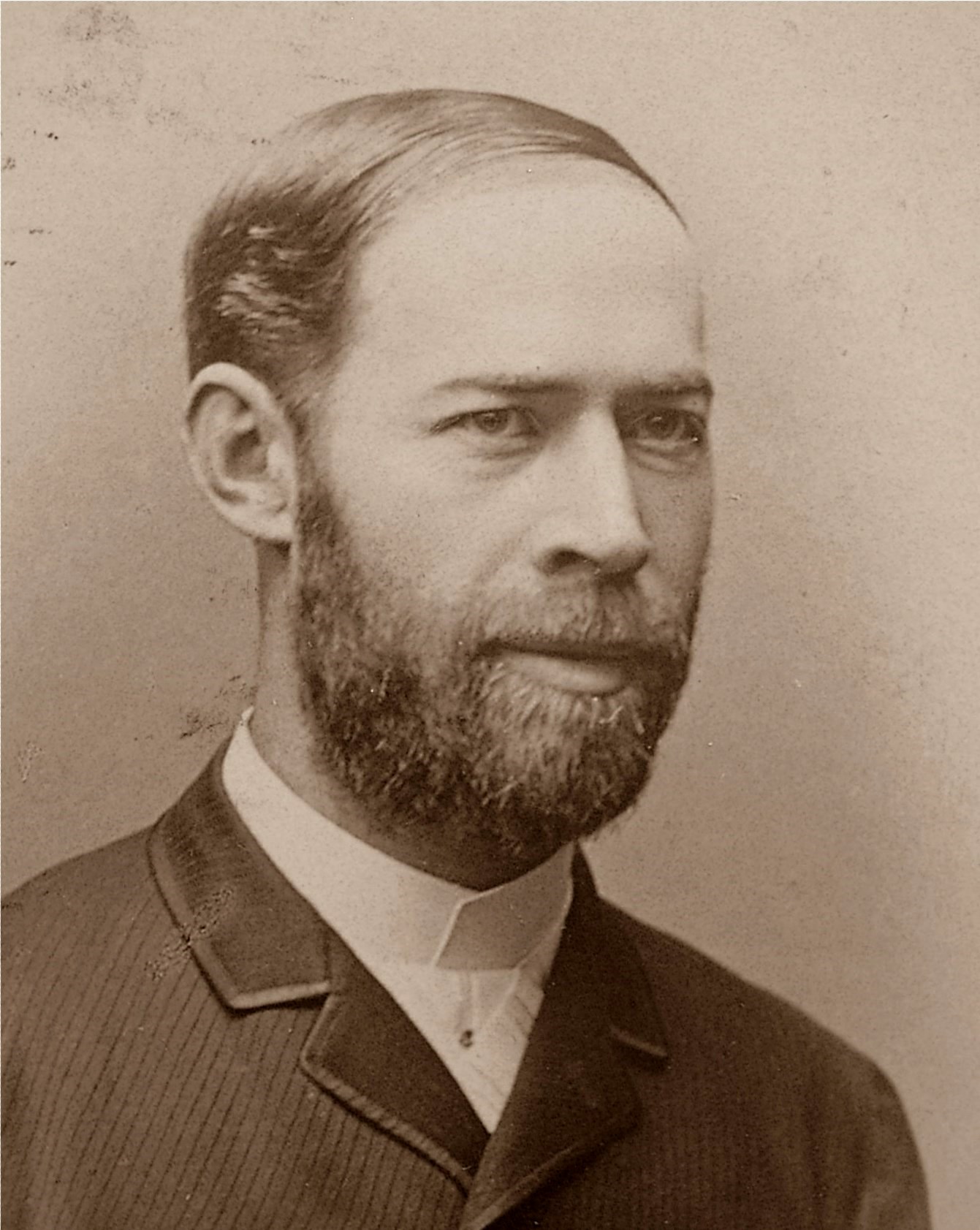
Heinrich Hertz
German physicist (1857–1894)
Heinrich Rudolf Hertz ( hurts; German: [hɛʁts] ; 22 February 1857 – 1 January 1894) was a German physicist who first conclusively proved the existence of the electromagnetic waves proposed by James Clerk Maxwell's equations of electromagnetism.
Biography
Heinrich Rudolf Hertz was born on 22 February 1857 in Hamburg, the son of Gustav Ferdinand Hertz, a lawyer and politician, and Anna Elisabeth Pfefferkorn.
While studying at the Gelehrtenschule des Johanneums in Hamburg, Hertz showed an aptitude for sciences as well as languages, learning Arabic. He studied sciences and engineering in the German cities of Dresden, Munich, and Berlin, where he studied under Gustav Kirchhoff and Hermann von Helmholtz. In 1880, Hertz obtained his Ph.D. from the University of Berlin, and for the next three years remained for post-doctoral study under Helmholtz, serving as his assistant. In 1883, Hertz took a post as a lecturer in theoretical physics at the University of Kiel. In 1885, Hertz became a full professor at the University of Karlsruhe.
In 1886, Hertz married Elisabeth Doll, the daughter of Max Doll, a lecturer in geometry at Karlsruhe. They had two daughters: Johanna, born on 20 October 1887 and Mathilde, born on 14 January 1891, who went on to become a notable biologist. During this time Hertz conducted his landmark research into electromagnetic waves.
Hertz took a position of Professor of Physics and Director of the Physics Institute at the University of Bonn on 3 April 1889, a position he held until his death. During this time he worked on theoretical mechanics with his work published in the book Die Prinzipien der Mechanik in neuem Zusammenhange dargestellt (The Principles of Mechanics Presented in a New Form), published posthumously in 1894.
Death
In 1892, Hertz was diagnosed with an infection (after a bout of severe migraines) and underwent operations to treat the illness. He died due to complications after surgery which had attempted to cure his condition. Based on a diary and extensive correspondence with his family made available in a 1997 biography by Albrecht Fölsing, the source of his illness is likely to have been Granulomatosis with Polyangiitis (formerly known as Wegener's granulomatosis), 45 years before the disease had yet been explored. He died on 1 January 1894 in Bonn, aged 36, and is buried in the Ohlsdorf Cemetery in Hamburg.
Hertz's wife, Elisabeth Hertz (née Doll; 1864–1941), did not remarry. He was survived by his daughters, Johanna (1887–1967) and Mathilde (1891–1975). Neither ever married or had children, hence Hertz has no living descendants.
Scientific work
Electromagnetic waves
In 1864 Scottish mathematical physicist James Clerk Maxwell proposed a comprehensive theory of electromagnetism, now called Maxwell's equations. Maxwell's theory predicted that coupled electric and magnetic fields could travel through space as an "electromagnetic wave". Maxwell proposed that light consisted of electromagnetic waves of short wavelength, but no one had been able to prove this, or generate or detect electromagnetic waves of other wavelengths.
During Hertz's studies in 1879 Helmholtz suggested that Hertz's doctoral dissertation be on testing Maxwell's theory. Helmholtz had also proposed the "Berlin Prize" problem that year at the Prussian Academy of Sciences for anyone who could experimentally prove an electromagnetic effect in the polarization and depolarization of insulators, something predicted by Maxwell's theory. Helmholtz was sure Hertz was the most likely candidate to win it. Not seeing any way to build an apparatus to experimentally test this, Hertz thought it was too difficult, and worked on electromagnetic induction instead. Hertz did produce an analysis of Maxwell's equations during his time at Kiel, showing they did have more validity than the then prevalent "action at a distance" theories.
In the autumn of 1886, after Hertz received his professorship at Karlsruhe, he was experimenting with a pair of Riess spirals when he noticed that discharging a Leyden jar into one of these coils produced a spark in the other coil. With an idea on how to build an apparatus, Hertz now had a way to proceed with the "Berlin Prize" problem of 1879 on proving Maxwell's theory (although the actual prize had expired uncollected in 1882). He used a dipole antenna consisting of two collinear one-meter wires with a spark gap between their inner ends, and zinc spheres attached to the outer ends for capacitance, as a radiator. The antenna was excited by pulses of high voltage of about 30 kilovolts applied between the two sides from a Ruhmkorff coil. He received the waves with a resonant single-loop antenna with a micrometer spark gap between the ends. This experiment produced and received what are now called radio waves in the very high frequency range.
Between 1886 and 1889 Hertz conducted a series of experiments that would prove the effects he was observing were results of Maxwell's predicted electromagnetic waves. Starting in November 1887 with his paper "On Electromagnetic Effects Produced by Electrical Disturbances in Insulators", Hertz sent a series of papers to Helmholtz at the Berlin Academy, including papers in 1888 that showed transverse free space electromagnetic waves traveling at a finite speed over a distance. In the apparatus Hertz used, the electric and magnetic fields radiated away from the wires as transverse waves. Hertz had positioned the oscillator about 12 meters from a zinc reflecting plate to produce standing waves. Each wave was about 4 meters long. Using the ring detector, he recorded how the wave's magnitude and component direction varied. Hertz measured Maxwell's waves and demonstrated that the velocity of these waves was equal to the velocity of light. The electric field intensity, polarization and reflection of the waves were also measured by Hertz. These experiments established that light and these waves were both a form of electromagnetic radiation obeying the Maxwell equations.
Hertz did not realize the practical importance of his radio wave experiments. He stated that,
It's of no use whatsoever ... this is just an experiment that proves Maestro Maxwell was right—we just have these mysterious electromagnetic waves that we cannot see with the naked eye. But they are there.
Asked about the applications of his discoveries, Hertz replied,
Nothing, I guess.
Hertz's proof of the existence of airborne electromagnetic waves led to an explosion of experimentation with this new form of electromagnetic radiation, which was called "Hertzian waves" until around 1910 when the term "radio waves" became current. Within 6 years Guglielmo Marconi began developing a radio wave based wireless telegraphy system, leading to the wide use of radio communication.
Cathode rays
In 1883, he tried to prove that the cathode rays are electrically neutral and got what he interpreted as a confident absence of deflection in electrostatic field. However, as J. J. Thomson explained in 1897, Hertz placed the deflecting electrodes in a highly-conductive area of the tube, resulting in a strong screening effect close to their surface.
Nine years later Hertz began experimenting and demonstrated that cathode rays could penetrate very thin metal foil (such as aluminium). Philipp Lenard, a student of Heinrich Hertz, further researched this "ray effect". He developed a version of the cathode tube and studied the penetration by X-rays of various materials. However, Lenard did not realize that he was producing X-rays. Hermann von Helmholtz formulated mathematical equations for X-rays. He postulated a dispersion theory before Röntgen made his discovery and announcement. It was formed on the basis of the electromagnetic theory of light (Wiedmann's Annalen, Vol. XLVIII). However, he did not work with actual X-rays.
Photoelectric effect
Hertz helped establish the photoelectric effect (which was later explained by Albert Einstein) when he noticed that a charged object loses its charge more readily when illuminated by ultraviolet radiation (UV). In 1887, he made observations of the photoelectric effect and of the production and reception of electromagnetic (EM) waves, published in the journal Annalen der Physik. His receiver consisted of a coil with a spark gap, whereby a spark would be seen upon detection of EM waves. He placed the apparatus in a darkened box to see the spark better. He observed that the maximum spark length was reduced when in the box. A glass panel placed between the source of EM waves and the receiver absorbed UV that assisted the electrons in jumping across the gap. When removed, the spark length would increase. He observed no decrease in spark length when he substituted quartz for glass, as quartz does not absorb UV radiation. Hertz concluded his months of investigation and reported the results obtained. He did not further pursue investigation of this effect, nor did he make any attempt at explaining how the observed phenomenon was brought about.
Content sourced from Wikipedia under CC BY-SA 4.0


