Hanukkah
Jewish holiday
Hanukkah (IPA: ; Hebrew: חֲנֻכָּה, romanized: Ḥănukkā, lit. 'dedication', ) is a Jewish holiday that commemorates the Maccabean Revolt against the Seleucid Empire in the 2nd century BCE, when the Maccabees successfully recovered Jerusalem and the Second Temple.
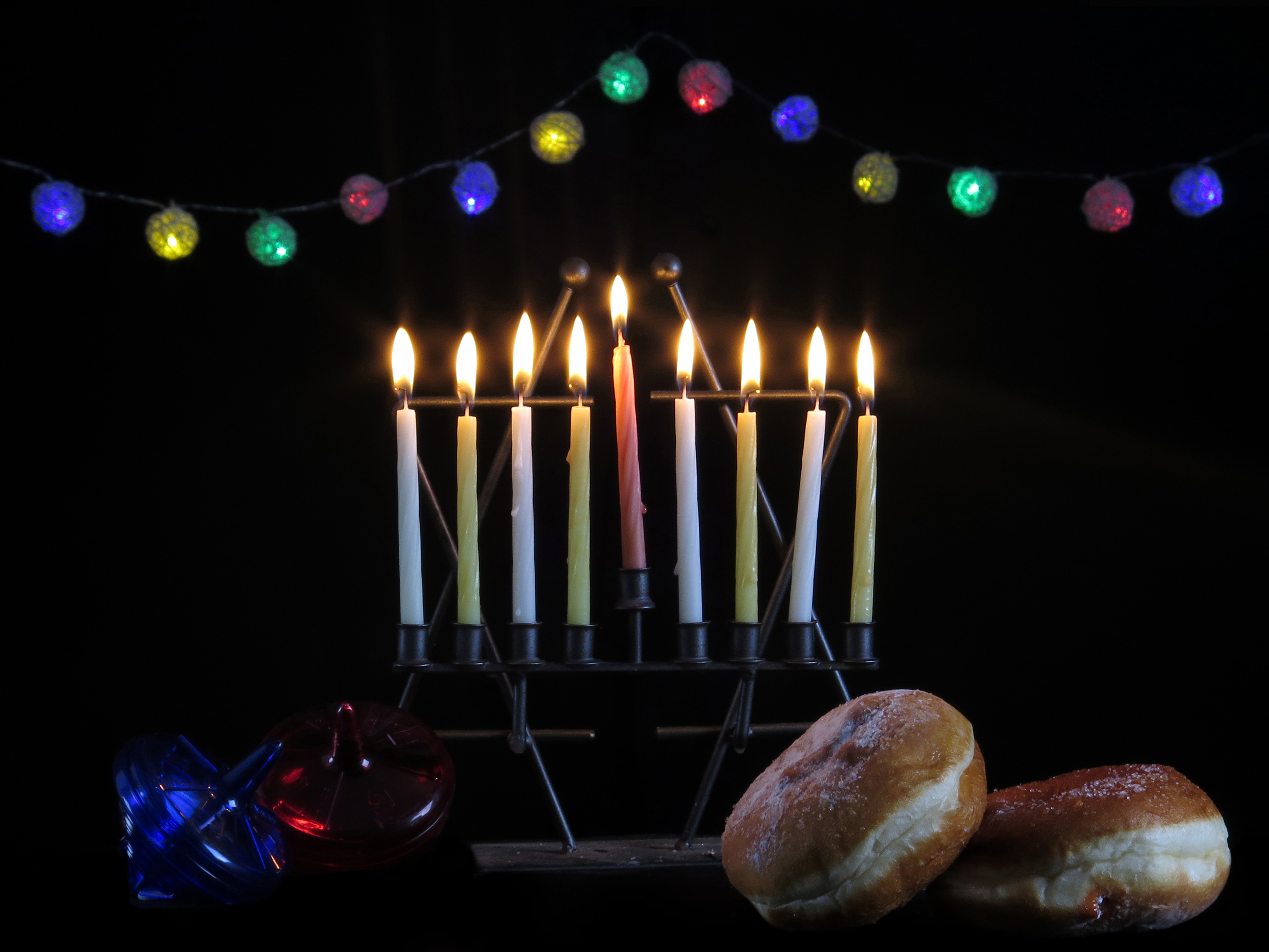
Beginning on the 25th of Kislev on the Hebrew calendar, Hanukkah lasts for eight nights and days. Each night is marked by lighting a Hanukkah menorah, a nine-branched candelabrum containing spaces for eight ceremonial lights plus one additional candle, the shámash (שַׁמָּשׁ, 'attendant'), which is used to light the others. Aside from the shamash, one candle is lit on the first night, two on the second, and so on, until all eight are burning together on the final night. It is the only Jewish holiday that starts in one month of the Hebrew calendar (Kislev) and concludes in another (Tevet).
Common practices on Hanukkah include certain Jewish prayers; indulging in Hanukkah music; playing the game of dreidel; and consuming fried food and dairy products, such as latke and sufganiyot. Since the 1970s, the Chabad movement within Hasidic Judaism has organized community-wide lightings of public menorahs in locales around the world.
Originally instituted as a feast "like the days of the festival of Sukkot" (2 Maccabees 10:9), it does not entail the corresponding obligations and is therefore a relatively minor holiday in strictly religious terms. Nevertheless, Hanukkah has attained major cultural significance in the Western world and elsewhere, especially among secular Jews, as it often falls during the Christmas and holiday season. Among American Jews, this chronological proximity also contributed to the seasonal gift-giving practice.
Etymology
The name "Hanukkah" derives from the Hebrew verb "חנך", meaning "to dedicate", because on Hanukkah, the Maccabees Jews regained control of Jerusalem and rededicated the Temple.
Many homiletical explanations have been given for the name:
- The name can be broken down into חנו כ״ה, "[they] rested [on the] twenty-fifth", referring to the fact that the Jews ceased fighting on the 25th day of Kislev, the day on which the holiday begins.
- חינוך Chinuch, from the same root, is the name for Jewish education, emphasizing ethical training and discipline.
- חנוכה (Hanukkah) is also the Hebrew acronym for ח נרות והלכה כבית הלל – "Eight candles, and the halakha is according to the House of Hillel". This is a reference to the disagreement between two rabbinical schools of thought – the House of Hillel and the House of Shammai – on the proper order in which to light the Hanukkah flames. Shammai opined that eight candles should be lit on the first night, seven on the second night, and so on down to one on the last night (because the miracle was greatest on the first day). Hillel argued in favor of starting with one candle and lighting an additional one every night, up to eight on the eighth night (because the miracle grew in greatness each day). Jewish law adopted the position of Hillel.
- Psalm 30 is called שיר חנכת הבית Shîr Ḥănukkāt HaBayit, "the Song of the 'Dedication' of the House", and is traditionally recited on Hanukkah. 25 (of Kislev) + 5 (Books of Torah) = 30, which is the number of the song.
Alternative spellings
In Hebrew, the word Hanukkah is written חֲנֻכָּה or חֲנוּכָּה (Ḥănukkā). It is most commonly transliterated to English as Hanukkah or Chanukah. The spelling Hanukkah is the most common and the preferred choice of Merriam–Webster, Collins English Dictionary, the Oxford Style Manual, and the style guides of The New York Times. The Guardian uses "Hanukah" The sound represented by Ch ([χ], similar to the Scottish pronunciation of loch) is not native to the English language, so those not familiar with Hebrew pronunciation may pronounce it with an h ([h]). Furthermore, the letter ḥeth (ח), which is the first letter in the Hebrew spelling, is pronounced differently in modern Hebrew (voiceless uvular fricative) from in classical Hebrew (voiceless pharyngeal fricative [ħ]), and neither of those sounds is unambiguously representable in English spelling. However, the classical Hebrew sound is closer to the English H than to the Scottish Ch, and Hanukkah more accurately represents the spelling in the Hebrew alphabet. Moreover, the 'kaf' consonant is geminate in classical (but not modern) Hebrew. Adapting the classical Hebrew pronunciation with the geminate and pharyngeal Ḥeth can lead to the spelling Hanukkah, while adapting the modern Hebrew pronunciation with no gemination and uvular Ḥeth leads to the spelling Chanukah.
Festival of Lights
In Modern Hebrew, Hanukkah may also be called the Festival of Lights (חַג הַאוּרִים, Ḥag HaUrim), based on a comment by Josephus in Antiquities of the Jews, καὶ ἐξ ἐκείνου μέχρι τοῦ δεῦρο τὴν ἑορτὴν ἄγομεν καλοῦντες αὐτὴν φῶτα "And from then on we celebrate this festival, and we call it Lights". The first Hebrew translation of Antiquities (1864) used (חַג הַמְּאֹרוֹת) "Festival of Lamps", but the translation "Festival of Lights" (חַג הַאוּרִים) appeared by the end of the nineteenth century. The term "Festival of Lights" is also commonly used in English.
Historical sources
Books of Maccabees
The story of Hanukkah is told in the books of the First and Second Maccabees, which describe in detail the re-dedication of the Temple in Jerusalem and the lighting of the menorah. These books, however, are not a part of the canonized Masoretic Text version of the Tanakh (Hebrew and Aramaic language Jewish Bible) used and accepted by normative Rabbinical Judaism and therefore modern Jews (as copied, edited and distributed by a group of Jews known as the Masoretes between the 7th and 10th centuries of the Common Era). However, the books of Maccabees were included among the deuterocanonical books added to the Septuagint, Greek-language translations of the Hebrew Bible (The Tanakh) originally compiled in the mid-3rd century BCE. The Roman Catholic and Orthodox Churches consider the books of Maccabees as a canonical part of the Old Testament.
The eight-day re-dedication of the temple is described in 1 Maccabees, though the miracle of the oil does not appear here. A story similar in character, and older in date, is the one alluded to in 2 Maccabees according to which the relighting of the altar fire by Nehemiah was due to a miracle which occurred on the 25th of Kislev, and which appears to be given as the reason for the selection of the same date for the rededication of the altar by Judah Maccabee. The above account in 1 Maccabees, as well as 2 Maccabees portrays the feast as a delayed observation of the eight-day Feast of Booths (Sukkot); similarly 2 Maccabees explains the length of the feast as "in the manner of the Feast of Booths".
Early rabbinic sources
Megillat Taanit (1st century) contains a list of festive days on which fasting or eulogizing is forbidden. It specifies, "On the 25th of [Kislev] is Hanukkah of eight days, and one is not to eulogize". The scholion (9th-10th century) then references the story of the rededication of the Temple and the miracle of the cruse of oil.
The Mishna (late 2nd century) mentions Hanukkah in several places, but never describes its laws in detail and never mentions any aspect of the history behind it. To explain the Mishna's lack of a systematic discussion of Hanukkah, Nissim ben Jacob postulated that information on the holiday was so commonplace that the Mishna felt no need to explain it. Modern scholar Reuvein Margolies suggests that as the Mishnah was redacted after the Bar Kochba revolt, its editors were reluctant to include explicit discussion of a holiday celebrating another relatively recent revolt against a foreign ruler, for fear of antagonizing the Romans.
Content sourced from Wikipedia under CC BY-SA 4.0


