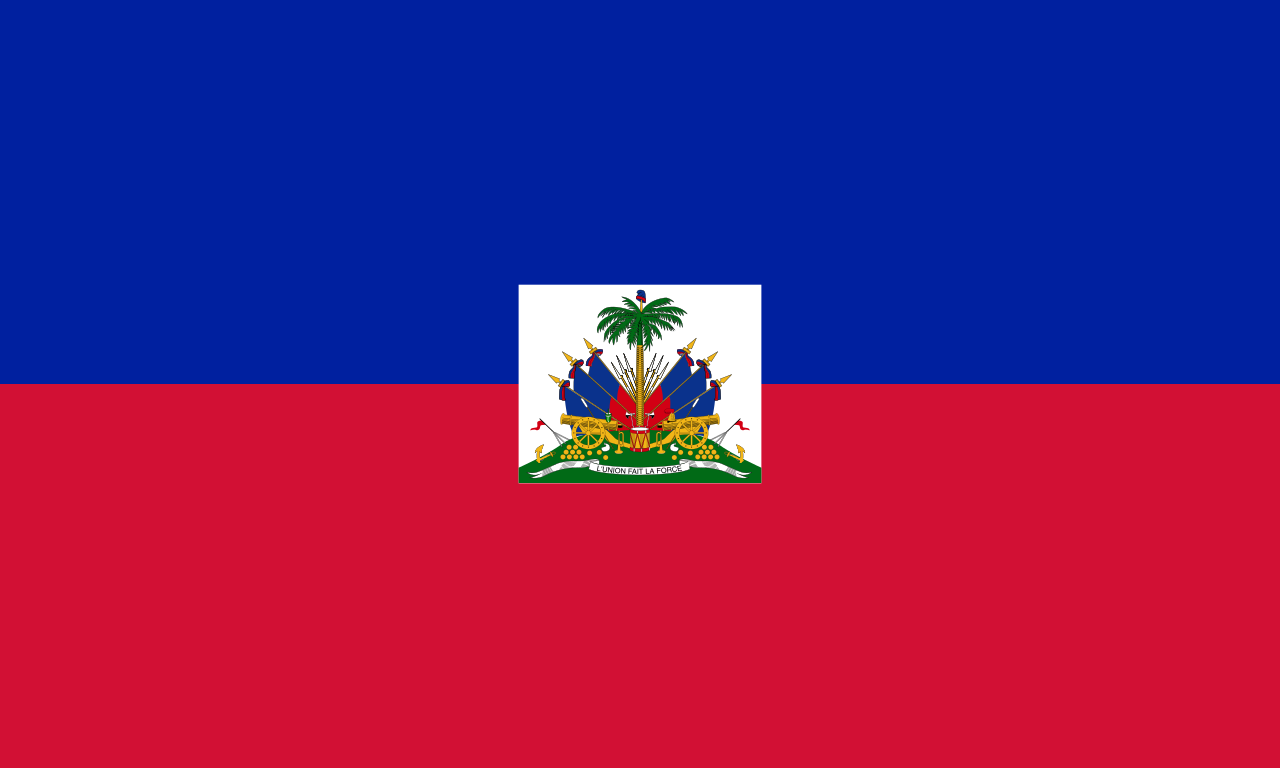
Haiti
Country in the Caribbean
Haiti, officially the Republic of Haiti, is a country in the Caribbean on the island of Hispaniola in the Caribbean Sea, east of Cuba and Jamaica and south of the Bahamas. It occupies the western side of the island, which it shares with the Dominican Republic. Haiti is the third largest country in the Caribbean, and with an estimated population of 11.4 million, it is the most populous Caribbean country. The capital and largest city is Port-au-Prince.
Haiti was originally inhabited by the Taíno people. In 1492, Christopher Columbus established the first European settlement in the Americas, La Navidad, on its northeastern coast. The island was part of the Spanish Empire until 1697, when the western portion was ceded to France and became Saint-Domingue, dominated by sugarcane plantations worked by enslaved Africans. The 1791–1804 Haitian Revolution made Haiti the first sovereign state in the Caribbean, the second republic in the Americas, the first country in the Americas to officially abolish slavery, and the only country in history established by a slave revolt. The 19th century saw political instability, international isolation, debt to France, and failed invasions of the Dominican Republic, including a costly war. U.S. forces occupied Haiti from 1915 to 1934, followed by dictatorial rule of the Duvalier family (1957–1986). Following a coup d'état in 1991, a U.S.-led multinational force intervened in 1994; a second coup in 2004 was followed by a United Nations intervention. In the 2010s, a catastrophic earthquake and a large-scale cholera outbreak devastated the country.
Historically poor and politically unstable, Haiti has faced severe economic and political crises, gang activity displacing over 1.3 million, and the collapse of its government. One of the world's least developed countries and with no elected officials remaining, Haiti has been described as a failed state.
Haiti is a founding member of the United Nations, Organization of American States, Association of Caribbean States, and the Organisation internationale de la Francophonie. In addition to CARICOM, it is a member of the International Monetary Fund, World Trade Organization, and Community of Latin American and Caribbean States.
Etymology
Haiti (also earlier Hayti) comes from the indigenous Taíno language and means "land of high mountains"; it was the native name for the entire island of Hispaniola. The name was restored by Haitian revolutionary Jean-Jacques Dessalines as the official name of independent Saint-Domingue, as a tribute to the Amerindian predecessors. Another theory on the name Haiti is its origin in African tradition; in Fon language, one of the most spoken by the bossales (Haitians born in Africa), Ayiti-Tomè means: "From nowadays this land is our land."
In French, the ï in Haïti has a diacritical mark, a diaeresis (used to show that the second vowel is pronounced separately, as in the word naïve), while the H is silent. (In English, this rule for the pronunciation is often disregarded, thus the spelling Haiti is used.) There are different anglicizations for its pronunciation such as HIGH-ti, high-EE-ti and haa-EE-ti, which are still in use, but HAY-ti is the most widespread and best-established. In French, Haiti's nickname is La Perle des Antilles ("Pearl of the Antilles") because of both its natural beauty and the amount of wealth it accumulated for the Kingdom of France. In Haitian Creole, it is spelled and pronounced with a y but no H: Ayiti. In the Haitian community the country has multiple nicknames: Ayiti-Toma (as its origin in Ayiti Tomè), Ayiti-Cheri (Ayiti my Darling), Tè-Desalin (Dessalines' Land) or Lakay (Home).
History
Pre-Columbian era
The island of Hispaniola, of which Haiti occupies the western three-eighths, has been inhabited since around 6,000 years ago by Native Americans who are thought to have arrived from Central or northern South America. These Archaic Age people are thought to have been largely hunter-gatherers. During the 1st millennium BC, the Arawakan-speaking ancestors of the Taino people began to migrate into the Caribbean. Unlike the Archaic peoples, they practiced the intensive production of pottery and agriculture. The earliest evidence of the ancestors of the Taino people on Hispaniola is the Ostionoid culture, which dates to around 600 AD.
In Taíno society the largest unit of political organization was led by a cacique, or chief, as the Europeans understood them. At the time of European contact, Hispaniola was divided among five 'caciquedoms': the Magua in the northeast, the Marien in the northwest, the Jaragua in the southwest, the Maguana in the central regions of Cibao, and the Higüey in the southeast.
Taíno cultural artifacts include cave paintings in several locations in the country. These have become national symbols of Haiti and tourist attractions. Modern-day Léogâne, started as a French colonial town in the southwest, is beside the former capital of the caciquedom of Xaragua.
Colonial era
Spanish rule (1492–1625)
Navigator Christopher Columbus landed in Haiti on 6 December 1492, in an area that he named Môle-Saint-Nicolas, and claimed the island for the Crown of Castile. On 25 December his ship the Santa María ran aground near the present site of Cap-Haïtien. Columbus left 39 men on the island, who founded the settlement of La Navidad. Relations with the native peoples were initially good; however the settlers were later killed by the Taíno.
The sailors carried endemic Eurasian infectious diseases, causing epidemics that killed a large number of native people. The first recorded smallpox epidemic in the Americas erupted on Hispaniola in 1507. Their numbers were further reduced by the harshness of the encomienda system, in which the Spanish forced natives to work in gold mines and plantations. The Spanish passed the Laws of Burgos (1512–1513) which forbade the maltreatment of natives, endorsed their conversion to Catholicism, and gave legal framework to encomiendas. The natives were brought to these sites to work in specific plantations or industries.
As the Spanish re-focused their colonization efforts on the greater riches of mainland Central and South America, Hispaniola became reduced largely to a trading and refueling post. As a result piracy became widespread, encouraged by European powers hostile to Spain such as France (based on Île de la Tortue) and England. The Spanish largely abandoned the western third of the island, focusing their colonization effort on the eastern two-thirds. The western part of the island was thus gradually settled by French buccaneers; among them was Bertrand d'Ogeron, who succeeded in growing tobacco and recruited many French colonial families from Martinique and Guadeloupe. In 1697 France and Spain settled their hostilities on the island by way of the Treaty of Ryswick of 1697, which divided Hispaniola between them.
French rule (1625–1804)
France received the western third and subsequently named it Saint-Domingue, the French equivalent of Santo Domingo, the Spanish colony on Hispaniola. The French set about creating sugar and coffee plantations, worked by vast numbers of those enslaved imported from Africa, and Saint-Domingue grew to become their richest colonial possession, generating 40% of France’s foreign trade and doubling the wealth generation of all of England’s colonies, combined.
The French settlers were outnumbered by enslaved persons by almost 10 to 1. According to the 1788 census, Haiti's population consisted of nearly 25,000 Europeans, 22,000 free coloreds and 700,000 Africans in slavery. In the north of the island, those enslaved were able to retain many ties to African cultures, religion and language; these ties were continually being renewed by newly imported Africans. Some West Africans in slavery held on to their traditional Vodou beliefs by secretly syncretizing it with Catholicism.
The French enacted the Code Noir ("Black Code"), prepared by Jean-Baptiste Colbert and ratified by Louis XIV, which established rules on slave treatment and permissible freedoms. Saint-Domingue has been described as one of the most brutally efficient slave colonies; at the end of the 18th century it was supplying two-thirds of Europe's tropical produce while one-third of newly imported Africans died within a few years. Many enslaved persons died from diseases such as smallpox and typhoid fever. They had low birth rates, and there is evidence that some women aborted fetuses rather than give birth to children within the bonds of slavery. The colony's environment also suffered, as forests were cleared to make way for plantations and the land was overworked so as to extract maximum profit for French plantation owners.
Content sourced from Wikipedia under CC BY-SA 4.0


