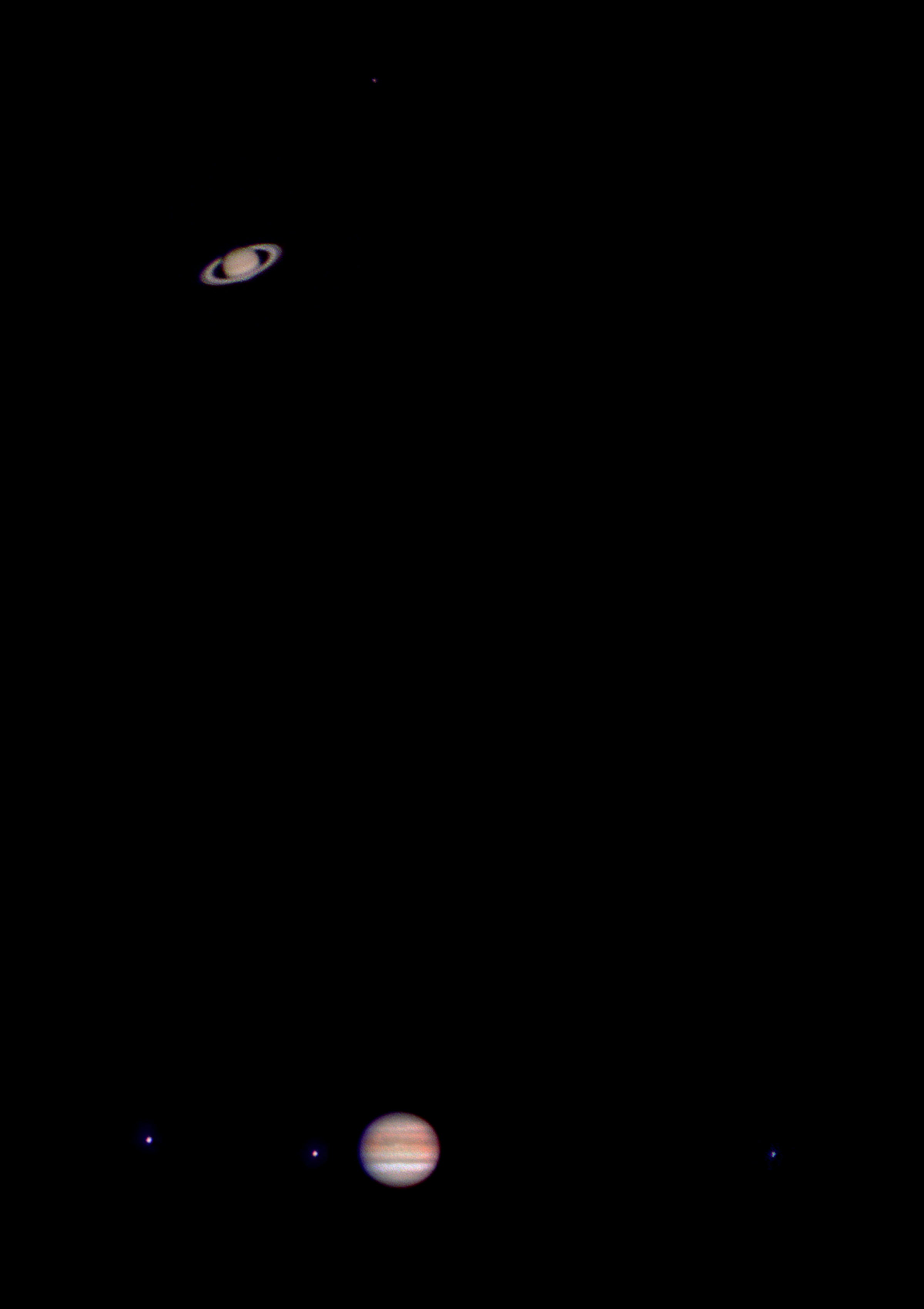
Great conjunction
Conjunction of the planets Jupiter and Saturn
A great conjunction is a conjunction of the planets Jupiter and Saturn, when the two planets appear closest together in the sky. Great conjunctions occur approximately every 20 years when Jupiter "overtakes" Saturn in its orbit. They are named "great" for being by far the rarest of the conjunctions between naked-eye planets (i.e. excluding Uranus, Neptune, and the dwarf planets).
The spacing between the planets varies from conjunction to conjunction with most events being 0.5 to 1.3 degrees (30 to 78 arcminutes, or 1 to 2.5 times the width of a full moon). Very close conjunctions happen much less frequently (though the maximum of 1.3° is still close by inner planet standards): separations of less than 10 arcminutes have only happened four times since 1200, most recently in 2020.
In history
Great conjunctions attracted considerable attention in the past as omens. During the late Middle Ages and Renaissance they were a topic broached by the pre-scientific and transitional astronomer-astrologers of the period up to the time of Tycho Brahe and Johannes Kepler, by scholastic thinkers such as Roger Bacon and Pierre d'Ailly, and they are mentioned in popular and literary works by authors such as Dante, Lope de Vega, and Shakespeare. This interest is traced back in Europe to translations of Arabic texts, especially Albumasar's book on conjunctions.
Clusterings of several planets were considered even more significant. The Chinese apparently remembered the clustering of all five planets in 1953 BC, and noted the clustering of all but Venus in 1576 BC and of all five in 1059 BC. These were connected in Chinese thought to the founding of the first three historical dynasties, the Xia dynasty, the Shang dynasty, and the Zhou dynasty. The intervals involved, of 377.8 years (19 great conjunction intervals) and 516.4 years (26 great conjunction intervals) bring Mars back to approximately the same position. Further repeats of the 516-year period lead to the clustering in AD 1524, considered ominous in Europe at the time of the Radical Reformation, and the upcoming clustering of September 2040, which will involve all five planets again, in a longitude span of less than 7°.
Celestial mechanics
On average, great conjunction seasons occur once every 19.859 Julian years (each of which is 365.25 days). This number can be calculated by the synodic period formula
in which J and S are the orbital periods of Jupiter (4332.59 days) and Saturn (10759.22 days), respectively. This is about 52 days less than 20 years, but in practice, Earth's orbit size can cause great conjunctions to reoccur anytime between 18 years 10 months and 20 years 8 months after the previous one. (See table below.) Since the equivalent periods of other naked-eye planet pairs are all under 900 days, this makes great conjunctions the rarest.
Occasionally there is more than one great conjunction in a season, which happens whenever they're close enough to opposition: this is called a triple conjunction (which is not exclusive to great conjunctions). In this scenario, Jupiter and Saturn will occupy the same right ascension on three occasions or same ecliptic longitude on three occasions, depending on which definition of "conjunction" one uses (this is due to apparent retrograde motion and happens within months). The most recent triple conjunction occurred in 1980–81 and the next will be in 2238–39.
The most recent great conjunction occurred on 21 December 2020, and the next will occur on 4 November 2040. During the 2020 great conjunction, the two planets were separated in the sky by 6 arcminutes at their closest point, which was the closest distance between the two planets since 1623. The closeness is the result of the conjunction occurring in the vicinity of one of the two longitudes where the two orbits appear to intersect when viewed from the Sun (which has a point of view similar to Earth).
Because 19.859 years is equal to 1.674 Jupiter orbits and 0.674 Saturn orbits, three of these periods come close to a whole number of revolutions. As successive great conjunctions occur nearly 120° apart, their appearances form a triangular pattern. In a series, every third conjunction returns after some 60 years to the vicinity of the first. These returns are observed to be shifted by some 8° relative to the fixed stars, so no more than four of them occur in the same zodiacal constellation. Usually the conjunctions occur in one of the following triplicities or trigons of zodiacal constellations:
- Aries, Sagittarius, and Leo
- Taurus, Capricorn, and Virgo
- Gemini, Aquarius, and Libra
- Cancer, Pisces, and Scorpius
After about 220 years the pattern shifts to the next trigon, and in about 800 or 900 years returns to the first trigon.
The three points of the triangle revolve in the same direction as the planets at the rate of approximately one-sixth of a revolution per four centuries, thus creating especially close conjunctions on an approximately four-century cycle. Currently the longitudes of close great conjunctions are about 307.4 and 127.4 degrees, in Capricornus and Cancer respectively.
In astrology, one of the four elements was ascribed to each triangular pattern. Particular importance was accorded to the occurrence of a great conjunction in a new trigon, which is bound to happen after some 240 years at most. Even greater importance was attributed to the beginning of a new cycle after all fours trigons had been visited. Medieval astrologers usually gave 960 years as the duration of the full cycle, perhaps because in some cases it took 240 years to pass from one trigon to the next. If a cycle is defined by when the conjunctions return to the same right ascension rather than to the same constellation, then because of axial precession the cycle is less than 800 years. Use of the Alphonsine tables apparently led to the use of precessing signs, and Kepler gave a value of 794 years (40 conjunctions).
Despite mathematical errors and some disagreement among astrologers about when trigons began, belief in the significance of such events generated a stream of publications that grew steadily until the end of the 16th century. As the great conjunction of 1583 was last in the water trigon it was widely supposed to herald apocalyptic changes; a papal bull against divination was issued in 1586 but as nothing significant happened by the feared event of 1603, public interest rapidly died. By the start of the next trigon, modern scientific consensus had condemned astrology as pseudoscience, and astronomers no longer perceived planetary alignments as omens. However, in the year 1962, when all five planets formed a cluster 17° wide, there was considerable concern.
Saturn's orbit plane is inclined 2.485 degrees relative to Earth's, and Jupiter's is inclined 1.303 degrees. The ascending nodes of both planets are similar (100.6 degrees for Jupiter and 113.7 degrees for Saturn), meaning if Saturn is above or below Earth's orbital plane Jupiter usually is too. Because these nodes align so well it would be expected that no closest approach will ever be much worse than the difference between the two inclinations. Indeed, between year 1 and 3000, the maximum conjunction distances were 1.3 degrees in 1306 and 1940. Conjunctions in both years occurred when the planets were tilted most out of the plane: longitude 206 degrees (therefore above the plane) in 1306, and longitude 39 degrees (therefore below the plane) in 1940.
List of great conjunctions (1200 to 2400)
The following table details great conjunctions in between 1200 and 2400. The dates are given for the conjunctions in right ascension (the dates for conjunctions in ecliptic longitude can differ by several days). Dates before 1582 are in the Julian calendar while dates after 1582 are in the Gregorian calendar.
Content sourced from Wikipedia under CC BY-SA 4.0


