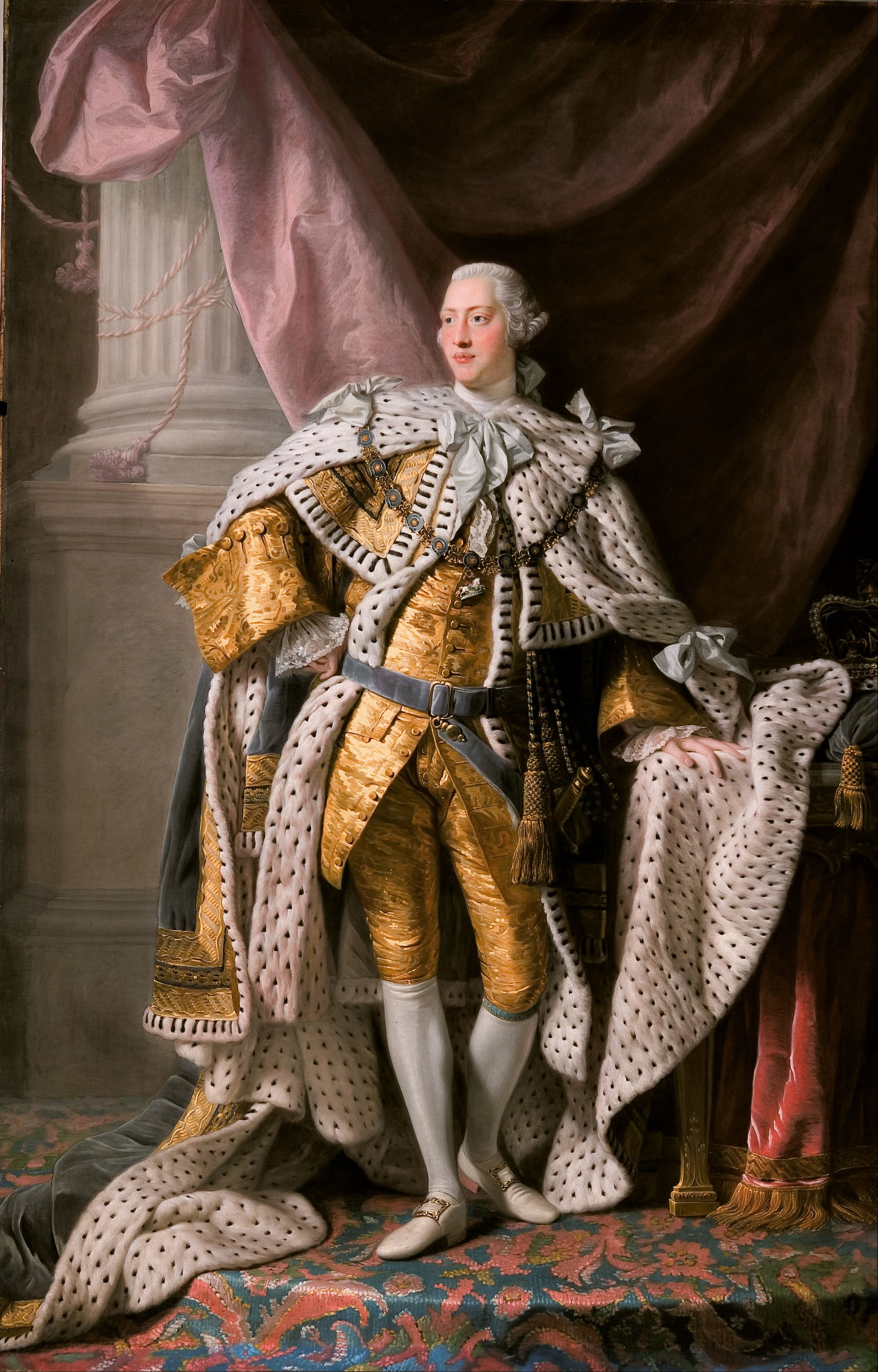
George III
King of Great Britain and Ireland from 1760 to 1820
George III (George William Frederick; 4 June 1738 – 29 January 1820) was King of Great Britain and Ireland from 25 October 1760 until his death in 1820. The Acts of Union 1800 unified Great Britain and Ireland into the United Kingdom of Great Britain and Ireland, with George as its king. He was concurrently duke and prince-elector of Hanover in the Holy Roman Empire before becoming King of Hanover on 12 October 1814. He was the first monarch of the House of Hanover who was born in Great Britain, spoke English as his first language, and never visited Hanover.
George was born during the reign of his paternal grandfather, King George II, as the first son of Frederick, Prince of Wales, and Princess Augusta of Saxe-Gotha. Following his father's death in 1751, Prince George became heir apparent and Prince of Wales. He succeeded to the throne on George II's death in 1760. The following year, he married Princess Charlotte of Mecklenburg-Strelitz, with whom he had 15 children. George III's life and reign were marked by a series of military conflicts involving his kingdoms, much of the rest of Europe, and places farther afield in Africa, the Americas and Asia. Early in his reign, Great Britain defeated France in the Seven Years' War, becoming the dominant European power in North America and India. However, Britain lost 13 of its North American colonies in the American War of Independence. Further wars against revolutionary and Napoleonic France from 1793 concluded in the defeat of Napoleon at the Battle of Waterloo in 1815. In 1807, the transatlantic slave trade was banned from the British Empire.
In the later part of his life, George had recurrent and eventually permanent mental illness. The exact nature of George's illness is not known definitively, but historians and medical experts have suggested that his symptoms and behaviour traits were consistent with either bipolar disorder or porphyria. In 1810, George suffered a final relapse, and his eldest son, George, Prince of Wales, was named Prince Regent the following year. The King died aged 81, at which time the Regent succeeded him as George IV. George III reigned during much of the Georgian and Regency eras. At the time of his death, he was the longest-lived and longest-reigning British monarch, having reigned for 59 years and 96 days; he remains the longest-lived and longest-reigning male monarch in British history.
Early life
George was born on 4 June 1738 at Norfolk House in St James's Square, London. He was a grandson of King George II and the eldest son of Frederick, Prince of Wales, and Augusta of Saxe-Gotha. As he was born two months prematurely, and thought unlikely to survive, he was baptised the same day by Thomas Secker, who was both Rector of St James's Church, Piccadilly, and Bishop of Oxford. One month later, he was publicly baptised at Norfolk House, again by Secker. His godparents were King Frederick I of Sweden (for whom Lord Baltimore stood proxy), his uncle Frederick III, Duke of Saxe-Gotha (for whom Lord Carnarvon stood proxy), and his great-aunt Sophia Dorothea, Queen in Prussia (for whom Lady Charlotte Edwin stood proxy).
George grew into a healthy, reserved and shy child. The family moved to Leicester Square, where George and his younger brother Edward (later Duke of York and Albany) were educated together by private tutors. Family letters show that he could read and write in both English and German, as well as comment on political events of the time, by the age of eight. He was the first British monarch to study science systematically.
Apart from chemistry and physics, his lessons included astronomy, mathematics, French, Latin, history, music, geography, commerce, agriculture and constitutional law, along with sporting and social accomplishments such as dancing, fencing and riding. His religious education was wholly Anglican. At the age of 10, George took part in a family production of Joseph Addison's play Cato and said in the new prologue: "What, tho' a boy! It may with truth be said, A boy in England born, in England bred." Historian Romney Sedgwick argued that these lines appear "to be the source of the only historical phrase with which he is associated".
King George II disliked Prince Frederick and took little interest in his grandchildren. However, in 1751, Frederick died unexpectedly from a lung injury at the age of 44, and his son George became heir apparent to the throne and inherited his father's title of Duke of Edinburgh. The King now took more interest in his grandson and created him Prince of Wales three weeks later.
In the spring of 1756, as George approached his eighteenth birthday, the King offered him a grand establishment at St James's Palace, but George refused the offer, guided by his mother and her confidant, John Stuart, 3rd Earl of Bute, who later served as prime minister. George's mother, now the Dowager Princess of Wales, preferred to keep George at home where she could imbue him with her strict moral values.
Accession and marriage
In 1759, George was smitten with Lady Sarah Lennox, sister of Charles Lennox, 3rd Duke of Richmond, but Lord Bute advised against the match and George abandoned his thoughts of marriage. "I am born for the happiness or misery of a great nation," he wrote, "and consequently must often act contrary to my passions." Nevertheless, George and his mother resisted attempts by the King to marry George to Princess Sophie Caroline of Brunswick-Wolfenbüttel.
The following year, at the age of 22, George succeeded to the throne when his grandfather George II died suddenly on 25 October 1760, at age 76. The search for a suitable wife intensified: after giving consideration to a number of Protestant German princesses, George's mother sent Colonel David Graeme with, on her son's behalf, an offer of marriage to Princess Charlotte of Mecklenburg-Strelitz. Charlotte accepted. While a royal household and staff were assembled for Charlotte in London, Lord Harcourt, the royal Master of the Horse, escorted her from Neustrelitz to London. Charlotte arrived in the afternoon of 8 September 1761 and the marriage ceremony was conducted that same evening in the Chapel Royal, St James's Palace. George and Charlotte's coronation was held at Westminster Abbey a fortnight later on 22 September. George never took a mistress (in contrast with his grandfather and his sons), and the couple enjoyed a happy marriage until his mental illness struck.
The King and Queen had 15 children—nine sons and six daughters. In 1762, George purchased Buckingham House (on the site now occupied by Buckingham Palace) for use as a family retreat. His other residences were Kew Palace and Windsor Castle. St James's Palace was retained for official use. He did not travel extensively and spent his entire life in southern England. In the 1790s, the King and his family took holidays at Weymouth, Dorset, which he thus popularised as one of the first seaside resorts in England.
Early reign
Early regnal years
George, in his accession speech to Parliament, proclaimed: "Born and educated in this country, I glory in the name of Britain." He inserted this phrase into the speech, written by Lord Hardwicke, to demonstrate his desire to distance himself from his German forebears, who were perceived as caring more for Hanover than for Britain. During George III's lengthy reign, Britain was a constitutional monarchy, ruled by his ministerial government and prominent men in Parliament. Although his accession was at first welcomed by politicians of all parties, the first years of his reign were marked by political instability, largely as a result of disagreements over the Seven Years' War. George came to be perceived as favouring Tory ministers, which led to his denunciation by the Whigs as an autocrat.
On his accession, the Crown lands produced relatively little income; most revenue was generated through taxes and excise duties. George surrendered the Crown Estate to Parliamentary control in return for a civil list annuity for the support of his household and the expenses of civil government. Claims that he used the income to reward supporters with bribes and gifts are disputed by historians who say such claims "rest on nothing but falsehoods put out by disgruntled opposition". Debts amounting to over £3 million over the course of George's reign were paid by Parliament, and the civil list annuity was increased from time to time. He aided the Royal Academy of Arts with large grants from his private funds, and may have donated more than half of his personal income to charity. Of his art collection, the two most notable purchases are Johannes Vermeer's Lady at the Virginals and a set of Canalettos, but it is as a collector of books that he is best remembered. The King's Library was open and available to scholars and was the foundation of a new national library.
Content sourced from Wikipedia under CC BY-SA 4.0


