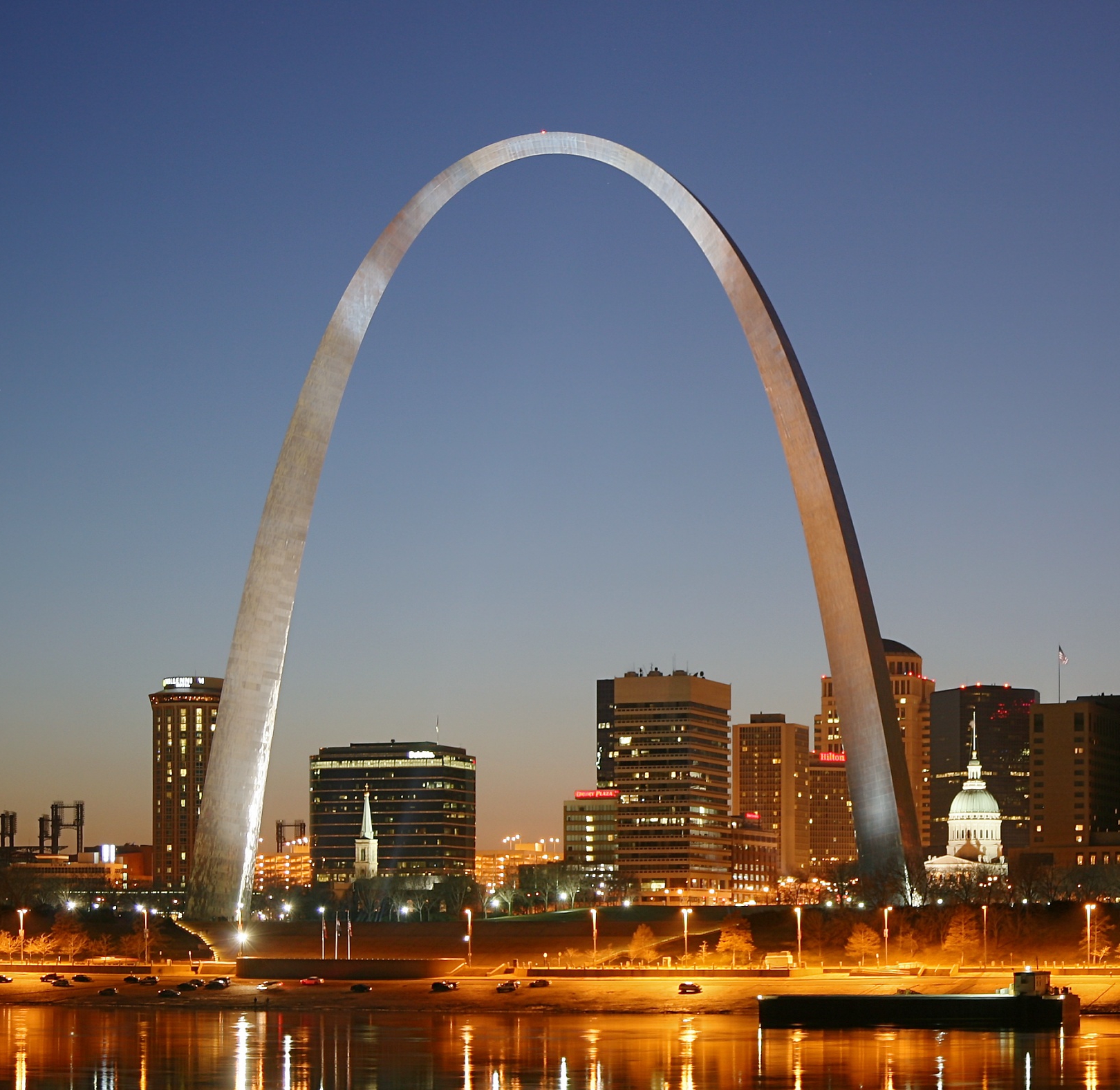
Gateway Arch
US National Historic Landmark in St. Louis, Missouri
The Gateway Arch is a 630-foot-tall (192 m) monument in St. Louis, Missouri, United States. Clad in stainless steel and built in the form of a weighted catenary arch, it is the world's tallest arch and Missouri's tallest accessible structure. Some sources consider it the tallest human-made monument in the Western Hemisphere. Built as a monument to the westward expansion of the United States and officially dedicated to "the American people", the Arch, commonly referred to as "The Gateway to the West", is a National Historic Landmark in Gateway Arch National Park and has become a popular tourist destination, as well as an internationally recognized symbol of St. Louis.
The Arch was designed by the Finnish-American architect Eero Saarinen in 1947. Construction began on February 12, 1963, and was completed on October 28, 1965, at an overall cost of $13 million (equivalent to $98.4 million in 2024). The monument opened to the public on June 10, 1967. It is located at the 1764 site of the founding of St. Louis on the west bank of the Mississippi River.
Historical background
Inception and funding (1933–1935)
Around late 1933, civic leader Luther Ely Smith, returning to St. Louis from the George Rogers Clark National Historical Park in Vincennes, Indiana, saw the St. Louis riverfront area and envisioned that building a memorial there would both revive the riverfront and stimulate the economy. He communicated his idea to mayor Bernard Dickmann, who on December 15, 1933, raised it in a meeting with city leaders. They sanctioned the proposal, and the nonprofit Jefferson National Expansion Memorial Association JNEMA for short, was formed. Smith was appointed chairman and Dickmann vice chairman. The association's goal was to create:
A suitable and permanent public memorial to the men who made possible the western territorial expansion of the United States, particularly President Jefferson, his aides Livingston and Monroe, the great explorers, Lewis and Clark, and the hardy hunters, trappers, frontiersmen and pioneers who contributed to the territorial expansion and development of these United States, and thereby to bring before the public of this and future generations the history of our development and induce familiarity with the patriotic accomplishments of these great builders of our country.
Many locals did not approve of depleting public funds for the cause. Smith's daughter SaLees related that when "people would tell him we needed more practical things", he would respond that "spiritual things" were equally important.
The association expected that $30 million would be needed to undertake the construction of such a monument (about $576 million in 2024 dollars). It called upon the federal government to foot three-quarters of the bill ($22.5 million).
The suggestion to renew the riverfront was not original, as previous projects were attempted but lacked popularity. The Jefferson memorial idea emerged amid the economic disarray of the Great Depression and promised new jobs. The project was expected to create 5,000 jobs for three to four years. Committee members began to raise public awareness by organizing fundraisers and writing pamphlets. They also engaged Congress by planning budgets and preparing bills, in addition to researching ownership of the land they had chosen, "approximately one-half mile in length ... from Third Street east to the present elevated railroad." In January 1934, Senator Bennett Champ Clark and Representative John Cochran introduced to Congress an appropriation bill seeking $30 million for the memorial, but the bill failed to garner support due to the large amount of money solicited. In March of the same year, joint resolutions proposed the establishment of a federal commission to develop the memorial. Although the proposal aimed for only authorization, the bill incurred opposition because people suspected that JNEMA would later seek appropriation. On March 28 the Senate bill was reported out, and on April 5 it was turned over to the House Library Committee, which later reported favorably on the bills. On June 8, both the Senate and House bills were passed. On June 15, President Franklin D. Roosevelt signed the bill into law, instituting the United States Territorial Expansion Memorial Commission. The commission comprised 15 members, chosen by Roosevelt, the House, the Senate, and JNEMA. It first convened on December 19 in St. Louis, where members examined the project and its planned location.
Meanwhile, in December, the JNEMA discussed organizing an architectural competition to determine the design of the monument. Local architect Louis LaBeaume had drawn up competition guidelines by January 1935. On April 13, 1935, the commission certified JNEMA's project proposals, including memorial perimeters, the "historical significance" of the memorial, the competition, and the $30 million budget. Between February and April, the Missouri State Legislature passed an act allowing the use of bonds to facilitate the project. On April 15, then Governor Guy B. Park signed it into law. Dickmann and Smith applied for funding from two New Deal agencies—the Public Works Administration (headed by Harold Ickes) and the Works Progress Administration (headed by Harry Hopkins). On August 7, both Ickes and Hopkins assented to the funding requests, each promising $10 million, and said that the National Park Service (NPS) would manage the memorial. A local bond issue election granting $7.5 million (about $144 million in 2024 dollars) for the memorial's development was held on September 10 and passed.
On December 21, President Roosevelt signed Executive Order 7253 to approve the memorial, allocating the 82-acre area as the first National Historic Site. The order also appropriated $3.3 million through the WPA and $3.45 million through the PWA ($6.75 million in total). The motivation of the project was two-fold—commemorating westward expansion and creating jobs. Some taxpayers began to file suits to block the construction of the monument, which they called a "boondoggle".
Initial planning (1936–1939)
Using the 1935 grant of $6.75 million and $2.25 million in city bonds, the NPS acquired the historic buildings within the historic site—through condemnation rather than purchase—and demolished them. By September 1938, condemnation was complete. The condemnation was subject to many legal disputes which culminated on January 27, 1939, when the United States Circuit Court of Appeals ruled that condemnation was valid. A total of $6.2 million was distributed to land owners on June 14. Demolition commenced on October 9, 1939, when Dickmann extracted three bricks from a vacant warehouse.
Led by Paul Peters, adversaries of the memorial delivered to Congress a leaflet titled "Public Necessity or Just Plain Pork". The JNEMA's lawyer, Bon Geaslin, believed that the flyers did not taint the project, but motivated members of Congress to find out more about the same. Although Representative John Cochran wanted to ask Congress to approve more funds, Geaslin believed the association should "keep a low profile, maintaining its current position during this session of Congress". He advised the association to "get a good strong editorial in one of the papers to the effect that a small group of tenants ... is soliciting funds [to fight] the proposed improvement, and stating that these efforts do not represent the consensus of opinion in St. Louis ... , and pointing out that such obstructions should be condemned".
Congress's reduction in spending made it impossible for the allocated funds to be obtained. NPS responded that the city would reduce its contribution if the federal government did. It also asserted that the funds were sanctioned by an executive order, but superintendent John Nagle pointed out that what "one Executive Order does, another can undo". In March 1936, Representative Cochran commented during a House meeting that he "would not vote for any measure providing for building the memorial or allotting funds to it". Geaslin found Cochran's statements to be a greater hindrance to the project than Paul Peters' opposition, for Congress might have Cochran's opinions as representative of public opinion.
Peters and other opponents asked Roosevelt to rescind Executive Order 7253 and to redirect the money to the American Red Cross. Smith impugned their motives, accusing them of being "opposed to anything that is ever advanced in behalf of the city." In February 1936, an editorial written by Paul W. Ward in The Nation denounced the project. Smith was infuriated, fearing the impact of attacks from a prestigious magazine, and wanted "to jump on it strong with hammer and tongs". William Allen White, a renowned newspaper editor, advised Smith not to fret.
Content sourced from Wikipedia under CC BY-SA 4.0


