Fort Lauderdale, Florida
City in Florida, United States
Fort Lauderdale ( LAW-dər-dayl) is a coastal city located in the U.S. state of Florida, 30 miles (48 km) north of Miami along the Atlantic Ocean. It is the seat of government of and most populous city in Broward County with a population of 182,760 at the 2020 census, making it the tenth-most populous city in Florida. After Miami and Hialeah, Fort Lauderdale is the third-most populous city in the Miami Metro Area, which had a population of 6,166,488 in 2019.
Built in 1838 and first incorporated in 1911, Fort Lauderdale is named after a series of forts built by the United States during the Second Seminole War. The forts took their name from Major William Lauderdale (1782–1838), younger brother of Lieutenant Colonel James Lauderdale. Development of the city did not begin until 50 years after the forts were abandoned at the end of the conflict. Three forts named "Fort Lauderdale" were constructed including the first at the fork of the New River, the second at Tarpon Bend on the New River between the present-day Colee Hammock and Rio Vista neighborhoods, and the third near the site of the Bahia Mar Marina.
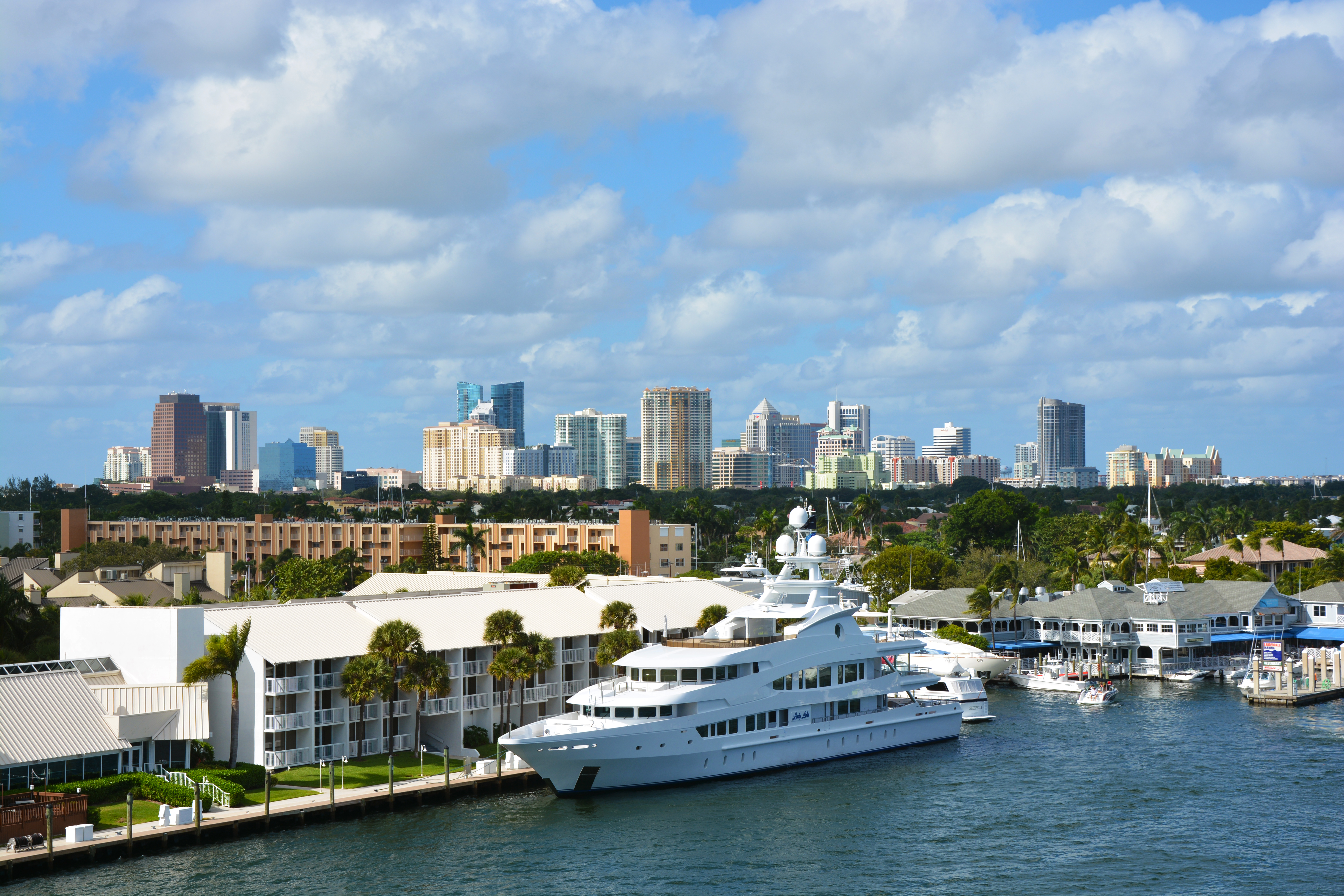
Known as the "Venice of America", Fort Lauderdale has 165 miles of inland waterways across the city. In addition to tourism, Fort Lauderdale has a diversified economy including marine, manufacturing, finance, insurance, real estate, high technology, avionics/aerospace, film, and television production. The city is a popular tourist destination with an average year-round temperature of 75.5 °F (24.2 °C) and 3,000 hours of sunshine per year. Greater Fort Lauderdale, encompassing all of Broward County, hosted more than 13 million overnight visitors in 2018. Nearly four million cruise passengers annually pass through its Port Everglades, making it the world's third-busiest cruise port. With over 50,000 registered yachts and 100 marinas, Fort Lauderdale is also known as the "yachting capital of the world."
History
The area of present-day Fort Lauderdale was inhabited for over 2,000 years by the Tequesta Indians. Contact with Spanish explorers in the 16th century proved disastrous for the Tequesta, as the Europeans brought with them diseases, including smallpox, to which the native populations possessed no resistance. For the Tequesta, disease, coupled with continuing conflict with their Calusa neighbors, contributed greatly to their decline over the next two centuries.
18th century
By 1763, there were only a few Tequesta left in Florida, and most of them were evacuated to Cuba when the Spanish ceded Florida to the British in 1763, under the terms of the Treaty of Paris, which ended the Seven Years' War. Although control of the area changed between Spain, the United Kingdom, the United States, and the Confederate States of America, it remained largely undeveloped until the 20th century. The Fort Lauderdale area was known as the "New River Settlement" before the 20th century.
19th century
In the 1830s, there were approximately 70 settlers living along the New River. William Cooley, the local Justice of the Peace, was a farmer and wrecker, who traded with the Seminole Indians. On January 6, 1836, while Cooley was leading an attempt to salvage a wrecked ship, a band of Seminoles attacked his farm, killing his wife and children, and the children's tutor. The other farms in the settlement were not attacked, but all the white residents in the area abandoned the settlement, fleeing first to the Cape Florida Lighthouse on Key Biscayne, and then to Key West.
The first United States stockade named Fort Lauderdale was built in 1838, and subsequently was a site of fighting during the Second Seminole War. The fort was abandoned in 1842, after the end of the war, and the area remained unsettled by colonists until the 1890s. In 1893, a ferry operated Frank Stranahan provided transit across New River. Florida East Coast Railroad also was completed, providing a route through the area, which sparked the city's development.
20th century
In 1911, the city was incorporated. In 1915, it was designated the county seat of newly formed Broward County.
Fort Lauderdale's first major development began in the 1920s, during the Florida land boom. The Great Miami Hurricane of 1926 and the Great Depression of the 1930s caused a great deal of economic dislocation. In July 1935, an African-American man named Rubin Stacy was accused of robbing a white woman at knifepoint. He was arrested and being transported to a Miami jail when police were run off the road by a mob. A group of 100 white men proceeded to hang Stacy from a tree near the scene of his alleged robbery. His body was riddled with some 20 bullets. The murder was subsequently used by the press in Nazi Germany to discredit U.S. critiques of its own persecution of Jews, Communists, and Catholics.
When World War II began, Fort Lauderdale became a major U.S. base, with a Naval Air Station to train pilots, radar operators, and fire control operators. A Coast Guard base at Port Everglades was also established.
Until July 1961, only whites were allowed on Ft. Lauderdale beaches. There were no beaches for African-Americans in Broward County until 1954, when "the Colored Beach," today Dr. Von D. Mizell-Eula Johnson State Park, was opened in Dania Beach; however, no road was built to it until 1965. On July 4, 1961, African Americans started a series of wade-ins as protests at beaches that were off-limits to them, to protest "the failure of the county to build a road to the Negro beach." On July 11, 1962, a verdict by Ted Cabot went against the city's policy of racial segregation of public beaches, and Broward County beaches were desegregated in 1962.
Fort Lauderdale is a major center for yachting, one of the nation's largest tourist destinations, and the center of a metropolitan division with 1.8 million people.
Population
After end of World War II, service members returned to the area, spurring an enormous population explosion that dwarfed the 1920s boom. The 1960 census counted 83,648 people in the city, about 230% of the 1950 figure. A 1967 report estimated that the city was approximately 85% developed, and the 1970 population figure was 139,590.
After 1970, growth in the area shifted to suburbs to the west. As cities such as Coral Springs, Miramar, and Pembroke Pines experienced explosive growth, Fort Lauderdale's population stagnated, and the city actually shrank by almost 4,000 people between 1980, when the city had 153,279 people, and 1990, when the population was 149,377. A slight rebound brought the population back up to 152,397 at the 2000 census. Since 2000, Fort Lauderdale has gained slightly over 18,000 residents through annexation of seven neighborhoods in unincorporated Broward County.
Geography
Location
According to the United States Census Bureau, the city has a total area of 38.6 square miles (99.9 km2), 34.7 square miles (90.0 km2) of which is land and 3.8 square miles (9.9 km2) of which is water (9.87%). Fort Lauderdale is known for its extensive network of canals; there are 165 miles (266 km) of waterways within the city limits.
The city of Fort Lauderdale is adjacent to the Atlantic Ocean, includes 7 miles (11 km) of beaches, and borders the following municipalities:
On its east:
- Lauderdale-by-the-Sea
- Sea Ranch Lakes
On its south:
- Hollywood
- Dania Beach
On its southwest:
- Davie
On its west:
- Plantation
- Lauderhill
- Lauderdale Lakes
On its northwest:
- North Lauderdale
- Oakland Park
- Tamarac
On its north:
- Wilton Manors
- Pompano Beach
The northwestern section of Fort Lauderdale is separate from the remainder of the city, connected only by the Cypress Creek Canal as it flows under I-95. This section of Fort Lauderdale borders the cities of Tamarac and Oakland Park on its south side. Oakland Park also borders Fort Lauderdale on the west side of its northeastern portion. The greater portion of Fort Lauderdale in the south is bordered, along its north side by Wilton Manors.
Off the coast of Fort Lauderdale is the Osborne Reef, an artificial reef made of discarded tires that has proven to be an ecological disaster. The dumping began in the 1960s, with the intent of providing habitat for fish, while disposing of trash from the land. However, in the rugged and corrosive environment of the ocean, nylon straps used to secure the tires wore out, cables rusted, and tires broke free. The tires posed a particular threat after breaking free from their restraints. The tires then migrated shoreward, and ran into a living reef tract, washed up on its slope, and killed many things in their path. In recent years, thousands of tires have also washed up on nearby beaches, especially during hurricanes. Local authorities are now working to remove the 700,000 tires, in cooperation with the U.S. Army, Navy, and Coast Guard.
Neighborhoods
Fort Lauderdale has a program for designating and recognizing neighborhoods. Under the Neighborhood Organization Recognition Program, more than 60 distinct neighborhoods have received official recognition from the city. An additional 25–30 neighborhoods exist without official recognition, although the city's neighborhood map displays them as well.
Content sourced from Wikipedia under CC BY-SA 4.0


