Film noir
Style of crime drama films
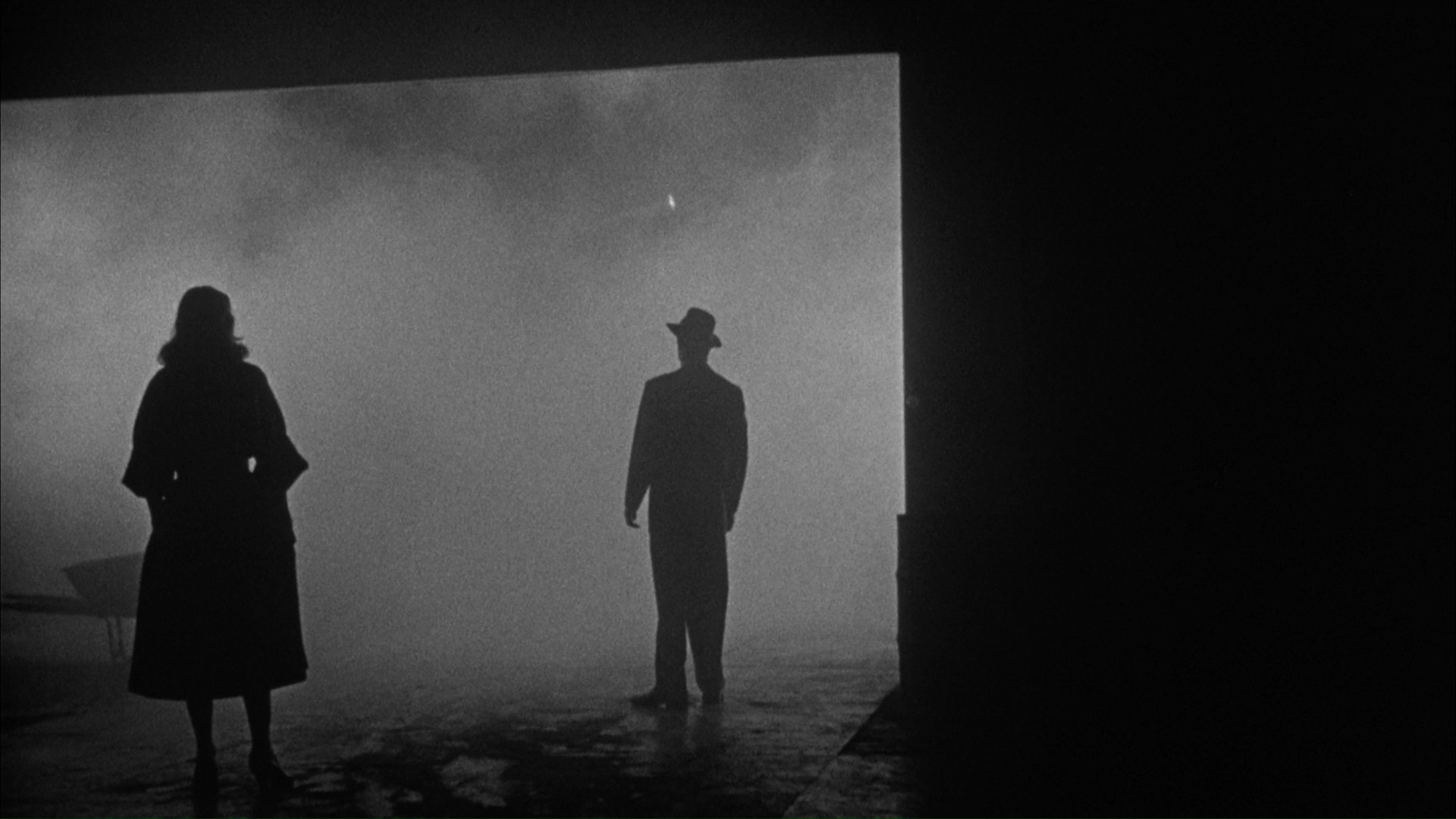
Film noir (; French: [film nwaʁ]) is a style of Hollywood crime drama that emphasizes cynical attitudes and motivations. The 1940s and 1950s are generally regarded as the "classic period" of American film noir. Film noir of this era is associated with a low-key, black-and-white visual style that has roots in German expressionist cinematography. Many of the prototypical stories and attitudes expressed in classic noir derive from the hardboiled school of crime fiction that emerged in the United States during the Great Depression, known as noir fiction.
The term film noir, French for "black film" (literal) or "dark film" (closer meaning), was first applied to Hollywood films by French critic Nino Frank in 1946, but was unrecognized by most American film industry professionals of that era. Frank is believed to have been inspired by the French literary publishing imprint Série noire, founded in 1945.
Cinema historians and critics defined the category retrospectively. Before the notion was widely adopted in the 1970s, many of the classic film noirs[a] were referred to as "melodramas". Whether film noir qualifies as a distinct genre or whether it should be considered a filmmaking style is a matter of ongoing and heavy debate among film scholars.
Film noir encompasses a range of plots; common archetypical protagonists include a private investigator (The Big Sleep), a plainclothes police officer (The Big Heat), an aging boxer (The Set-Up), a hapless grifter (Night and the City), a law-abiding citizen lured into a life of crime (Gun Crazy), a femme fatale (Gilda) or simply a victim of circumstance (D.O.A.). Although film noir was originally associated with American productions, the term has been used to describe films from around the world. Many films released from the 1960s onward share attributes with film noirs of the classical period, and often treat its conventions self-referentially. Latter-day works are typically referred to as neo-noir. The clichés of film noir have inspired parody since the mid-1940s.
Definition
The question of what defines film noir and what sort of category it is, provokes continuing debate. "We'd be oversimplifying things in calling film noir oneiric, strange, erotic, ambivalent, and cruel ..."—this set of attributes constitutes the first of many attempts to define film noir made by French critics Raymond Borde and Étienne Chaumeton in their 1955 book Panorama du film noir américain 1941–1953 (A Panorama of American Film Noir), the original and seminal extended treatment of the subject. They emphasize that not every noir film embodies all five attributes in equal measure—one might be more dreamlike; another, particularly brutal. The authors' caveats and repeated efforts at alternative definition have been echoed in subsequent scholarship, but in the words of cinema historian Mark Bould, film noir remains an "elusive phenomenon."
Though film noir is often identified with a visual style that emphasizes low-key lighting and unbalanced compositions, films commonly identified as noir evidence a variety of visual approaches, including ones that fit comfortably within the Hollywood mainstream. Film noir similarly embraces a variety of genres, from the gangster film to the police procedural to the gothic romance to the social problem picture—any example of which from the 1940s and 1950s, now seen as noir's classical era, was likely to be described as a melodrama at the time.
While many critics refer to film noir as a genre itself, others argue that it can be no such thing. Foster Hirsch defines a genre as determined by "conventions of narrative structure, characterization, theme, and visual design." Hirsch, as one who has taken the position that film noir is a genre, argues that these elements are present "in abundance." Hirsch notes that there are unifying features of tone, visual style and narrative sufficient to classify noir as a distinct genre.
Others argue that film noir is not a genre. It is often associated with an urban setting, but many classic noirs take place in small towns, suburbia, rural areas, or on the open road; setting is not a determinant, as with the Western. Similarly, while the private eye and the femme fatale are stock character types conventionally identified with noir, the majority of films in the genre feature neither. Nor does film noir rely on anything as evident as the monstrous or supernatural elements of the horror film, the speculative leaps of the science fiction film, or the song-and-dance routines of the musical.
An analogous case is that of the screwball comedy, widely accepted by film historians as constituting a "genre": screwball is defined not by a fundamental attribute, but by a general disposition and a group of elements, some—but rarely and perhaps never all—of which are found in each of the genre's films. Because of the diversity of noir (much greater than that of the screwball comedy), certain scholars in the field, such as film historian Thomas Schatz, treat it as not a genre but a "style". Alain Silver, the most widely published American critic specializing in film noir studies, refers to film noir as a "cycle" and a "phenomenon", even as he argues that it has—like certain genres—a consistent set of visual and thematic codes. Screenwriter Eric R. Williams labels both film noir and screwball comedy a "pathway" in his screenwriters taxonomy; explaining that a pathway has two parts: 1) the way the audience connects with the protagonist and 2) the trajectory the audience expects the story to follow. Other critics treat film noir as a "mood," a "series", or simply a chosen set of films they regard as belonging to the noir "canon." There is no consensus on the matter.
Background
Cinematic sources
The aesthetics of film noir were influenced by German Expressionism, an artistic movement of the 1910s and 1920s that involved theater, music, photography, painting, sculpture and architecture, as well as cinema. The opportunities offered by the booming Hollywood film industry and then the threat of Nazism led to the emigration of many film artists working in Germany who had been involved in the Expressionist movement or studied with its practitioners. M (1931), shot only a few years before director Fritz Lang's departure from Germany, is among the first crime films of the sound era to join a characteristically noirish visual style with a noir-type plot, in which the protagonist is a criminal (as are his most successful pursuers). Directors such as Lang, Jacques Tourneur, Robert Siodmak and Michael Curtiz brought a dramatically shadowed lighting style and a psychologically expressive approach to visual composition (mise-en-scène) with them to Hollywood, where they made some of the most famous classic noirs.
By 1931, Curtiz had already been in Hollywood for half a decade, making as many as six films a year. Movies of his such as 20,000 Years in Sing Sing (1932) and Private Detective 62 (1933) are among the early Hollywood sound films arguably classifiable as noir—scholar Marc Vernet offers the latter as evidence that dating the initiation of film noir to 1940 or any other year is "arbitrary". Expressionism-orientated filmmakers had free stylistic rein in Universal horror pictures such as Dracula (1931), The Mummy (1932)—the former photographed and the latter directed by the Berlin-trained Karl Freund—and The Black Cat (1934), directed by Austrian émigré Edgar G. Ulmer. The Universal horror film that comes closest to noir, in story and sensibility, is The Invisible Man (1933), directed by Englishman James Whale and photographed by American Arthur Edeson. Edeson later photographed The Maltese Falcon (1941), widely regarded as the first major film noir of the classic era.
Josef von Sternberg was directing in Hollywood during the same period. Films of his such as Shanghai Express (1932) and The Devil Is a Woman (1935), with their hothouse eroticism and baroque visual style anticipated central elements of classic noir. The commercial and critical success of Sternberg's silent Underworld (1927) was largely responsible for spurring a trend of Hollywood gangster films. Successful films in that genre such as Little Caesar (1931), The Public Enemy (1931) and Scarface (1932) demonstrated that there was an audience for crime dramas with morally reprehensible protagonists. An important, possibly influential, cinematic antecedent to classic noir was 1930s French poetic realism, with its romantic, fatalistic attitude and celebration of doomed heroes. The movement's sensibility is mirrored in the Warner Bros. drama I Am a Fugitive from a Chain Gang (1932), a forerunner of noir. Among films not considered noir, perhaps none had a greater effect on the development of the genre than Citizen Kane (1941), directed by Orson Welles. Its visual intricacy and complex, voiceover narrative structure are echoed in dozens of classic film noirs.
Content sourced from Wikipedia under CC BY-SA 4.0


