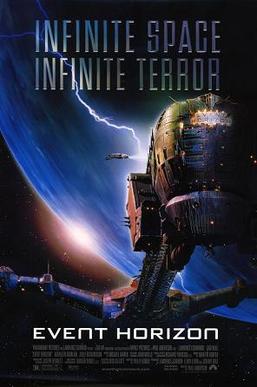
Event Horizon (film)
1997 film by Paul Anderson
Event Horizon is a 1997 science fiction horror film directed by Paul Anderson and written by Philip Eisner. It stars Laurence Fishburne, Sam Neill, Kathleen Quinlan, and Joely Richardson. The film follows a crew of astronauts in the year 2047 who are sent on a rescue mission after the Event Horizon, a spaceship that went missing seven years earlier, spontaneously reappears in orbit around Neptune.
The film had a troubled production, with filming and editing rushed by Paramount Pictures when it became clear that Titanic would not meet its projected release. The original 130-minute cut of the film was heavily edited by the studio's demand, much to Anderson's consternation.
Event Horizon was released in the United States on 15 August 1997 and the United Kingdom one week later. It was a commercial and critical failure, grossing $42 million on a $60 million budget. However, it sold well on home video; its initial DVD release sold so well that Paramount contacted Anderson to begin working on a restoration of the deleted footage, but it had been either lost or destroyed. The film has since been reassessed as a cult classic that influenced many sci-fi and horror films and video games, and has appeared on lists of the best horror films of all time.
In 2025, Event Horizon: Dark Descent, a comic book prequel series began being published by IDW Publishing. In 2026, Event Horizon: Inferno, a comic book sequel series, is set to begin being published by IDW Publishing.
Plot
In 2047, a distress signal is received from the Event Horizon, a spaceship that disappeared during its maiden voyage to Proxima Centauri seven years earlier. The ship has mysteriously reappeared in orbit around Neptune, prompting the US Aerospace Command to dispatch the Lewis and Clark rescue vessel to investigate. Its crew members—Captain Miller, second-in-command Lieutenant Starck, pilot Smith, medical technician Peters, engineer Justin, doctor D.J., and rescue technician Cooper—are joined by Dr. William Weir, who designed the Event Horizon. Shortly before arrival at the Event Horizon, Weir briefs them on the ship's experimental gravity drive with a simple visualization of how it folds spacetime to instantly transport the ship across vast distances. He then plays them the distress signal, which consists of screams, howls, and what sounds like a voice. D.J. recognizes it as the Latin phrase "līberāte mē", which he translates as "save me".
Upon boarding the Event Horizon, the crew finds signs of a massacre. As they search for survivors, the ship's gravity drive activates and briefly pulls Justin into a portal before unleashing a shock wave that breaches the hull of the Lewis and Clark. The crew is forced to move to the Event Horizon while Cooper rescues Justin from the portal, finding that he has been reduced to a catatonic state. Smith and Cooper are sent on a spacewalk to repair the hull of the Lewis and Clark while the rest of the crew begin to experience hallucinations of their biggest fears and regrets. Miller sees Eddie Corrick, a subordinate from a previous journey who he left to die in order to save the other crew members. Peters sees her son with his legs covered in bloody lesions, while Weir sees an eyeless vision of his late wife urging him to join her.
Justin suddenly wakes from his coma while the entire ship seems to be shaking and attempts to vent himself from the airlock; he is saved at the last second by Miller, who places a severely injured Justin in stasis. Shaken, Miller confides in D.J. about his hallucinations, prompting D.J. to reveal that he found a longer phrase in the distress signal. It really says "libera te tutemet ex inferis", which he translates as "save yourself from Hell". D.J. concludes that the ship's drive must have opened a gateway to somewhere beyond the known universe and brought something horrible back with it. His conclusion gains more credibility when a video log is discovered on the Event Horizon, showing the ship's crew members horrifically brutalizing each other after engaging the gravity drive, with their captain chanting in Latin as he holds his own eyeballs in his hands.
Miller immediately orders his crew to speed up their evacuation, ignoring Weir's protests to the contrary. Miller and Smith retrieve CO2 scrubbers from the Event Horizon as Peters is lured to her death by a hallucination of her son. Weir finds her body and is flung into a hallucination of his wife's suicide, driving him to gouge out his own eyes and embrace the ship's evil presence. Now corrupted, he uses an explosive to destroy the Lewis and Clark, killing Smith and blasting Cooper into space before killing D.J. by vivisecting him. Miller confronts Weir on the bridge but is overpowered. Weir initiates a 10-minute countdown to activate the gravity drive and return the ship to the hellish dimension. Meanwhile, Cooper uses his spacesuit's oxygen supply to propel himself back to the ship and appears at the bridge window. Weir shoots at him, shattering the window and blowing himself into space with the decompression.
Miller, Starck, and Cooper survive and manage to seal off the ship's bridge. With their own ship destroyed, Miller plans to split the Event Horizon in two with explosives and use its forward section as a lifeboat. He is attacked by hallucinations which turn out to be the resurrected and even more mutilated Weir. Miller fights him at the gravity drive and detonates the explosives, sacrificing himself to save his remaining crew. The gravity drive activates, pulling the ship's stern into a black hole. Starck and Cooper enter stasis beside a comatose Justin and wait to be rescued.
72 days later, the wreckage of the Event Horizon is boarded by a rescue party who discover the survivors in stasis. Starck hallucinates Weir as one of the rescuers and screams but she quickly awakens, realizing that it was only a nightmare. Cooper and the rescue team try to calm the terrified Starck as the doors close.
Cast
Production
Development
After Mortal Kombat (1995) was a commercial success in the United States, English director Paul Anderson was inundated with screenplay offers, as well as the opportunity to direct the Mortal Kombat sequel Mortal Kombat Annihilation (1997) and the upcoming X-Men (2000). He turned down the offers in favor of making an R-rated horror film, wanting to shift away from making another PG-13 film. Paramount Pictures sent him Philip Eisner's original script for Event Horizon, which they had been trying to develop with producers Lawrence Gordon and Lloyd Levin. According to Eisner, he first pitched its concept to Gordon as a "haunted house story in space", which the producer thought had potential: "Luckily", said Eisner, "he liked the idea enough to trust me to do it."
Anderson's initial reaction to the script, which involved the cruiseship Event Horizon experiencing a series of hauntings by "tentacular" aliens, it having crossed the threshold of their planet or "dimension", was that it bore striking resemblance to Alien (1979). Producer and longtime collaborator Jeremy Bolt felt it was a "terrific concept" but was "very dense" in terms of length and the storyline was "a bit lost". Anderson did not want to direct a mimicry of Alien, so he gave the script a major rewrite, picturing a "classic haunted house movie". He incorporated significant influences of successful horror films such as Robert Wise's The Haunting (1963) and Stanley Kubrick's The Shining (1980), because they created suspense from the unknown—the evil presence was hidden from the viewer—and their endings induced ambiguities of perception in the audience. He said he was also interested in the concept of Hell, and of "the ship itself being possessed rather than going 'Oh, it's an alien consciousness that is doing this'", and added these to the script. Anderson also said that the science fiction film Solaris (1972) was an inspiration for Event Horizon.
Screenwriter Philip Eisner acknowledged that Warhammer 40,000 influenced the story. In the setting of Warhammer 40,000, spaceships travel the galaxy by passing through "the Warp"—a parallel dimension where faster-than-light travel is possible, conceptually similar to "hyperspace" in Star Wars, but which is also inhabited by evil spirits that can infiltrate the ship and possess the crew if said ship is not properly shielded.
Filming and effects
Filming took place in Pinewood Studios, with visual effects provided by Cinesite and Computer Film Company. Using an architectural cam program, Anderson modeled the Event Horizon ship after Notre Dame Cathedral. Effects supervisors Richard Yuricich and Neil Corbould kept most visuals in-camera, and moving sets were constructed for the gyrosphere gravity drive and the revolving tunnel. For scenes depicting zero gravity, the actors were hung upside down in harnesses and spun around. The original script had more zero gravity scenes, but budget constraints had the filmmakers introduce magnetic boots. Because the majority of scenes were filmed in a studio on gothic-inspired sets, Anderson felt the cast experienced a kind of "cabin fever" that better served their performances. Joely Richardson called the experience of working on the film "cursed".
Content sourced from Wikipedia under CC BY-SA 4.0


