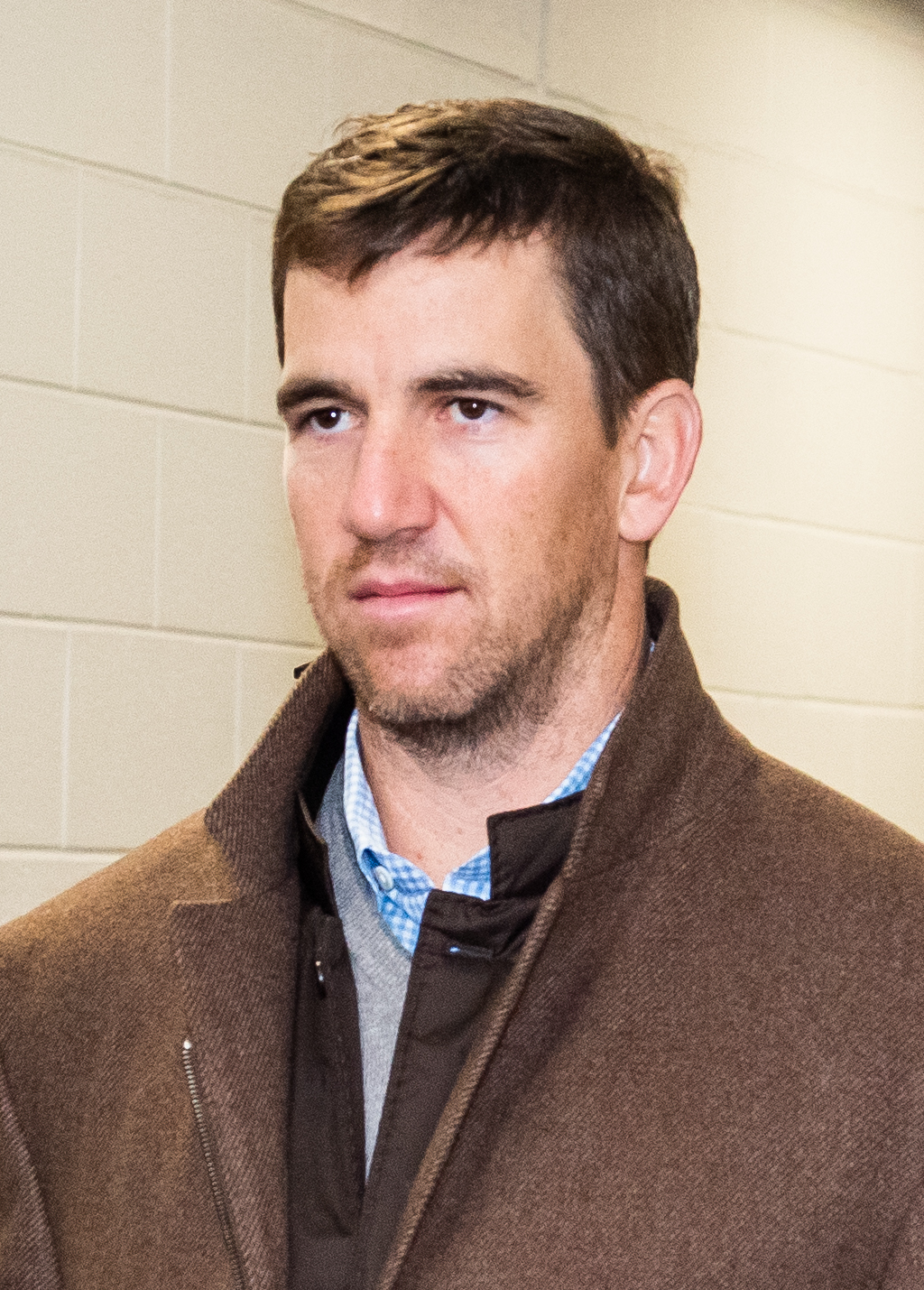
Eli Manning
American football player (born 1981)
Elisha Nelson Manning (born January 3, 1981) is an American former professional football quarterback who played in the National Football League (NFL) for 16 seasons with the New York Giants. A member of the Manning family, he is the youngest son of Archie, younger brother of Cooper and Peyton, and uncle of Arch. Manning played college football for the Ole Miss Rebels, winning the Maxwell and Johnny Unitas Golden Arm awards as a senior. He was selected first overall in the 2004 NFL draft by the San Diego Chargers and traded to the Giants during the draft.
Manning's greatest professional success was twice leading the Giants to underdog Super Bowl victories against the New England Patriots dynasty in Super Bowls XLII and XLVI. The former, which saw the wild card Giants defeat a Patriots team that was the first to win all 16 regular season games, is regarded as one of the greatest sports upsets of all time. Manning was named Super Bowl MVP in both championships, making him one of six players to receive the award multiple times.
As the Giants starting quarterback from 2004 to 2019, Manning holds the franchise records for passing yards, passing touchdowns, and completions. Never missing a game due to injury, he started 210 consecutive games from 2004 to 2017, the third-longest consecutive starts streak by an NFL quarterback. Manning ranks 11th all-time in both passing yards and passing touchdowns.
Early life
Manning was born in New Orleans, the youngest of three boys to Olivia (née Williams) and NFL quarterback Elisha Archibald "Archie" Manning III, both natives of Mississippi. His older brothers, Cooper and Peyton, both played football growing up.
Manning attended high school at the Isidore Newman School in New Orleans, where he played football and basketball for the Greenies. In his high school career, Manning was a three-time All-State selection from 1996 to 1998, was named the USA Today Player of the Year in Louisiana, and passed for a school-record 7,389 yards and 89 touchdowns. His passing mark was later broken by his nephew Arch in 2022. Eli committed to play college football at the University of Mississippi.
College career
Manning entered college in the shadow of his brother Peyton, quarterback of the Indianapolis Colts, and his father, who was considered a legend and folk hero at Ole Miss. During his years with the Rebels, Manning set or tied numerous single-game, season and career records. His career numbers include 10,119 passing yards (fifth on the SEC career list), 81 touchdown passes (third on the SEC career list), and a passer rating of 137.7 (tied for sixth on the SEC career list).
2000 season
As a redshirt freshman, Manning competed with veteran Romaro Miller for the starting quarterback position and saw little playing time. He appeared in six games and passed for 170 total yards and one interception in the Rebels 7–5 season.
2001 season
With the departure of Miller, Manning became the Rebels' starting quarterback as a sophomore. In the first game, against Murray State, he converted 20-of-23 pass attempts for 271 yards and five passing touchdowns in the 49–14 victory. In the following game, a 27–21 loss to Auburn, he had 265 passing yards, one passing touchdown and one interception. Over the next few games, Manning helped lead the Rebels to victories over Kentucky, Alabama and LSU. On November 3, in a 58–56 7OT loss to Arkansas, Manning passed for 312 passing yards and six passing touchdowns. The game marked the longest game in major college football history at the time. Overall, Manning had a solid first year as the Rebels' starting quarterback with 2,948 passing yards, 31 touchdowns, and nine interceptions, as the Rebels finished with a 7–4 record.
2002 season
Manning's junior season started out promising with a 31–3 victory over Louisiana-Monroe and a 38–16 victory over Memphis. Manning had four passing touchdowns and one interception combined in those two games. In the next game, a 42–28 loss to Texas Tech, Manning passed for 374 yards, three touchdowns and one interception. The Rebels won their next three games, which were over Vanderbilt, #6 Florida and Arkansas State to earn Ole Miss a #21 ranking in the AP Poll. Manning had five touchdowns and one interception in that stretch. The Rebels' fortunes turned in the latter half of the season with a five-game losing streak. In the stretch was a 48–28 loss to Arkansas, in which Manning completed 42-of-56 passes for 414 yards, two touchdowns, and two interceptions. In addition, he had a rushing touchdown. Manning's 414 passing yards marked the most he threw for in college. After a 24–12 win over rival Mississippi State, the Rebels qualified for the Independence Bowl with a 6–6 record to face off against Nebraska. Manning passed for 313 yards and one touchdown in the 27–23 victory. Overall, Manning finished with 3,401 passing yards, 21 touchdowns, and 15 interceptions in his junior season.
2003 season
Manning started off his senior season with a 2–2 record. He played well in that stretch with 1,329 passing yards, 11 touchdowns and four interceptions, with victories over Vanderbilt and Louisiana-Monroe, but had losses to Memphis and Texas Tech. The Rebels went on a six-game winning streak that included victories over major SEC opponents #24 Florida, Alabama, #21 Arkansas, South Carolina, and Auburn. Manning passed for 1,552 yards, 12 touchdowns, and four interceptions in the winning streak. Overall, he led the Rebels to a 10–3 record, earning a share of the SEC Western Division championship, and a 31–28 SBC Cotton Bowl Classic victory over #21 Oklahoma State, with 259 passing yards and two touchdowns in 2003. Manning helped lead Ole Miss to their first ten-win season since 1971.
As his senior year came to a close, Manning won many awards, including the Maxwell Award as the nation's best all-around player, the Johnny Unitas Golden Arm Award, the National Football Foundation and College Football Hall of Fame Scholar-Athlete Award, the Sporting News Radio Socrates Award, and the SEC Most Valuable Player Award. He was also a candidate for the 2003 Heisman Trophy, finishing third in the voting after winning quarterback Jason White (University of Oklahoma) and wide receiver Larry Fitzgerald (University of Pittsburgh). Manning was a member of the Sigma Nu fraternity (as was his father), was named Sigma Nu Athlete of the Year in 2001 and 2003, and was inducted into their Hall of Fame in 2008.
Manning graduated from the University of Mississippi with a degree in marketing and a GPA of 3.44 and was on the Dean's Honor Roll.
College statistics
Professional career
The San Diego Chargers had the first overall pick in the 2004 NFL draft due to their 4–12 record in 2003. With Manning being the most coveted player in the draft, it appeared that the Chargers' intentions were to draft him first overall. Meanwhile, Manning and his father Archie Manning stated that he would refuse to play for the Chargers if drafted by them. Archie asked the father of former Chargers quarterback Ryan Leaf before the draft about his son's experience with the team. In hearing that the Chargers did not help Leaf with his personal problems, it then became part of why Eli refused to play for the team.
The Chargers selected Manning with the first pick overall nonetheless. The team had a deal with the New York Giants, whereby the Giants would draft and then trade Philip Rivers and a 2004 third-round pick, used to select placekicker Nate Kaeding; a 2005 first-round pick, used to select linebacker Shawne Merriman; and a 2005 fifth-round pick (which was later traded away) to the Chargers for Manning. He signed a six-year, $45 million contract with the Giants.
Manning was one of 17 quarterbacks taken in the 2004 NFL draft, along with Rivers and the Pittsburgh Steelers' Ben Roethlisberger. All three would enjoy lengthy and successful careers with the teams that signed them and have been compared favorably to the 1983 NFL draft, which included Hall of Fame quarterbacks John Elway, Jim Kelly, and Dan Marino. Manning posted the lowest passing yards, touchdowns, pass completions, completion percentage, TD–INT ratio, passer rating, wins, winning percentage, and Pro Bowl honors of the three, but cemented his legacy with his two upset Super Bowl victories against the New England Patriots' dynasty. While both Manning and Roethlisberger were part of two Super Bowl-winning teams, Manning is the only quarterback of the three to earn Super Bowl MVP honors, which he received in both victories.
Content sourced from Wikipedia under CC BY-SA 4.0


