Elephant cognition
Intelligence and awareness in elephants
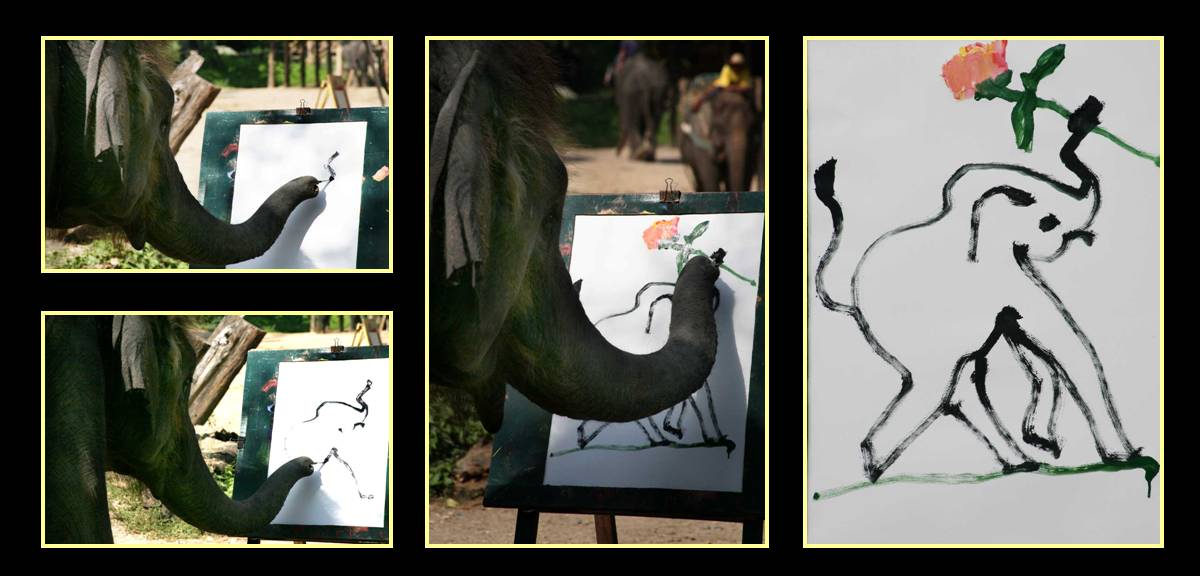
Elephant cognition is animal cognition as present in elephants. Most contemporary ethologists view the elephant as one of the world's most intelligent animals. Elephants manifest a wide variety of behaviors, including those associated with grief, learning, mimicry, playing, altruism, tool use, compassion, cooperation, self-awareness, memory, and communication. They can also exhibit negative qualities such as revenge towards those perceived to have harmed them or their families. "Duncan McNair, a lawyer and founder of conservation charity Save The Asian Elephants, told Newsweek that ... although gentle creatures, elephants can be 'dangerous and deadly'."
Evidence suggests elephants may understand pointing, the ability to nonverbally communicate an object by extending their multi-purpose trunks.
An elephant brain weighs around 5 kg (11 lb), which is about four times the size of a human brain and the heaviest of any terrestrial animal. It has about 257 billion neurons, which is about three times the number of neurons as a human brain. However, the cerebral cortex, which is the major center of cognition, has only about one-third of the number of neurons as a human's cerebral cortex. While elephant brains look similar to those of humans and other mammals and has the same functional areas, there are certain unique structural differences.
The intelligence of elephants is described as on par with cetaceans and various primates. Due to its higher cognitive intelligence and presence of family ties, researchers and wildlife experts argue that it is morally wrong for humans to kill them. Aristotle described the elephant as "the animal that surpasses all others in wit and mind."
Structure of the brain
Cerebral cortex
The living species of elephant (both Asian and African) have a very large and highly complex neocortex, a trait also shared by humans, apes and certain dolphin species.
Asian elephants have the greatest volume of cerebral cortex available for cognitive processing of all existing land animals. It exceeds that of any primate species, with one study suggesting elephants be placed in the category of great apes in terms of cognitive abilities for tool use and tool making.
The elephant brain exhibits a gyral pattern more complex and with more numerous convolutions, or brain folds, than that of humans, other primates, or carnivores, but less complex than that of cetaceans. Elephants are believed to rank equal with dolphins in terms of problem-solving abilities, and many scientists tend to rank elephant intelligence at the same level as cetaceans; a 2011 article published by ABC Science suggests that, "elephants [are as] smart as chimps, [and] dolphins".
Other areas of the brain
Elephants also have a very large and highly convoluted hippocampus, a brain structure in the limbic system that is much bigger than that of any human, primate or cetacean. The hippocampus of an elephant takes up about 0.7% of the central structures of the brain, comparable to 0.5% for humans and with 0.1% in Risso's dolphins and 0.05% in bottlenose dolphins.
The hippocampus is linked to emotion through the processing of certain types of memory, especially spatial. This is thought to be possibly why elephants suffer from psychological flashbacks and the equivalent of post-traumatic stress disorder (PTSD).
The encephalization quotient (EQ) (the size of the brain relative to body size) of elephants ranges from 1.13 to 2.36. The average EQ is 2.14 for Asian elephants, and 1.67 for African, with the overall average being 1.88. In comparison to other animals, the La Plata dolphin has an EQ of 1.67; the Ganges river dolphin of 1.55; the orca of 2.57; the bottlenose dolphin of 4.14; and the tucuxi dolphin of 4.56; chimpanzees at 2.49; dogs at 1.17, cats at 1.00; and mice at 0.50. Humans have an EQ of 7.44.
Brain size at birth relative to adult brain size
Comparing brain size at birth to the size of a fully developed adult's brain is one way to estimate how much an animal relies on learning as opposed to instinct. The majority of mammals are born with a brain close to 90% of the adult weight, while humans are born with 28%, bottlenose dolphins with 42.5%, chimpanzees with 54%, and elephants with 35%.
Spindle neurons
Spindle cells appear to play a central role in the development of intelligent behavior. As well as in humans and the rest of the great apes, spindle neurons are also found in the brains of both Asian and African elephants, as well as humpback whales, fin whales, killer whales, sperm whales, bottlenose dolphins, Risso's dolphins, and beluga whales. The remarkable similarity between the elephant brain and the human brain supports the thesis of convergent evolution.
Elephant society
The elephant has one of the most closely knit societies of any living species. Elephant families can only be separated by death or capture. Cynthia Moss, an ethologist specialising in elephants, recalls an event involving a family of African elephants:
- Two members of the family were shot by poachers, who were subsequently chased off by the remaining elephants. Although one of the elephants died, the other, named Tina, remained standing, but with knees beginning to give way. Two family members, Trista and Teresia (Tina's mother), walked to both sides of Tina and leaned in to hold her up. Eventually, Tina grew so weak, she fell to the ground and died. However, Trista and Teresia did not give up but continually tried to lift her. They managed to get Tina into a sitting position, but her body was lifeless and fell to the ground again. As the other elephant family members became more intensely involved in the aid, they tried to put grass into Tina's mouth. Teresia then put her tusks beneath Tina's head and front quarters and proceeded to lift her. As she did so, her right tusk broke completely off, right up to the lip and nerve cavity. The elephants gave up trying to lift Tina but did not leave her; instead, they began to bury her in a shallow grave and throw leaves over her body. They stood over Tina for the night and then began to leave in the morning. The last to leave was Teresia.
Because elephants are so closely knit and highly matriarchal, a family can be devastated by the death of another (especially a matriarch), and some groups never recover their organization. Cynthia Moss has observed a mother, after the death of her calf, walk sluggishly at the back of a family for many days.
Edward Topsell stated in his publication The History of Four-Footed Beasts in 1607, "There is no creature among all the Beasts of the world which hath so great and ample demonstration of the power and wisdom of almighty God as the elephant." Elephants are believed to be on par with chimpanzees with regard to their cooperative skills.
Elephant altruism
Elephants are thought to be highly altruistic animals that even aid other species, including humans, in distress. In India, an elephant was helping locals lift logs by following a truck and placing the logs in pre-dug holes upon instruction from the mahout (elephant trainer). At a certain hole, the elephant refused to lower the log. The mahout came to investigate the hold-up and noticed a dog sleeping in the hole. The elephant only lowered the log when the dog was gone. When an elephant is hurt, other elephants (even if they are unrelated) aid them.
Moss has often seen elephants going out of their way to avoid hurting or killing a human, even when it was difficult for them (such as having to walk backwards to avoid a person). Joyce Poole documented an encounter told to her by Colin Francombe on Kuki Gallman's Laikipia Ranch. A ranch herder was walking alongside camels when he came across a family of elephants. The matriarch charged at him and knocked him over with her trunk, breaking one of his legs. In the evening, when he did not return, a search party was sent in a truck to find him. When the party discovered him, he was being guarded by an elephant. The animal charged the truck, so they shot over her and scared her away. The herdsman later told them that when he could not stand up, the elephant used her trunk to lift him under the shade of a tree. She guarded him for the day and would gently touch him with her trunk.
Self-medication
Elephants in Africa self-medicate by chewing on the leaves of a tree from the family Boraginaceae, which induces labour. Kenyans also use this tree for the same purpose.
Death ritual
Scientists often debate the extent to which elephants feel emotion. Elephants have been one of few species of mammals other than Homo sapiens sapiens and Neanderthals known to have or have had any recognizable ritual around death. Elephants show a keen interest in the bones of their own kind (even unrelated elephants that have died long ago). They are often seen gently investigating the bones with their trunks and feet while remaining very quiet. Sometimes elephants that are completely unrelated to the deceased still visit their graves.
Content sourced from Wikipedia under CC BY-SA 4.0


