Eigengrau
Illusionary dark gray color
Why this is trending
Interest in “Eigengrau” spiked on Wikipedia on 2026-02-25.
Sudden spikes in Wikipedia readership generally point to a newsworthy event or emerging public conversation that piques widespread curiosity.
By monitoring millions of daily Wikipedia page views, GlyphSignal helps you spot cultural moments as they happen and understand the stories behind the numbers.
Key Takeaways
- Eigengrau (German for 'intrinsic gray'; pronounced [ˈʔaɪ̯gŋ̍ˌgʁaʊ̯] ), also called Eigenlicht (Dutch and German for 'intrinsic light'), dark light , or brain gray , is the uniform dark gray background color that many people report seeing in the absence of visible light.
- Common scientific terms for the phenomenon include "visual noise" or "background adaptation".
- Eigengrau is perceived as lighter than a black object in normal lighting conditions because contrast is more important to the visual system than absolute brightness.
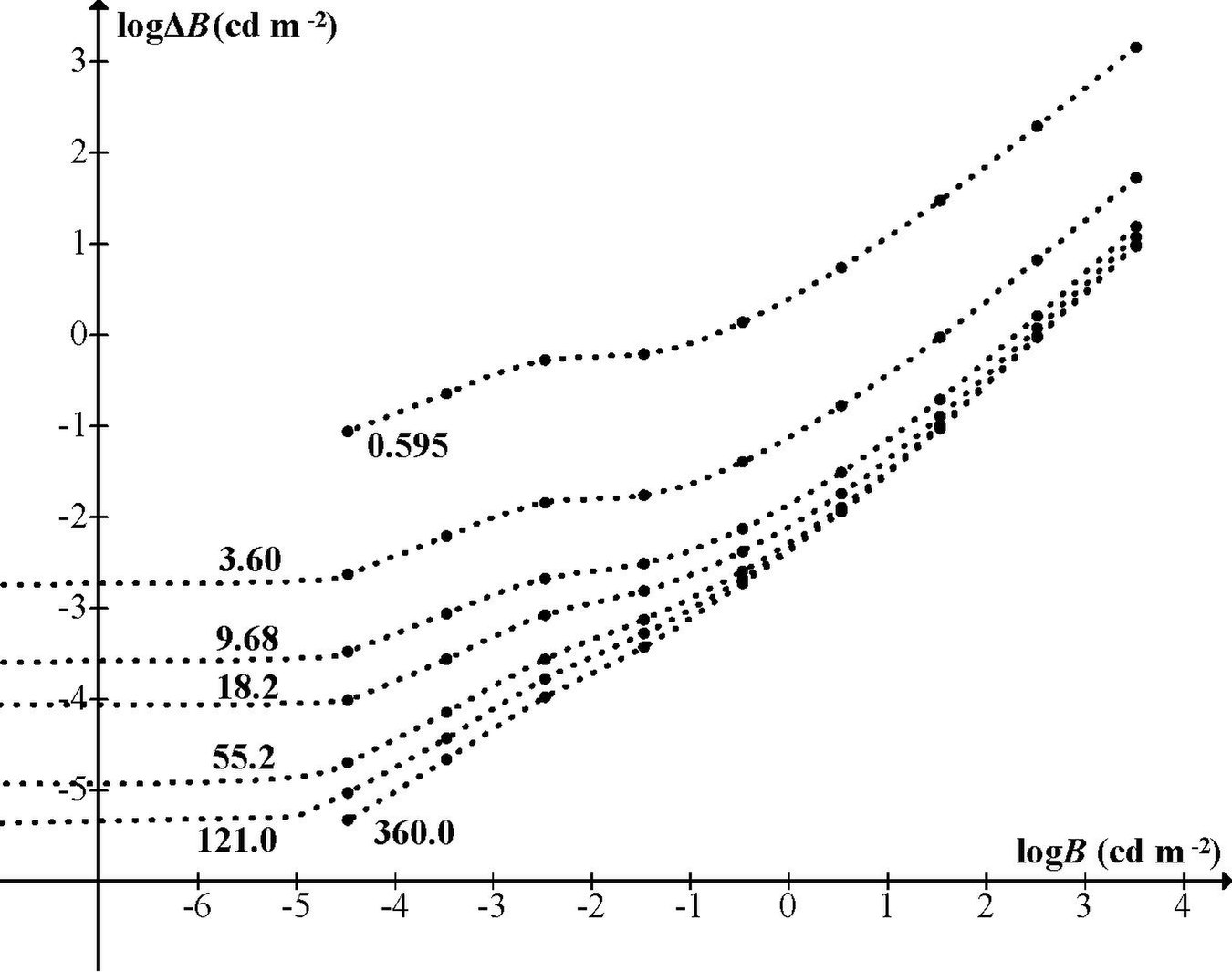
- Contrast threshold data, collected by Blackwell and plotted by Crumey, shows Eigengrau occurring at adaptation luminances below approximately 10 − 5 cd m −2 (25.
- This is a limiting case of Ricco's law.
Eigengrau (German for 'intrinsic gray'; pronounced [ˈʔaɪ̯gŋ̍ˌgʁaʊ̯] ), also called Eigenlicht (Dutch and German for 'intrinsic light'), dark light, or brain gray, is the uniform dark gray background color that many people report seeing in the absence of visible light.
Background
The term Eigenlicht dates back to the nineteenth century, and has rarely been used in recent scientific publications. Common scientific terms for the phenomenon include "visual noise" or "background adaptation". These terms arise due to the perception of an ever-changing field of tiny black and white dots seen in the phenomenon.
Eigengrau is perceived as lighter than a black object in normal lighting conditions because contrast is more important to the visual system than absolute brightness. For example, the night sky looks darker than Eigengrau because of the contrast provided by the stars.
Contrast threshold data, collected by Blackwell and plotted by Crumey, shows Eigengrau occurring at adaptation luminances below approximately 10− 5 cd m−2 (25.08 mag arcsec−2). This is a limiting case of Ricco's law.
Content sourced from Wikipedia under CC BY-SA 4.0


