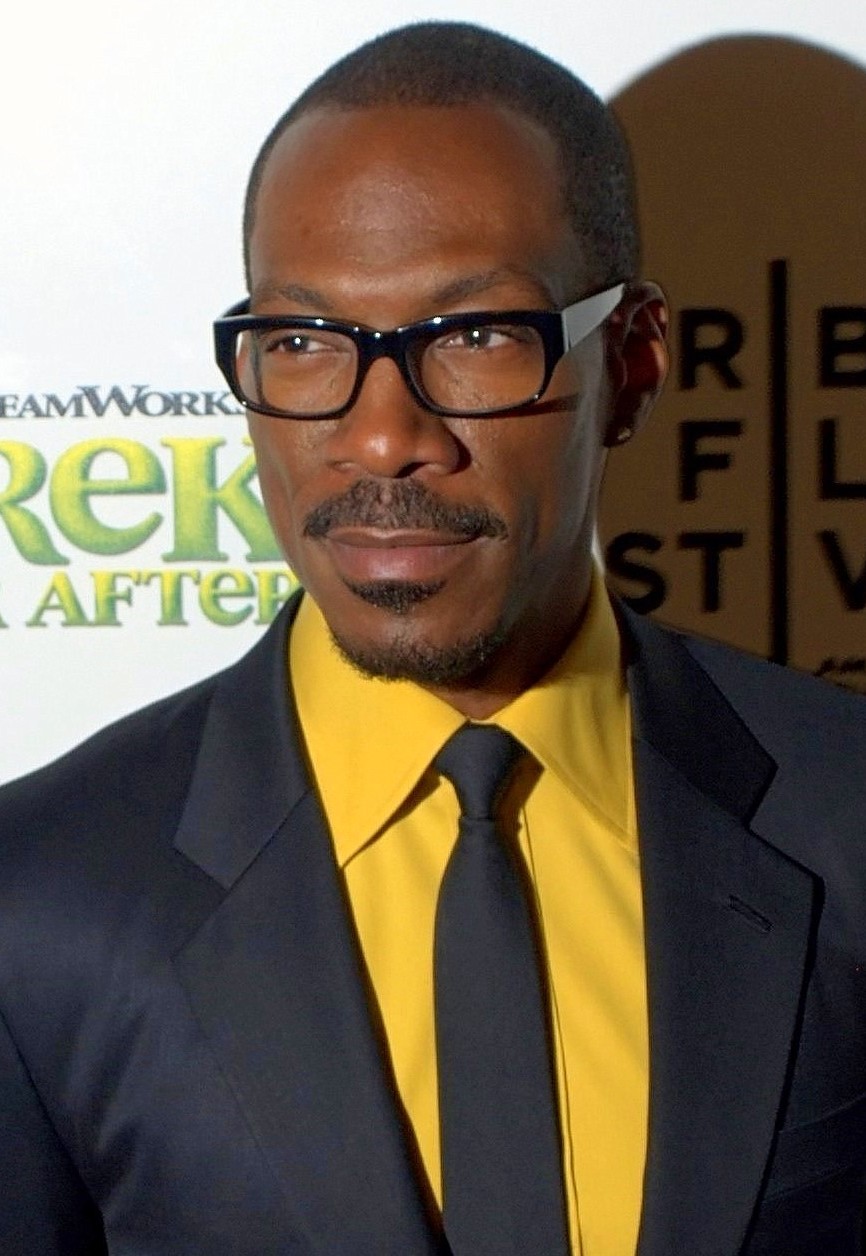
Eddie Murphy
American comedian, actor, and singer (born 1961)
Edward Regan Murphy (born April 3, 1961) is an American comedian, actor, and singer. He had his breakthrough as a stand-up comic before gaining stardom for his film roles; he is widely recognized as one of the greatest comedians of all time. He has received several accolades including a Golden Globe Award, a Grammy Award, and an Emmy Award as well as nominations for an Academy Award and a BAFTA Award. He was honored with the Mark Twain Prize for American Humor in 2015 and the Cecil B. DeMille Award in 2023.
Murphy shot to fame on the sketch comedy show Saturday Night Live, for which he was a regular cast member from 1980 to 1984 and broke out as a movie star in the 1980s films 48 Hrs., Trading Places, and Beverly Hills Cop. He then established himself as a leading man with starring roles in: The Golden Child (1986), Coming to America (1988), Harlem Nights (which he also directed) (1989), Boomerang (1992), The Nutty Professor (1996), Dr. Dolittle (1997), Bowfinger (1999), Daddy Day Care (2003), and Norbit (2007). Murphy both won the Golden Globe for Best Supporting Actor and received a nomination for the Academy Award for Best Supporting Actor for his role in Dreamgirls (2006).
Murphy has worked as a voice actor, including Mushu in Disney's Mulan (1998), Thurgood Stubbs in the sitcom The PJs (1999–2001), and Donkey in the Shrek franchise (2001–present), the latter of which earned him a BAFTA Award for Best Actor in a Supporting Role nomination. Murphy often takes on multiple roles in a single film, such as in Coming to America, Vampire in Brooklyn, the Nutty Professor films, Bowfinger, The Adventures of Pluto Nash and Norbit. This is intended as Murphy's tribute to one of his idols, Peter Sellers. Following a string of poorly received films, he had a career resurgence with leading roles in films such as Dolemite Is My Name (2019), Coming 2 America (2021), You People, Candy Cane Lane (both 2023) and Beverly Hills Cop: Axel F (2024).
In 2020, he won his first Primetime Emmy Award for Outstanding Guest Actor in a Comedy Series for hosting Saturday Night Live. Murphy's films have grossed over $3.8 billion ($6.5 billion adjusted for inflation) in the United States and Canada box office, and over $6.7 billion worldwide. In 2015, his films made him the sixth-highest grossing actor in the United States. As a singer, Murphy has released three studio albums, including How Could It Be (1985), So Happy (1989), and Love's Alright (1993). He is also known for his 1985 single "Party All the Time", which peaked at number two on the Billboard Hot 100.
Early life
Murphy was born April 3, 1961, in Brooklyn, New York City, and raised in the borough's Bushwick neighborhood. His mother, Lillian Murphy (née Laney, later Murphy Lynch), was a telephone operator, and his father, Charles Edward Murphy (1940–1969), was a transit police officer and an amateur actor and comedian.
His father was murdered in 1969. Murphy later stated:
My mother and father broke up when I was three and he died when I was eight, so I have very dim memories. ... He was a victim of the Murphy charm (laughs). A woman stabbed my father. I never got all the logistics. It was supposed to be one of those crimes of passion: "If I can't have you, no one else will" kind of deal.
When Murphy's single mother became ill, eight-year-old Murphy and his elder brother Charlie (1959–2017) lived in foster care for one year. In interviews, Murphy has said his time in foster care was influential in developing his sense of humor. Later, he and his brother were raised in Roosevelt, New York, by his mother and stepfather Vernon Lynch, a foreman at an ice cream plant.
Career
1976–1980: Early standup career
When Murphy was fifteen, he listened to Richard Pryor's comedy album That Nigger's Crazy, which inspired his decision to become a comedian. As a child, Murphy developed playing multiple characters in imitation of his acting hero, Peter Sellers. Other early influences included Bill Cosby, Redd Foxx, Robin Williams, Muhammad Ali, Bruce Lee, and Charlie Chaplin.
On July 9, 1976, the date with which Murphy marks the beginning of his career, he performed in a talent show at the Roosevelt Youth Center, doing an impersonation of singer Al Green as Green's song "Let's Stay Together" played. This led to work at other clubs within walking distance, and then late-night jobs at locations that required him to commute by train. To do this, he secretly skipped school, and after his mother discovered this at the end of his senior year, he was required to attend summer school.
1980s: Superstar status and career peak
In the early 1980s, Murphy first earned national attention as a cast member on Saturday Night Live (SNL) and was credited with helping to revitalize the show. His characters included a grown-up version of the Little Rascals character Buckwheat; a streetwise children's show host named Mr. Robinson (parodying Fred Rogers, who found it amusing); and a morose, cynical Gumby, whose trademark slogan became an SNL catchphrase: "I'm Gumby, dammit!" According to Joseph Clokey, whose father Art Clokey created Gumby, both of them "thought Eddie was a genius in the way he played that character". The Buckwheat character was retired in spectacular fashion—assassinated, on camera, in front of 30 Rockefeller Plaza—at Murphy's request, after he grew tired of constant demands from fans to "Do Buckwheat! Do Buckwheat!" In Rolling Stone's February 2015 appraisal of all 141 SNL cast members to-date, Murphy was ranked second (behind John Belushi). "It is customary (and accurate) to say that Eddie Murphy is the only reason SNL survived the five-year wilderness without Lorne Michaels", the magazine noted. Murphy's early comedy was characterized by copious profanity and sketches lampooning diverse groups of people, including WASPs, African Americans, Italian Americans, overweight people, and gay people. He released two stand-up specials. Delirious was filmed in 1983 in Washington, D.C.
Due to the popularity of Delirious, his concert film, Eddie Murphy Raw (1987), received a wide theatrical release, grossing $50 million; the movie was filmed in the Felt Forum at Madison Square Garden in New York City. In 1982, Murphy made his big-screen debut in the film 48 Hrs. with Nick Nolte. 48 Hrs. proved to be a hit when it was released during the Christmas season of 1982. Nolte was scheduled to host the December 11, 1982, Christmas episode of Saturday Night Live, but became too ill to host, so Murphy took over. He became the only cast member to host while still a regular. Murphy opened the show with the phrase, "Live from New York, it's the Eddie Murphy Show!" The following year, Murphy starred in Trading Places with SNL original cast member Dan Aykroyd. The movie marked the first of Murphy's collaborations with director John Landis, who would go on to direct Murphy in Coming to America (1988) and Beverly Hills Cop III (1994). Trading Places was an even greater box-office success than 48 Hrs.
Murphy appeared in Best Defense (1984), co-starring Dudley Moore. Credited as a "Strategic Guest Star", Murphy was added to the film after an original version was completed but tested poorly with audiences. Best Defense was a major financial and critical disappointment. When he hosted SNL, Murphy joined the chorus of those bashing Best Defense, calling it "the worst movie in the history of everything". The same year, he won a Grammy Award for Best Comedy Recording for his album Eddie Murphy: Comedian. (Murphy has been nominated for a total of three Grammy Awards.) Murphy starred in the successful action comedy film Beverly Hills Cop (1984). The film was Murphy's first solo leading role. Beverly Hills Cop grossed over $230 million at the U.S. box office, becoming the highest-grossing film released in 1984, the highest-grossing comedy of all time, and the highest-grossing R-rated film of all time; as of May 2018, it was 46th in the list of all-time U.S. box-office grossers after adjusting for inflation (third-highest amongst R-rated films). Murphy chose to do that film instead of Ghostbusters (1984). Murphy was offered a part in Star Trek IV: The Voyage Home (1986), a role that, after being heavily rewritten from one of comic relief to one of love interest, went to Catherine Hicks. By this time, Murphy's near-exclusive contract with Paramount Pictures rivaled Star Trek as Paramount's most lucrative franchise.
Content sourced from Wikipedia under CC BY-SA 4.0


