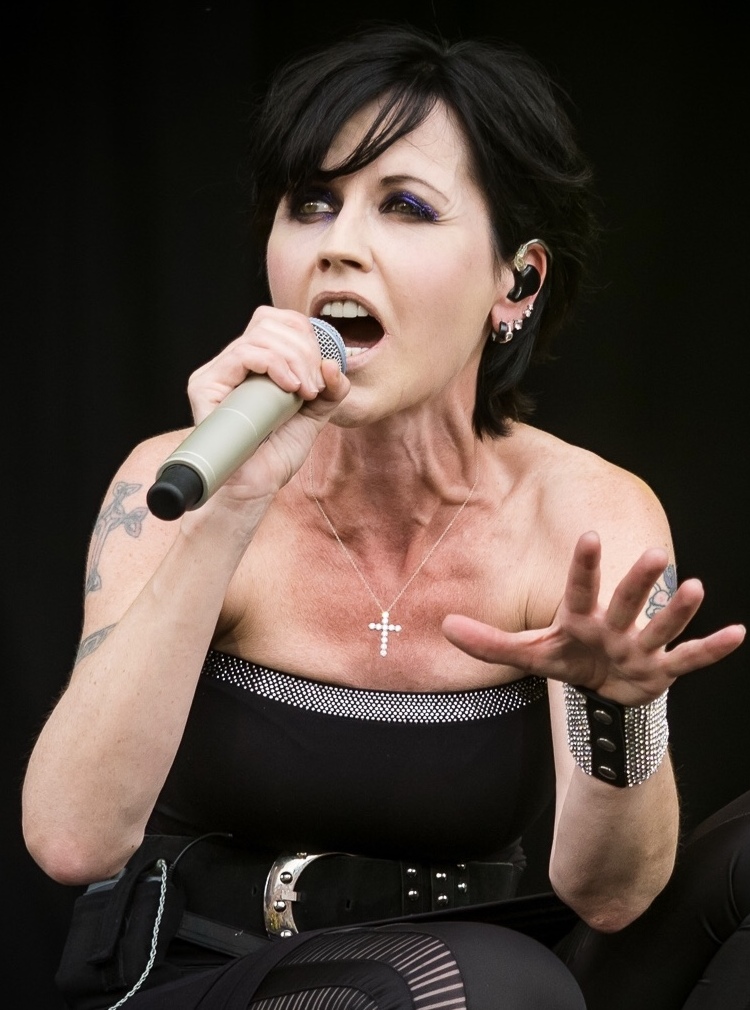
Dolores O'Riordan
Irish musician (1971–2018)
Dolores Mary Eileen O'Riordan ( oh-REER-dən; 6 September 1971 – 15 January 2018) was an Irish musician and singer-songwriter who achieved international fame as the lead vocalist of the rock band the Cranberries. O'Riordan was the principal songwriter of the band and also played acoustic and electric guitars. She became one of the most recognisable voices in alternative rock and was known for her lilting mezzo-soprano voice, signature yodel, use of keening, and strong Limerick accent.
O'Riordan was born in County Limerick, Ireland to a Catholic working-class family. She began performing as a soloist in her church choir before leaving secondary school to join the Cranberries in 1990. The band released the number-one album Everybody Else Is Doing It, So Why Can't We? in 1993; that album was followed by No Need to Argue (1994), To the Faithful Departed (1996), Bury the Hatchet (1999), and Wake Up and Smell the Coffee (2001). The Cranberries went on hiatus in 2003. During the hiatus, O'Riordan released two solo studio albums: Are You Listening? (2007) and No Baggage (2009). The Cranberries reunited in 2009, released Roses (2012), and went on a world tour. O'Riordan's other activities included appearing as a judge on RTÉ's The Voice of Ireland (2013–2014) and recording material with the trio D.A.R.K. (2014). The Cranberries' seventh album, Something Else (2017), was the last to be released during her lifetime.
Throughout her life, O'Riordan suffered from depression and the pressure of her own success; she was diagnosed with bipolar disorder in 2015. O'Riordan died from drowning due to alcohol intoxication in January 2018 at the age of 46. After her death, the Cranberries released the Grammy-nominated album In the End (2019), which featured her final vocal recordings; the group then disbanded. With the Cranberries, O'Riordan sold more than 40 million albums worldwide during her lifetime; that total increased to almost 50 million albums worldwide as of 2019. She was honoured with the Ivor Novello International Achievement award. In the months following her death, O'Riordan was named "The Top Female Artist of All Time" on Billboard's Alternative Songs chart.
Early life and education
Dolores Mary Eileen O'Riordan was born on 6 September 1971 in Ballybricken in County Limerick, Ireland, the youngest of nine children, two of whom died in infancy. Her father, Terence Patrick "Terry" O'Riordan (1937–2011), worked as a farm labourer until a motorbike accident in 1968 left him brain damaged. Her mother, Eileen (née Greensmith), was a school caterer. O'Riordan was raised in a devout Roman Catholic family, and was named by her mother in reference to the Lady of the Seven Dolours.
O'Riordan was singing before she could talk. When she was five years of age, the principal of her school took her into the sixth class, sat her on the teacher's desk, and told her to sing for the twelve-year-old students in the class. She started with traditional Irish music and playing the Irish tin whistle when she went to school.
When O'Riordan was seven years old, her sister accidentally burned the family house down. The family's rural community was able to raise funds to purchase a new homestead for them. O'Riordan's formative experiences were as a liturgical soloist in the choir in a local church and as a singer at school. From the age of eight, she was sexually abused for four years by a person whom she trusted. At the age of ten, she sang in local pubs where her uncles took her.
O'Riordan attended Laurel Hill Coláiste FCJ school in Limerick. School principal Aedín Ní Bhriain said in the Limerick Post about O'Riordan's first day at Laurel Hill Coláiste at the age of twelve that she stood up in front of classmates and announced: "My name is Dolores O'Riordan and I'm going to be a rock star". She then stood on her chair and sang "Tra la la la la, Triangle". According to her school friend Catherina Egan, she was "boisterous, wild, but lovely". She regularly played the spoons and the bodhrán. At the age of twelve, O'Riordan began piano lessons, and then later, achieved Grade 4 in Practical and Grade 8 in Theory. She sat every day at the piano in the main hall to play, then her classmates sat around her after having lunch to listen to her sing. At age 17, she learned to play the guitar and performed a solo gig in Laurel Hill Coláiste secondary school. That same year, she met her first boyfriend, Mike O'Mahoney.
She described having a strict daily routine through her teenage years that consisted of going to piano lessons, going to church and doing homework. O'Riordan later admitted that she had neglected her school lessons in favour of writing music and songs, although at school she became head girl. Former principal Anne Mordan said in Nova about O'Riordan that she was a "delightful, unsophisticated, sensitive student, who enjoyed her time with us"; she described her as "a bright, kind, good-humoured girl, who loved her family, her friends, and had an easy relationship with all her teachers, both lay and FCJ sisters." During her six years at Laurel Hill Coláiste, O'Riordan won the Slógadh song contest almost every year, at several local events, and culminating in national singing competitions. In total she won 20 Slógadh medals.
Around this time, O'Riordan divided the rest of her schedule among assisting her mother, learning the accordion from her dad, and having part-time employment at clothing shops. Her mother, whom she "adored", encouraged her to consider becoming a nun or get a college degree and become a music teacher; instead, she ran away from home at 18 and lived a couple of years with her boyfriend. In an interview with Vox magazine, O'Riordan clarified her reasons for leaving home: "At 18 I left home because I wanted to sing. My parents wanted me to go to college and things like that. I was really poor for a year-and-a-half; I remember actually being hungry, like I'd die for a bag of chips. That's when I joined the Cranberries".
Career
1989–2003: Formation of the Cranberries, early success and stardom
In 1989, brothers Mike (bass) and Noel (guitar) Hogan formed the Cranberry Saw Us with drummer Fergal Lawler and singer Niall Quinn, in Limerick, Ireland. Less than a year later, Quinn left the band. He then told the remaining members that his girlfriend knew a girl who was looking for a band playing original material.
In mid-1990, on a Sunday afternoon, O'Riordan and Quinn came to the band's rehearsal room. Noel Hogan later recalled that "Niall came up with Dolores on that Sunday and I remember she was shy, very soft-spoken. Not the Dolores that everyone grew to know. And she comes in and we're just kind of a gang of young guys sitting around the place. It must have been very, very intimidating for her". O'Riordan sang a couple of songs that she had written and she also did a Sinéad O'Connor song, "Troy". The band was impressed and gave her a cassette with instrumentals, asking her if she could work on it. When she returned with a rough version of "Linger", she was hired. Hogan told Rolling Stone that "the minute she sang, you know, it was like your jaw drops at her voice. Dolores was musically far superior to me, because she had been doing it all her life".
O'Riordan was still a student at Laurel Hill Coláiste FCJ secondary school when she first joined the band. She had set her sights on the musical life and her desire to be in "a band with no barriers, where I could write my own songs", she told The Guardian in 1995. At the time, she was doing her Leaving Certificate. Although her marks in school were good, academic study did not hold much interest for her. As a result, she left school without any qualifications.
The group recorded demo tapes, including Nothing Left at All, a three-track EP released on tape by local record label Xeric Records which sold 300 copies. The owner of Xeric Studios, Pearse Gilmore, became their manager and provided the group with studio time to complete another demo tape, which he produced. It featured early versions of "Linger" and "Dreams", which were sent to record companies in the UK. This demo gained attention from both the UK press and the record industry and sparked a bidding war among record labels. Eventually, the group signed with Island Records. The group changed their name to "the Cranberries" and released a four-track EP, Uncertain.
By then, O'Riordan had experienced difficult touring conditions with low income, sleeping on people's floors and in cramped vans across Ireland and UK. Furthermore, she had to overcome her shyness; during her early live performances with the Cranberries, she sang "with her back to the audience". Lawler recalled, "we just went up, and we had six songs. Dolores was turned to the side; Noel, Mike and I had our heads down". At this stage, she had spent eight years with classical piano, and had played the harmonium in her church for ten years. O'Riordan had been rapidly gaining international attention after the release of the Cranberries' first album, Everybody Else Is Doing It, So Why Can't We?. It contained the group's most successful singles, "Dreams" and "Linger", which charted at No. 8 on the Billboard Hot 100 when she was only 22.
Content sourced from Wikipedia under CC BY-SA 4.0


