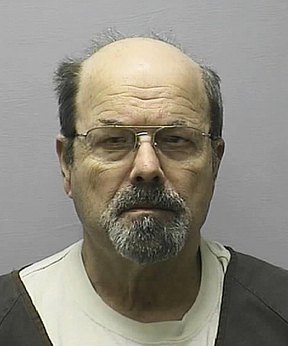
Dennis Rader
American serial killer (born 1945)
Dennis Lynn Rader (born March 9, 1945), better known by his pseudonym BTK (for "bind, torture, kill"), is an American serial killer and mass murderer who murdered at least ten people in Wichita and Park City, Kansas, between 1974 and 1991. Although he occasionally killed or attempted to kill men and children, Rader typically targeted women. His victims were often attacked in their homes and then bound, sometimes with objects from their homes, and either suffocated with a plastic bag or manually strangled with a ligature.
In a series of crimes that terrorized Wichita in the mid-to-late 1970s, Rader also initiated a series of taunting letters sent to police and media outlets, describing his crimes in detail and referring to himself as "BTK". In addition, he stole keepsakes from his female victims, including underwear, driver's licenses and personal items. In 1979, BTK suddenly went quiet, and despite an exhaustive investigation, the case grew into one of the most infamous cold cases in American history. Rader would later confess to killing three further victims between 1985 and 1991 that were not initially linked to BTK but were confirmed to be his doing through DNA and items found in his possession.
In 2004, after a thirteen-year hiatus, Rader resumed sending letters, where he hinted at committing further crimes. Based on items he turned over to law enforcement, he was identified and arrested in February 2005, pleading guilty to his crimes months later and given ten consecutive life sentences. Rader is currently incarcerated at the El Dorado Correctional Facility in Kansas.
Early life
Childhood
Dennis Lynn Rader was born in Pittsburg, Kansas, on March 9, 1945, the oldest of four sons. His parents were Dorothea Mae Rader (née Cook), a bookkeeper; and William Elvin Rader, a former United States Marine and Kansas Gas Service worker. Rader's parents were members of the Zion Lutheran Church in Pittsburg, where Rader was baptized. Both parents worked long hours and paid little attention to their children at home, and in later years Rader said he felt neglected. Rader's father was described as strict and God-fearing, but not abusive.
Growing up in Wichita, Rader had an interest in novels, comic books, fishing, and cub scouting. From a young age, however, he also harbored sadistic sexual fantasies about torturing "trapped and helpless" women. Rader exhibited zoosadism by torturing, killing and hanging small animals. He acted out sexual fetishes for voyeurism, autoerotic asphyxiation, and cross-dressing, often spying on female neighbors while dressed in women's clothing, including women's underwear that he had stolen. He also masturbated with ropes or other bindings around his arms and neck.
As a student at Wichita Heights High School, Rader, who did not play any sports nor partake in any extracurricular activities, was described by fellow students as utterly lacking humor and always "hung back in the background." He spent most of his out-of-school time working as a bag boy and shelf stocker for a local grocery store to earn money for a motor vehicle. After graduating in 1963, Rader attended Kansas Wesleyan University, where he received only mediocre grades and dropped out after one year.
Early adulthood
Rader joined the United States Air Force in June 1966. He completed basic training and technical school in Texas before being stationed at Brookley Air Force Base in Mobile, Alabama, where he worked as an antenna installer and maintenance specialist. After being stationed for assignments in Turkey, Greece, and South Korea, Rader was transferred to Japan in January 1968, where he spent six months stationed at Kadena Air Base in Okinawa followed by twenty-five months stationed at Tachikawa Airfield in Tokyo. He earned a medal for good conduct and a ribbon for marksmanship; he also earned a National Defense Service Medal because his service coincided with the military being under a state of emergency due to the Vietnam War. Rader later credited the Air Force for teaching him about sex.
Rader received an honorable discharge on August 12, 1970, at the rank of staff sergeant. He subsequently served in the Air Force Reserve Command until June 20, 1972, around the time he was hired by the Coleman Company (the outdoor recreational equipment manufacturer). A year after his discharge, Rader purchased a home in Park City, Kansas, a suburb of Wichita. He enrolled at Butler County Community College in El Dorado, earning an associate degree in electronics engineering in 1973. He then attended Wichita State University and graduated in 1979 with a Bachelor of Science degree, majoring in administration of justice.
Rader initially worked in the meat department of an IGA supermarket where his mother was employed as a bookkeeper. From mid-1972 to mid-1973, he worked as an assembler for Coleman, where two of his victims (Julie Otero and Kathryn Bright) also worked. From 1974 to 1988, Rader worked at the local Wichita office of ADT Security Services, where he installed security alarms. Ironically, many of his clients were concerned homeowners seeking security from his own killings as BTK. At ADT, Rader was nicknamed "blue book man" by his coworkers because he always followed rules and scolded others for doing as much as making small talk during work hours.
Marriage
On May 22, 1971, Rader married Paula Dietz, a secretary for the American Legion, in a ceremony held at Christ Lutheran Church. They had two children, Kerri and Brian. On July 26, 2005, after Rader's arrest, Dietz was granted an emergency divorce, waiving the normal sixty-day waiting period. All of the crimes were committed while Rader was married, although neither Dietz nor her children suspected anything was amiss. The family's former Park City residence was demolished in March 2007.
BTK crimes
Otero family murders
On January 15, 1974, Rader murdered four members of the Otero family in Wichita: Joseph Sr. (38), Julia (33), Joseph II (9) and Josephine (11). Their bodies were discovered by the family's three older children, who had been at school at the time of the killings. After his 2005 arrest, Rader claimed that he first targeted the family two months prior, when he spotted Julia leaving to take her children to school, and stalked them for two to three weeks.
On the morning of the murders, Rader parked his car and walked to the Otero residence, scaled a fence and cut the phone lines when in the backyard. It was after this that Joey let the dog out the back door to the backyard, where Rader confronted him and forced his way into the home at gunpoint. Initially, the family thought he was pulling a prank; Rader asserted that it was not a joke and clarified that he had a .22 caliber pistol loaded with hollow-point bullets. Rader told the Otero family that he was wanted in California before ordering them at gunpoint to lie on the living room floor. Then, he led the family into a bedroom and bound them with rope he had prepared ahead of time. Joseph and Joey were laid out on the floor, while Julie and Josie were laid out on the bed.
After being bound, Rader said the family began complaining of problems related to poor blood circulation. Joseph complained of a cracked rib, so Rader put a pillow under him. Rader later stated that it was around this time that he decided to kill them. Rader covered Joseph's head with a plastic bag, which he then secured with ropes. After Joseph chewed a hole in the bag, Rader replaced it, causing him to slowly suffocate. Rader then strangled Julie with a rope. At one point she regained consciousness and pleaded for mercy for her children, prompting Rader to kill her. Rader then placed another plastic bag, followed by two T-shirts and an additional bag, over Joey's head. Rader watched him struggle from a chair set up in the bedroom.
After the rest of the family was murdered, Rader took Josephine down to the basement, where he undressed the girl and tied a noose around a sewage pipe. Rader asked Josephine if her father had a camera so he could take pictures, to which she responded no. When she asked what was going to happen to her, Rader replied: "Well, honey, you're going to be in heaven with the rest of your family." Rader proceeded to hang the girl in the basement and masturbated as he watched her struggle on the rope. Leaving the house, he got in the Otero family car and drove it to the parking lot of a Dillons grocery store. Realizing that he had dropped a knife in the backyard of the Otero home, he drove the car back to the house to retrieve it.
Murder of Kathryn Bright
Rader selected Kathryn Bright (21) as his next victim after he spotted her entering her house with a friend, referring to Bright as "Project Lights Out." He had no knowledge of her younger brother Kevin (19) living at the same house, which might have dissuaded him from targeting her, as he was trying to "stay away from the males as much as possible" to make the killings easier.
Content sourced from Wikipedia under CC BY-SA 4.0


