Daylight saving time
Seasonal change of clock settings
Daylight saving time (DST), also referred to as daylight savings time, daylight time (United States and Canada), or summer time (United Kingdom, European Union, and others), is the practice of advancing clocks to make better use of the longer daylight available during summer so that darkness falls at a later clock time. The typical implementation of DST is to adjust clocks ahead of standard time by one hour in spring or late winter, and to set clocks back by one hour in the autumn (or fall in North American English, hence the mnemonic: "spring forward and fall back").
In many countries, the part of the year when DST is observed is much longer than the part aligned to standard time. The practice of DST was first tested in the early 20th century. Many countries, such as Russia and Mexico, have abandoned DST entirely.
Overview
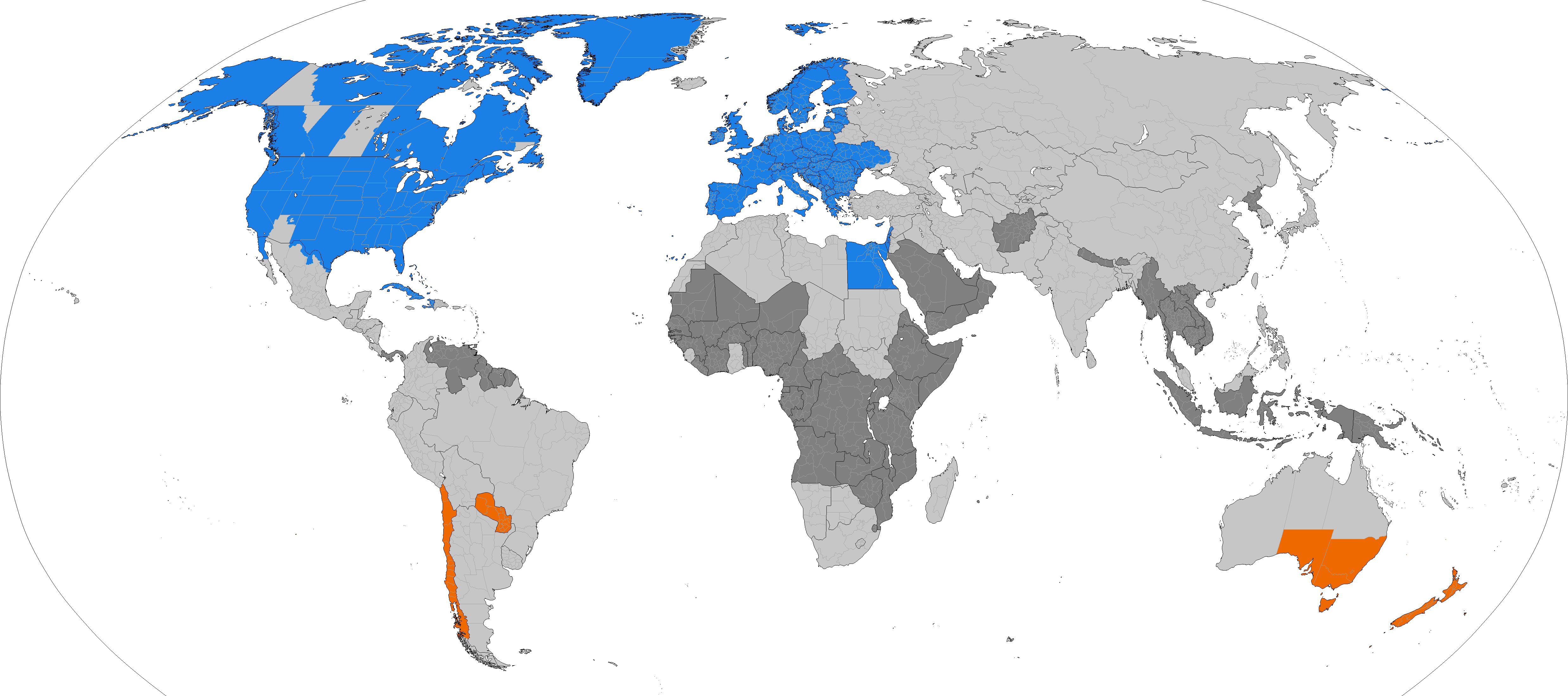
As of 2023, around 34 percent of the world's countries use DST, primarily in Europe and North America, with some countries observing it only in some regions. Canada largely observes DST, with the exceptions of Yukon, most of Saskatchewan, and parts of Nunavut, British Columbia and Quebec. It is observed by four Australian states and one territory. In the United States, it is observed everywhere except the states of Hawaii and Arizona (within the latter, however, the Navajo Nation does observe it) and the territories of the U.S.
Historically, several ancient societies adopted seasonal changes to their timekeeping to make better use of daylight; Roman timekeeping even included changes to water clocks to accommodate this. However, these were changes to the time divisions of the day rather than setting the whole clock forward. In a satirical letter to the editor of the Journal de Paris in 1784, Benjamin Franklin suggested that if Parisians could only wake up earlier in the summer they would economize on candle and oil usage, but he did not propose changing the clocks. In 1895, New Zealand entomologist and astronomer George Hudson made the first realistic proposal to change clocks by two hours every spring to the Wellington Philosophical Society, but this was not implemented until 1928 and in another form. In 1907, William Willett proposed the adoption of British Summer Time as a way to save energy; although seriously considered by Parliament, it was not implemented until 1916.
The first implementation of DST was by Port Arthur (later merged into Thunder Bay), in Ontario, Canada, in 1908, but only locally, not nationally. The first nation-wide implementations were by the German and Austro-Hungarian Empires, both starting on 30 April 1916. Since then, many countries have adopted DST at various times, particularly since the 1970s energy crisis.
Rationale
Industrialized societies usually follow a clock-based schedule for daily activities that do not change throughout the course of the year. The time of day that individuals begin and end work or school, and the coordination of mass transit, for example, usually remain constant year-round. In contrast, an agrarian society's daily routines for work and personal conduct are more likely governed by the length of daylight hours and by solar time, which change seasonally because of the Earth's axial tilt. North and south of the tropics, daylight lasts longer in that hemisphere's summer and is shorter in that hemisphere's winter, with the effect becoming greater the farther one moves away from the equator. DST is of little use for locations near the Equator, because these regions see only a small variation in daylight over the course of the year.
After synchronously resetting the clocks in a region to one hour ahead of standard time in spring in anticipation of longer daylight hours, individuals following a clock-based schedule will be awakened an hour earlier in the solar day than they would have been otherwise. They will begin and complete daily work routines an hour earlier; in most cases, they will have an extra hour of daylight available to them after their workday activities.
The clock shift is partly motivated by practicality. At the summer solstice, in American temperate latitudes, for example, the sun rises around 04:30 standard time and sets around 19:30. Since most people are asleep at 04:30, it is seen as practical to treat 04:30 as if it were 05:30, thereby allowing people to wake closer to the sunrise and be active in the evening light, as the sun under DST sets an hour later (20:30).
Proponents of daylight saving time argue that most people prefer more daylight hours after the typical "nine to five" workday. Supporters have also argued that DST decreases energy consumption by reducing the need for lighting and heating, but the actual effect on overall energy use is heavily disputed. For evaluation, it is required to go beyond considering only energy demand for lighting and also consider the energy used for heating or cooling buildings.
Variation within a time zone
The effect of daylight saving time also varies according to how far east or west the location is within its time zone, with locations farther east inside the time zone benefiting more from DST than locations farther west in the same time zone.
History
Ancient civilizations adjusted daily schedules to the sun more flexibly than DST does, often dividing daylight into 12 hours regardless of daytime, so that each daylight hour became progressively longer during spring and shorter during autumn. For example, the Romans kept time with water clocks that had different scales for different months of the year; at Rome's latitude, the third hour from sunrise (hora tertia) started at 09:02 solar time and lasted 44 minutes at the winter solstice, but at the summer solstice it started at 06:58 and lasted 75 minutes. From the 14th century onward, equal-length civil hours supplanted unequal ones, so civil time no longer varied by season. Unequal hours are still used in a few traditional settings, such as monasteries of Mount Athos and in Jewish ceremonies.
Benjamin Franklin published the proverb "early to bed and early to rise makes a man healthy, wealthy, and wise", and published a letter in the Journal de Paris when he was an American envoy to France (1776–1785) suggesting that Parisians economize on candles by rising earlier to use morning sunlight. This 1784 satire proposed taxing window shutters, rationing candles, and waking the public by ringing church bells and firing cannons at sunrise. Despite common misconception, Franklin did not actually propose DST; 18th-century Europe did not even keep precise schedules. However, this changed as rail transport and communication networks required a standardization of clocks unknown in Franklin's day.
In 1810, the Spanish National Assembly Cortes of Cádiz issued a regulation that moved certain meeting times forward by one hour from 1 May to 30 September in recognition of seasonal changes, but it did not change the clocks. It also acknowledged that private businesses were in the practice of changing their opening hours to suit daylight conditions, but they did so of their volition.
New Zealand entomologist George Hudson first proposed modern DST. His shift-work job gave him spare time to collect insects and led him to value after-hours daylight. In 1895, he presented a paper to the Wellington Philosophical Society proposing a two-hour daylight-saving shift, and considerable interest was expressed in Christchurch; he followed up with an 1898 paper. Many publications credit the DST proposal to prominent English builder and outdoorsman William Willett, who independently conceived DST in 1907 during a pre-breakfast ride when he observed how many Londoners slept through a large part of a summer day. Willett also was an avid golfer who disliked cutting short his round at dusk. His solution was to advance the clock during the summer, and he published the proposal two years later. Liberal Party member of parliament Robert Pearce took up the proposal, introducing the first Daylight Saving Bill to the British House of Commons on 12 February 1908. A select committee was set up to examine the issue, but Pearce's bill did not become law and several other bills failed in the following years. Willett lobbied for the proposal in the UK until his death in 1915.
Port Arthur, Ontario, Canada, was the first city in the world to enact DST, on 1 July 1908. This was followed by Orillia, Ontario, introduced by William Sword Frost while mayor from 1911 to 1912. The first states to adopt DST (German: Sommerzeit) nationally were those of the German Empire and its World War I ally Austria-Hungary commencing on 30 April 1916, as a way to conserve coal during wartime. Britain, most of its allies, and many European neutrals soon followed. Russia and a few other countries waited until the next year, and the United States adopted daylight saving in 1918. Most jurisdictions abandoned DST in the years after the war ended in 1918, with exceptions including Canada, the United Kingdom, France, Ireland, and the United States. It became common during World War II (some countries adopted double summer time), and was standardized in the US by federal law in 1966, and widely adopted in Europe from the 1970s as a result of the 1970s energy crisis. Since then, the world has seen many enactments, adjustments, and repeals.
Content sourced from Wikipedia under CC BY-SA 4.0


