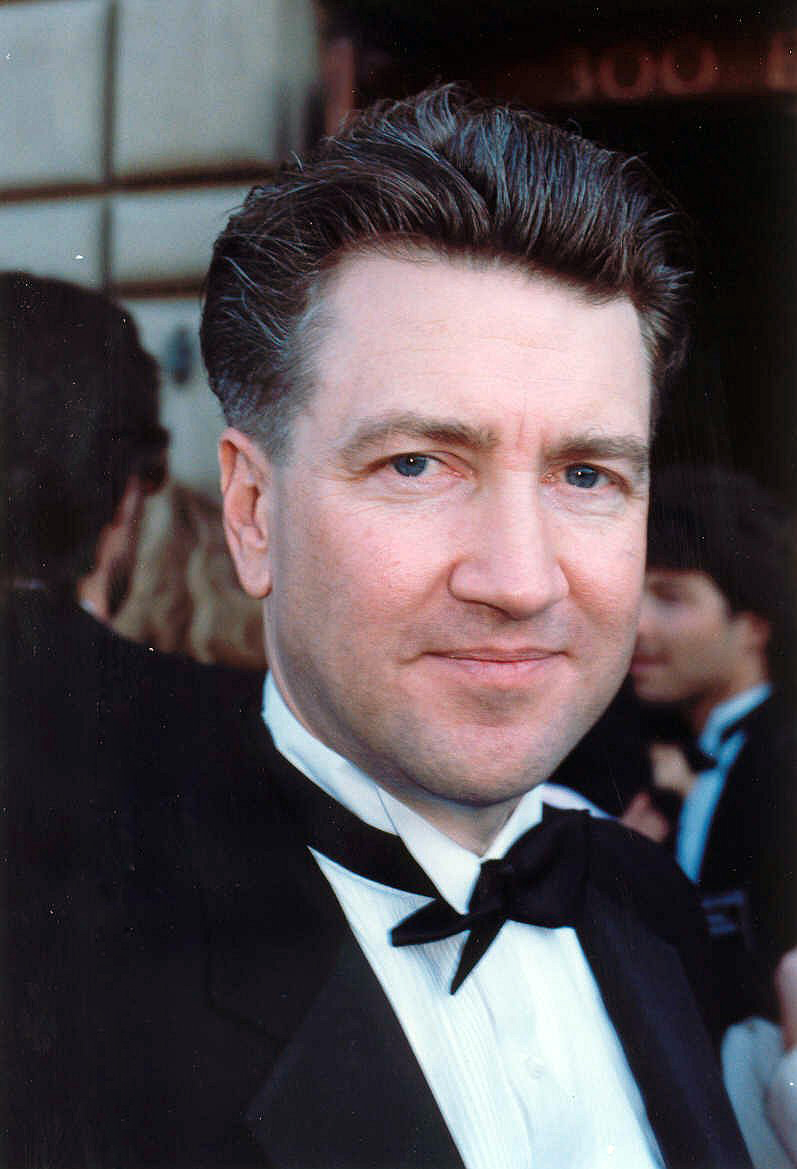
David Lynch
American filmmaker (1946–2025)
David Keith Lynch (January 20, 1946 – January 16, 2025) was an American filmmaker, actor, painter, and musician. He is widely regarded as one of the greatest and most influential filmmakers in the history of cinema, with his films often characterized by a distinctive surrealist sensibility that gave rise to the adjective "Lynchian". In a career spanning more than five decades, he received numerous accolades, including a Golden Lion for Lifetime Achievement at the Venice Film Festival, an Academy Honorary Award, and a (posthumous) Laurel Award for Screenwriting Achievement in addition to nominations for four Academy Awards, four Golden Globe Awards and nine Primetime Emmy Awards.
Initially aspiring to become a painter, Lynch began creating short films out of a desire to effect movement in his paintings. He made his feature film debut with the surrealist body horror film Eraserhead (1977), which took him five years to make due to financial issues and slowly found success as a midnight movie. He garnered critical acclaim for the biographical drama film The Elephant Man (1980) and the neo-noir mystery films Blue Velvet (1986) and Mulholland Drive (2001), all three of which earned him nominations for the Academy Award for Best Director. His romantic crime drama film Wild at Heart (1990) won the Palme d'Or at the Cannes Film Festival. He also directed the neo-noir horror film Lost Highway (1997), the comedy-drama film The Straight Story (1999), and the experimental psychological horror film Inland Empire (2006), his last feature film. He wrote and directed the space opera film Dune (1984) but disowned it after extensive studio interference.
Lynch co-created (with Mark Frost) and directed the ABC surrealist horror-mystery series Twin Peaks (1990–1991; 2017), for which he received nine Primetime Emmy Award nominations. The series is considered a landmark turning point in television and often listed among the greatest television series of all time. He also co-wrote (with Robert Engels) and directed its film prequel Twin Peaks: Fire Walk with Me (1992). He directed music videos for Donovan, Interpol, Chris Isaak, X Japan, Moby, and Nine Inch Nails, and commercials for Dior, Gucci, Yves Saint Laurent, the PlayStation 2, and the New York City Department of Sanitation. His acting roles included Gordon Cole on Twin Peaks, the voice of Gus on the animated sitcom The Cleveland Show (2010–2013), Jack Dahl on the sitcom Louie (2012), Howard in the drama film Lucky (2017), and film director John Ford in Steven Spielberg's drama film The Fabelmans (2022).
Lynch also worked as an animator, author, cartoonist, furniture designer, musician, photographer, and sculptor. A longtime practitioner of Transcendental Meditation, he founded the David Lynch Foundation to fund meditation lessons for at-risk populations. He was a lifelong chain smoker and his emphysema was exacerbated when he was evacuated from his home in Los Angeles due to the January 2025 Southern California wildfires. He died at his daughter Jennifer's home soon thereafter.
Early life and education
David Keith Lynch was born at St. Patrick's Hospital in Missoula, Montana, on January 20, 1946, the son of English-language tutor Edwina "Sunny" Lynch (née Sundholm) and USDA research scientist Donald Walton Lynch. Two of his mother's grandparents were Swedish-speaking Finns who settled in the U.S. in the 19th century. Lynch was also of German descent through his mother, as well as of English, Irish and Scottish descent through his father. He recalled of his father, "He would drive me through the woods in his green Forest Service truck, over dirt roads, through the most beautiful forests where the trees are very tall and shafts of sunlight come down and in the mountain streams the rainbow trout leap out and their little trout sides catch glimpses of light. Then my father would drop me in the woods and go off. It was a weird, comforting feeling being in the woods." He was raised Presbyterian.
The family often moved around according to where the USDA assigned Lynch's father. When Lynch was two months old, they moved to Sandpoint, Idaho, where his brother John was born two years later; they then moved to Spokane, Washington, where his sister Martha was born. The family subsequently lived in Durham, North Carolina; Boise, Idaho; and Alexandria, Virginia. Lynch adjusted to this transitory early life with relative ease, noting that he usually had no difficulty making friends when he attended a new school.
Lynch said of his early life, "I found the world completely and totally fantastic as a child. Of course, I had the usual fears, like going to school ... for me, back then, school was a crime against young people. It destroyed the seeds of liberty. The teachers didn't encourage knowledge or a positive attitude." He joined the Boy Scouts, and despite later saying that he joined only so he "could quit and put it behind me", he rose to the highest rank of Eagle Scout. He befriended Toby Keeler, whose father Bushnell was a painter. Bushnell gave Lynch a copy of Robert Henri's book The Art Spirit (1923), which inspired Lynch to dedicate himself to "the art life".
At Francis C. Hammond High School in Alexandria, Lynch did not excel academically and had little interest in schoolwork, but was popular with other students. After leaving, he decided that he wanted to study painting in college, which he began at the Corcoran School of the Arts and Design in Washington, D.C. In 1964, he transferred to the School of the Museum of Fine Arts in Boston, where his roommate was future musician Peter Wolf. He dropped out after a year, later saying he "was not inspired at all in that place". He then traveled around Europe with his friend Jack Fisk, who was similarly unhappy with his studies; the two hoped to train at the school of Austrian painter Oskar Kokoschka. But upon reaching Salzburg, they found that Kokoschka was not available; having planned to spend three years in Europe, they found themselves disillusioned and returned to the U.S. after just two weeks.
Career
1967–1977: Early career and film debut
Back in the United States, Lynch returned to Virginia. Because his parents had moved to Walnut Creek, California, he stayed with his friend Toby Keeler for a while. He decided to move to Philadelphia and enroll at the Pennsylvania Academy of the Fine Arts, after advice from Fisk, who was already enrolled there. He preferred this college to his previous school in Boston, saying, "In Philadelphia there were great and serious painters, and everybody was inspiring one another and it was a beautiful time there." He recalled that Philadelphia had "a great mood—factories, smoke, railroads, diners, the strangest characters and the darkest night. I saw vivid images—plastic curtains held together with Band-Aids, rags stuffed in broken windows." He was influenced by the Irish painter Francis Bacon. In Philadelphia, Lynch began a relationship with a fellow student, Peggy Reavey, whom he married in 1967. The next year, their daughter Jennifer was born. Peggy later said Lynch "definitely was a reluctant father, but a very loving one. Hey, I was pregnant when we got married. We were both reluctant." As a family, they moved to Philadelphia's Fairmount neighborhood, where they bought a 12-room house for the relatively low price of $3,500 (equivalent to $33,800 in 2025) due to the area's high crime and poverty rates. Lynch later said:
We lived cheap, but the city was full of fear. A kid was shot to death down the street ... We were robbed twice, had windows shot out and a car stolen. The house was first broken into only three days after we moved in ... The feeling was so close to extreme danger, and the fear was so intense. There was violence and hate and filth. But the biggest influence in my whole life was that city.
Meanwhile, to help support his family, Lynch took a job printing engravings. At the Pennsylvania Academy, Lynch made his first short film, Six Men Getting Sick (Six Times) (1967). He had first come up with the idea when he developed a wish to see his paintings move, and he began discussing creating animation with an artist named Bruce Samuelson. When this project never came about, Lynch decided to work on a film alone and purchased the cheapest 16mm camera he could find. Taking one of the academy's abandoned upper rooms as a workspace, he spent $150, which at the time he felt was a lot of money, to produce Six Men Getting Sick. Calling the film "57 seconds of growth and fire, and three seconds of vomit", Lynch played it on a loop at the academy's annual end-of-year exhibit, where it shared joint-first prize with a painting by Noel Mahaffey. This led to a commission from one of his fellow students, the wealthy H. Barton Wasserman, who offered him $1,000 (equivalent to $9,300 in 2025) to create a film installation in his home. Spending $478 of that on the second-hand Bolex camera "of [his] dreams", Lynch produced a new animated short but, upon getting the film developed, realized that the result was a blurred, frameless print. He later said, "So I called up [Wasserman] and said, 'Bart, the film is a disaster. The camera was broken and what I've done hasn't turned out.' And he said, 'Don't worry, David, take the rest of the money and make something else for me. Just give me a print.' End of story."
Content sourced from Wikipedia under CC BY-SA 4.0


