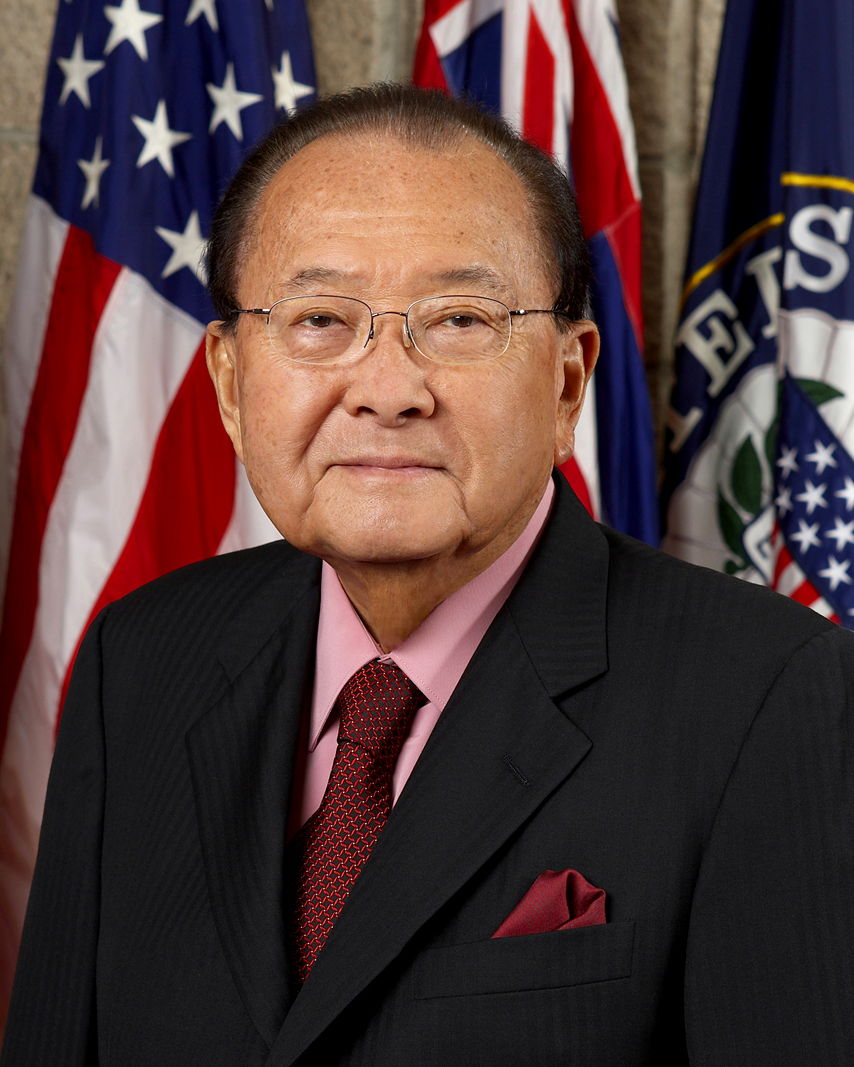
Daniel Inouye
American politician (1924–2012)
Daniel Ken Inouye ( ee-NOH-ay; Japanese: 井上 建; September 7, 1924 – December 17, 2012) was an American attorney, soldier, and statesman from the state of Hawaii. A member of the Democratic Party, he represented Hawaii in the United States Senate from 1963 until his death. Prior to his Senate service, he served in the Hawaii Territorial Legislature and the United States House of Representatives. Inouye is a Medal of Honor recipient for his heroism during World War II, in which he lost his right arm while serving with the 442nd Infantry Regiment.
Inouye earned a J.D. degree from George Washington University Law School in 1952. He was elected to Hawaii's territorial House of Representatives the following year and was elected to the territorial Senate in 1957. When Hawaii achieved statehood in 1959, Inouye was elected as its first member of the U.S. House of Representatives. He was first elected to the U.S. Senate in 1962. Inouye was the second Asian American U.S. senator in history, following Hawaii Republican Hiram Fong. Because of his seniority, Inouye became president pro tempore of the Senate following the death of Robert Byrd on June 28, 2010, making him third in the presidential line of succession after the vice president and the speaker of the House of Representatives. Inouye continued to serve in the U.S. Senate until his death in 2012. He never lost an election in 58 years as an elected official, and he exercised an exceptionally large influence on Hawaii politics.
Inouye was a posthumous recipient of the Presidential Medal of Freedom and the Order of the Paulownia Flowers. Among other public structures named after Inouye, Honolulu International Airport has since been renamed Daniel K. Inouye International Airport in his memory.
Early life (1924–1942)
Daniel Ken Inouye was born in Honolulu, Territory of Hawaii on September 7, 1924. His father, Hyotaro Inouye, was a jeweler who had immigrated to Hawaii from Japan as a child. His mother, Kame (née Imanaga) Inouye, was a homemaker born on Maui to Japanese immigrants. Her parents died young, and she was adopted and raised by a family in Honolulu. Both of Daniel's parents were Christians. They met at the River Street Methodist Church in Honolulu and married in 1923. Inouye was a Nisei (second-generation Japanese-American) through his father and a Sansei (third-generation) through his mother. He was named after his mother's adoptive father.
Inouye grew up in Bingham Tract, a Chinese-American enclave in Honolulu. He was raised Christian, and was the oldest of four children. As a child, Inouye collected homing pigeons, which were hatched from eggs given to him at an army base in Schofield Barracks in return for Inouye cleaning the coops. As a teenager, he worked on the local beaches teaching tourists how to surf. Inouye's parents raised him and his siblings with a mix of American and Japanese customs. His parents spoke English at home, but had their children attend a private Japanese language school in addition to public school. Inouye dropped out of the Japanese school in 1939 because he disagreed with his instructor's anti-American rhetoric, and focused on his studies at President William McKinley High School. Inouye intended to go to college and medical school after his planned 1942 graduation.
Inouye witnessed the attack on Pearl Harbor on December 7, 1941, while still a high school senior. The Japanese surprise attack brought the United States into World War II. Being a volunteer first aid instructor with the Red Cross, he was called on by his supervisor to report to a Red Cross station set up at Lunalilo Elementary School. There, Inouye tended to civilians injured by antiaircraft shells that had fallen into the city. After the United States declared war on Japan the next day, Inouye took up a paid job from his Red Cross supervisor to work there as a medical aide. For the rest of his senior year, Inouye attended school during the day and worked at the Red Cross station at night. He graduated from McKinley High School in 1942.
Although Inouye wanted to join the Armed Forces when he completed high school, Japanese-Americans were excluded from doing so at that time. Beginning in February 1942, the United States Department of War had declared all Japanese-Americans as "enemy aliens", which meant they could not volunteer or be drafted for military service (an exception was made for the previously established 298th and 299th Infantry Regiments, which became the 100th Infantry Battalion in 1942). Inouye enrolled at the University of Hawaiʻi at Mānoa in September 1942 as a premedical student with the goal of becoming a surgeon.
Army service (1943–1947)
In March 1943, U.S. President Franklin D. Roosevelt established the 442nd Regimental Combat Team, an all-Nisei combat unit. Inouye applied and was initially turned down because his work at the Red Cross was deemed critical, but was inducted later that month. The unit was composed of over 2,500 Nisei from Hawaii, and 800 from the mainland. Inouye went with his unit in April to Camp Shelby in Mississippi for a 10-month training period, postponing his medical studies. While in Mississippi, the unit visited the Rohwer War Relocation Center in Arkansas, where Inouye witnessed the internment of Japanese Americans first hand.
The 442nd shipped off to Italy in May 1944 after the conclusion of their training, shortly before the liberation of Rome. Inouye was promoted to sergeant within the first three months of fighting in the Italian countryside north of Rome. The 442nd was then sent to eastern France, where they seized the towns of Bruyères, Belmont, and Biffontaine from the Germans. In late October, the regiment was transferred to the Vosges Mountains region of France, where they rescued 211 members of the 1st Battalion of the 141st Infantry Regiment, otherwise known as the "Lost Battalion". Inouye received a battlefield commission to second lieutenant for his actions there, becoming the youngest officer in his regiment. During the battle, a shot struck him in the chest directly above his heart, but the bullet was stopped by the two silver dollars he happened to have stacked in his shirt pocket. He continued to carry the coins throughout the war in his shirt pocket as good luck charms, but lost them later, shortly before the battle in which he lost his arm. The 442nd spent the next several months near Nice, guarding the French-Italian border until early 1945, when they were called to Northern Italy to assist with an assault on German strongholds in the Apennine Mountains.
World War II wounds and heroism
On April 21, 1945, Inouye was grievously wounded while leading an assault on the heavily defended Colle Musatello ridge near San Terenzo Monti, Tuscany, Italy. The ridge served as a strongpoint of the German fortifications known as the Gothic Line, the last and most unyielding line of German defensive works in Italy. During a flanking maneuver against German machine gun nests, Inouye was shot in the stomach from 40 yards away. Ignoring his wound, Inouye proceeded with the attack and together with the unit, destroyed the first two machine gun nests. As his squad distracted the third machine gunner, the injured Inouye crawled toward the final bunker and came within 10 yards. As he prepared to toss a grenade within, a German soldier fired out a 30 mm Schiessbecher antipersonnel rifle grenade at Inouye, striking Inouye in the right elbow. Although it failed to detonate, the blunt force of the grenade amputated most of his right arm at the elbow. The nature of the injury caused Inouye's arm muscles to involuntarily squeeze the grenade tightly via a reflex arc, preventing his arm from going limp and dropping a live grenade at his feet. This injury left Inouye disabled, in terrible pain, under fire with minimal cover and staring at a live grenade "clenched in a fist that suddenly didn't belong to me anymore."
Inouye's platoon moved to his aid, but Inouye shouted for them to keep back out of fear his severed fist would involuntarily relax and drop his own grenade. As the German inside the bunker began reloading his rifle with regular full metal jacket ammunition to finish off Inouye, Inouye pried the live hand grenade from his useless right hand with his left, and tossed it into the bunker, killing the German. Stumbling to his feet, Inouye continued forward, killing at least one more German before sustaining his fifth and final wound of the day in his left leg. Inouye fell unconscious, and awoke to see the worried men of his platoon hovering over him. His only comment before being carried away was to gruffly order them back to their positions, saying "Nobody called off the war!" By the end of the day, the ridge had fallen to American control, without the loss of any soldiers in Inouye's platoon. The remainder of Inouye's mutilated right arm was later amputated at a field hospital without proper anesthesia, as he had been given too much morphine at an aid station and it was feared any more would lower his blood pressure enough to kill him. The war in Europe ended on May 8, less than three weeks later.
Content sourced from Wikipedia under CC BY-SA 4.0


