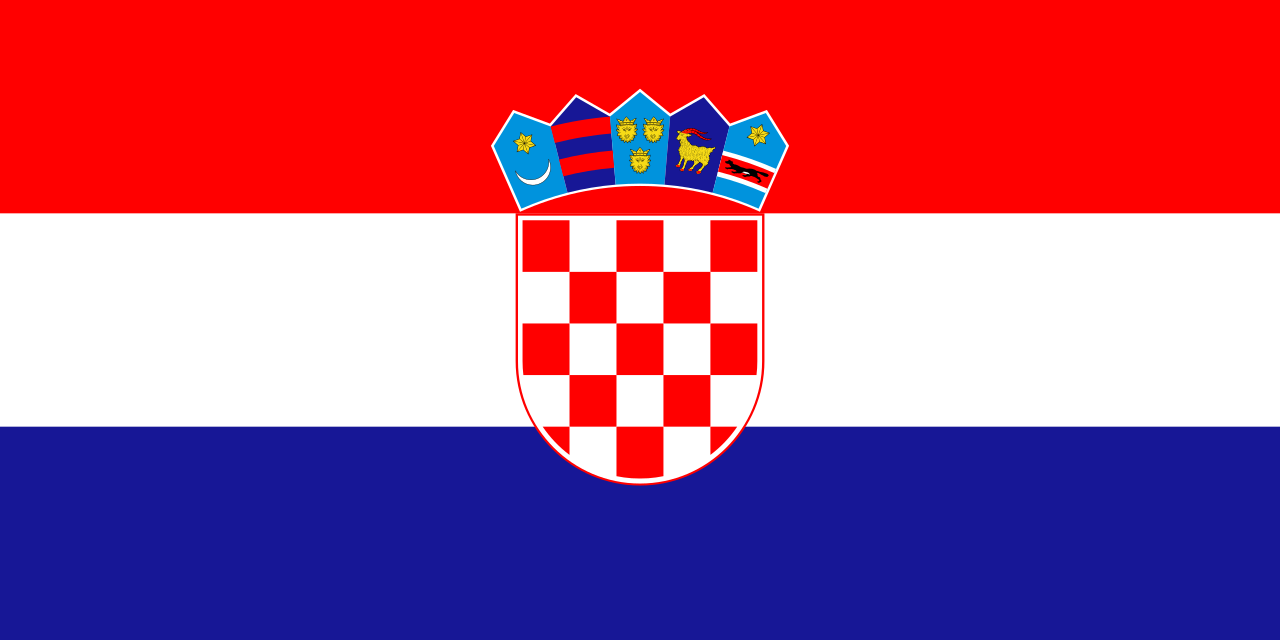
Croatia
Country in Central and Southeast Europe
Croatia, officially the Republic of Croatia, is a country in Central and Southeast Europe, on the coast of the Adriatic Sea. It borders Slovenia to the northwest, Hungary to the northeast, Serbia to the east, Bosnia and Herzegovina and Montenegro to the southeast, and shares a maritime border with Italy to the west. Its capital and largest city, Zagreb, forms one of the country's primary subdivisions, with twenty counties. Other major urban centers include Split, Rijeka and Osijek. The country spans 56,594 square kilometres (21,851 square miles), and has a population of nearly 3.9 million.
The Croats arrived in modern-day Croatia, then part of Roman Illyria, in the late 6th century. In the 7th century, they organized the territory into two duchies. Croatia was first internationally recognized as independent on 7 June 879 during the reign of Duke Branimir. Tomislav became the first king by 925, elevating Croatia to the status of a kingdom. During the succession crisis after the Trpimirović dynasty ended, Croatia entered a personal union with Hungary in 1102. In 1527, faced with Ottoman conquest, the Croatian Parliament elected Ferdinand I of Austria to the Croatian throne. In October 1918, the State of Slovenes, Croats, and Serbs, independent from the Habsburg Empire, was proclaimed in Zagreb, and in December 1918, it merged into the Kingdom of Yugoslavia. Following the Axis invasion of Yugoslavia in April 1941, most of Croatia was incorporated into a Nazi-installed puppet state, the Independent State of Croatia. A resistance movement led to the creation of the Socialist Republic of Croatia, which after the war became a founding member and constituent of the Socialist Federal Republic of Yugoslavia. On 25 June 1991, Croatia declared its independence from Yugoslavia, and the War of Independence was successfully fought over the next four years.
Croatia is a republic and a parliamentary democracy. It is a member of the European Union, the Eurozone, the Schengen Area, NATO, the United Nations, the Council of Europe, the OSCE, the World Trade Organization, a founding member of the Union for the Mediterranean, and is currently in the process of joining the OECD. An active participant in United Nations peacekeeping, Croatia contributed troops to the International Security Assistance Force and was elected to fill a non-permanent seat on the United Nations Security Council in the 2008–2009 term for the first time.
Croatia is a developed country with an advanced high-income economy. Service, industrial sectors, and agriculture dominate the economy. Tourism is a significant source of revenue for the country, with nearly 20 million tourist arrivals as of 2019. Since the 2000s, the Croatian government has heavily invested in infrastructure, especially transport routes and facilities along the Pan-European corridors. Croatia has also positioned itself as a regional energy leader in the early 2020s and is contributing to the diversification of Europe's energy supply via its floating liquefied natural gas import terminal off Krk island, LNG Hrvatska. Croatia provides social security, universal health care, and tuition fee-free primary and secondary education while supporting culture through public institutions and corporate investments in media and publishing.
Etymology
Croatia's non-native name derives from Medieval Latin Croātia, itself a derivation of North-West Slavic *Xərwate, by liquid metathesis from Common Slavic period *Xorvat, from proposed Proto-Slavic *Xъrvátъ which possibly comes from the 3rd-century Scytho-Sarmatian form attested in the Tanais Tablets as Χοροάθος (Khoroáthos, alternate forms comprise Khoróatos and Khoroúathos). The origin of the ethnonym is uncertain, but most probably is from Proto-Ossetian / Alanian *xurvæt- or *xurvāt-, in the meaning of "one who guards" ("guardian, protector").
The oldest preserved record of the Croatian ethnonym's native variation *xъrvatъ is of the variable stem, attested in the Baška tablet in style zvъnъmirъ kralъ xrъvatъskъ ("Zvonimir, Croatian king"), while the Latin variation Croatorum is archaeologically confirmed on a church inscription found in Bijaći near Trogir dated to the end of the 8th or early 9th century. The presumably oldest stone inscription with fully preserved ethnonym is the 9th-century Branimir inscription found near Benkovac, where Duke Branimir is styled Dux Cruatorvm, likely dated between 879 and 892, during his rule. The Latin term Chroatorum is attributed to a charter of Duke Trpimir I of Croatia, dated to 852 in a 1568 copy of a lost original, but it is not certain if the original was indeed older than the Branimir inscription.
History
Prehistory and antiquity
The area known as Croatia today was inhabited throughout the prehistoric period. Neanderthal fossils dating to the middle Palaeolithic period were unearthed in northern Croatia, best presented at the Krapina site. Remnants of Neolithic and Chalcolithic cultures were found in all regions. The largest proportion of sites is in the valleys of northern Croatia. The most significant are Baden, Starčevo, and Vučedol cultures. Iron Age hosted the early Illyrian Hallstatt culture and the Celtic La Tène culture.
The region of modern-day Croatia was settled by Illyrians and Liburnians, while the first Greek colonies were established on the islands of Hvar, Korčula, and Vis. In 9 AD, the territory of today's Croatia became part of the Roman Empire. Emperor Diocletian was native to the region. He had a large palace built in Split, to which he retired after abdicating in AD 305.
During the 5th century, the last de jure Western Roman Emperor Julius Nepos ruled a small realm from the palace after fleeing Italy in 475.
Middle Ages
The Roman period ends with Avar and Croat invasions in the late 6th and first half of the 7th century and the destruction of almost all Roman towns. Roman survivors retreated to more favourable sites on the coast, islands, and mountains. The city of Dubrovnik was founded by such survivors from Epidaurum.
There's some uncertainty about the ethnogenesis of Croats. The most accepted theory, the Slavic theory, proposes migration of White Croats from White Croatia during the Migration Period. Conversely, the Iranian theory proposes Sarmatian-Alanic origin of Proto-Croats, based on Tanais Tablets containing Ancient Greek inscriptions of given names Χορούαθος, Χοροάθος, and Χορόαθος (Khoroúathos, Khoroáthos, and Khoróathos) and their interpretation as anthroponyms related to the Croatian ethnonym.
According to the work De Administrando Imperio written by 10th-century Byzantine Emperor Constantine VII, Croats settled in the Roman province of Dalmatia in the first half of the 7th century after they defeated the Avars. Although there exist some scholarly disputes about the account's reliability and interpretation, recent archaeological data has established that the migration and settlement of the Slavs/Croats was in the late 6th and early 7th century. Eventually, a dukedom was formed, Duchy of Croatia, ruled by Borna, as attested by chronicles of Einhard starting in 818. The record represents the first document of Croatian realms, vassal states of Francia at the time. Its neighbor to the North was Principality of Lower Pannonia, at the time ruled by duke Ljudevit who ruled the territories between the Drava and Sava rivers, centred from his fort at Sisak. This population and territory throughout history was tightly related and connected to Croats and Croatia.
Christianisation of Croats began in the 7th century at the time of archon Porga of Croatia, initially probably encompassed only the elite and related people, but mostly finished by the 9th century. The Frankish overlordship ended during the reign of Mislav, or his successor Trpimir I. The native Croatian royal dynasty was founded by duke Trpimir I in the mid 9th century, who defeated the Byzantine and Bulgarian forces.
The first native Croatian ruler recognised by the Pope was duke Branimir, who received papal recognition from Pope John VIII on 7 June 879. Tomislav was the first king of Croatia, noted as such in a letter of Pope John X in 925. Tomislav defeated Hungarian and Bulgarian invasions. The medieval Croatian kingdom reached its peak in the 11th century during the reigns of Petar Krešimir IV (1058–1074) and Dmitar Zvonimir (1075–1089). When Stjepan II died in 1091, ending the Trpimirović dynasty, Dmitar Zvonimir's brother-in-law Ladislaus I of Hungary claimed the Croatian crown. This led to a war and personal union with Hungary in 1102 under Coloman.
Content sourced from Wikipedia under CC BY-SA 4.0


