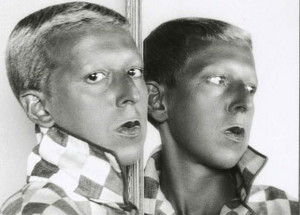
Claude Cahun
French artist (1894–1954)
Claude Cahun (French pronunciation: [klod ka.œ̃], born Lucy Renée Mathilde Schwob; 25 October 1894 – 8 December 1954) was a French surrealist photographer, sculptor, and writer.
Schwob adopted the pseudonym Claude Cahun in 1914. From 1920 onwards she began to appear publicly under this name. Her photographic work is characterised by self‑stagings, light reflections and shadows. The artist saw herself as a master of transformation and used photography to record her metamorphoses. Cahun is best known as a writer and self-portraitist, who assumed a variety of performative personae.
In her writing, Cahun mostly referred to herself with grammatically feminine words, but she also said that her actual gender was fluid. For example, in what is generally considered to be her masterpiece, 'Aveux non Avenus' (1930), available in English as Cancelled Confessions or Disavowals, Cahun writes: "Masculine? Feminine? It depends on the situation. Neuter is the only gender that always suits me." Cahun is most well known for her androgynous appearance, which challenged the strict gender roles of her time.
During World War II, Cahun and lifelong partner Marcel Moore launched a two-person resistance campaign against the Nazis who had occupied Jersey. For this they would be sentenced to death (saved at the last minute by the Armistice). They were also active in the leftist group Contre Attaque, a union of communist writers, artists and workers, alongside André Breton.
Early life
Cahun was born in Nantes in 1894, into a well-off literary family. Her mother, Mary-Antoinette Courbebaisse, was Catholic, her father, Maurice Schwob was Jewish. Cahun would later embrace her Jewish identity, adopting her paternal grandmother, Mathilde Cahun's surname. Avant-garde writer Marcel Schwob was her uncle and Orientalist David Léon Cahun was her great-uncle. When Cahun was four years old, her mother, Mary-Antoinette Courbebaisse, began suffering from mental illness, which ultimately led to her mother's permanent internment at a psychiatric facility. In her mother's absence, Cahun was brought up by her grandmother, Mathilde.
Cahun attended a private school (Parsons Mead School) in Surrey after experiences with antisemitism at high school in Nantes. She attended the University of Paris, Sorbonne. She began making photographic self-portraits as early as 1912 (aged 18), and continued taking images of herself throughout the 1930s.
Around 1914, she changed her name to Claude Cahun, after having previously used the names Claude Courlis (after the curlew) and Daniel Douglas (after Lord Alfred Douglas). During the early 1920s, she settled in Paris with lifelong partner Suzanne Malherbe, who adopted the pseudonym Marcel Moore. The two became step-sisters in 1917 after Cahun's divorced father and Moore's widowed mother married, eight years after Cahun and Moore's artistic and romantic partnership began. For the rest of their lives together, Cahun and Moore collaborated on various written works, sculptures, photomontages and collages. The two published articles and novels, notably in the periodical Mercure de France, and befriended Henri Michaux, Pierre Morhange, and Robert Desnos.
Around 1922 Cahun and Moore began holding artists' salons at their home. Among the regulars who would attend were artists Henri Michaux and André Breton and literary entrepreneurs Sylvia Beach and Adrienne Monnier.
Work
Cahun's works encompassed writing, photography, sculpture and theatre, much of it in collaboration with Marcel Moore.
In the 1980s Cahun and Moore's highly staged 'self-portraits' (of Cahun) and tableaux that incorporated the visual aesthetics of Surrealism began to be discovered by a new audience.
Interest in her writing would be slower; her masterpiece 'Aveux non avenus' (first published in 1930 by Carrefour) was not republished in French until 1992 and would not be translated into English (as 'Disavowals') until 2008 for Tate Publishing. Susan de Muth revised her translation as Confessions or Disavowals in 2024 for a new publication with Thin Man Press.
During the 1920s, Cahun produced an astonishing number of self-portraits in various guises such as aviator, dandy, doll, body builder, vamp and vampire, angel, and Japanese puppet.
Cahun gave a unique perspective within surrealism, using mirrors, collages and doubling in her photos to reflect the diversion from social norms.
Some of Cahun's portraits feature the artist looking directly at the viewer, head shaven, often revealing only head and shoulders (eliminating body from the view), and a blurring of gender indicators and behaviors which serve to undermine the male gaze. Scholar Miranda Welby-Everard has written about the importance of theatre, performance, and costume that underlies Cahun's work, suggesting how this may have informed the artist's varying gender presentations.
Cahun's published writings include "Heroines", (1925) a series of monologues based upon famous female characters from fairy tales, mythology and the Bible which draw witty comparisons with the contemporary image of women; Aveux non avenus, (Carrefour, 1930), widely considered to be Cahun's masterpiece is a highly original collection of written fragments, including stories, dreams, adventures, jokes, dramatic dialogues and apparent agonies of soul-searching which she delights in finally undermining with an ironic aside ('I am so good at lying!'). The book is illustrated by ten photomontages made in collaboration with Marcel Moore. Cahun also wrote many articles and essays for magazines and journals.
In 1932, Cahun joined the Association des Écrivains et Artistes Révolutionnaires, where she met André Breton and René Crevel. Following this, Cahun began associating with the surrealist group and later participated in a number of surrealist exhibitions, including the London International Surrealist Exhibition (New Burlington Gallery) and Exposition surréaliste d'Objets (Charles Ratton Gallery, Paris), both in 1936. Cahun's photograph from the London exhibition of Sheila Legge standing in the middle of Trafalgar Square, her head obscured by a flower arrangement and pigeons perching on her outstretched arms, appeared in numerous newspapers and was later reproduced in a number of books. In 1934, Cahun published a short polemic essay, Les Paris sont Ouverts, and in 1935 took part in the founding of the left-wing anti-fascist alliance Contre Attaque, alongside André Breton and Georges Bataille. Breton called Cahun "one of the most curious spirits of our time."
In 1994, the Institute of Contemporary Arts in London held an exhibition of Cahun's photographic self-portraits from 1927 to 1947, alongside the work of two young contemporary British artists, Virginia Nimarkoh and Tacita Dean, entitled Mise en Scene. In the surrealist self-portraits, Cahun represented herself as an androgyne, nymph, model, and soldier.
In 2007, David Bowie created a multi-media exhibition of Cahun's work in the gardens of the General Theological Seminary in New York. It was part of a venue called the Highline Festival, which also included offerings by Air, Laurie Anderson, and Mike Garson. Bowie said of Cahun:
You could call her transgressive or you could call her a cross-dressing Man Ray with surrealist tendencies. I find this work really quite mad, in the nicest way. Outside of France and now the UK she has not had the kind of recognition that, as a founding follower, friend and worker of the original Surrealist movement, she surely deserves.
Collaboration with Marcel Moore
Cahun's work was often a collaboration with Marcel Moore (the pseudonym of Suzanne Malherbe). It is believed that they were lovers with Moore being an integral part of Cahun's creative and playful process, though this often goes unrecognized. It is believed that Moore was often the person standing behind the camera during Cahun's portrait shoots and was an equal partner in Cahun's collages.
With the majority of the photographs attributed to Cahun coming from a personal collection, not one meant for public display, it has been proposed that these personal photographs allowed for Cahun to experiment with gender presentation and the role of the viewer to a greater degree.
World War II activism
In 1937 Cahun and Moore settled in Jersey. Following the fall of France and the German occupation of Jersey and the other Channel Islands, they became active as resistance workers and propagandists. Fervently against war, the two worked extensively in producing anti-German flyers. Many were snippets from English-to-German translations of BBC reports on the Nazis' crimes and insolence, which were pasted together to create rhythmic poems and harsh criticism. They created many of these messages under the German pseudonym Der Soldat Ohne Namen, or The Soldier With No Name, to deceive German soldiers that there was a conspiracy among the occupation troops. The couple then dressed up and attended many German military events in Jersey, strategically placing their pamphlets in soldier's pockets, on their chairs, and in cigarette boxes for soldiers to find. Additionally, they inconspicuously crumpled up and threw their fliers into cars and windows.
Content sourced from Wikipedia under CC BY-SA 4.0


