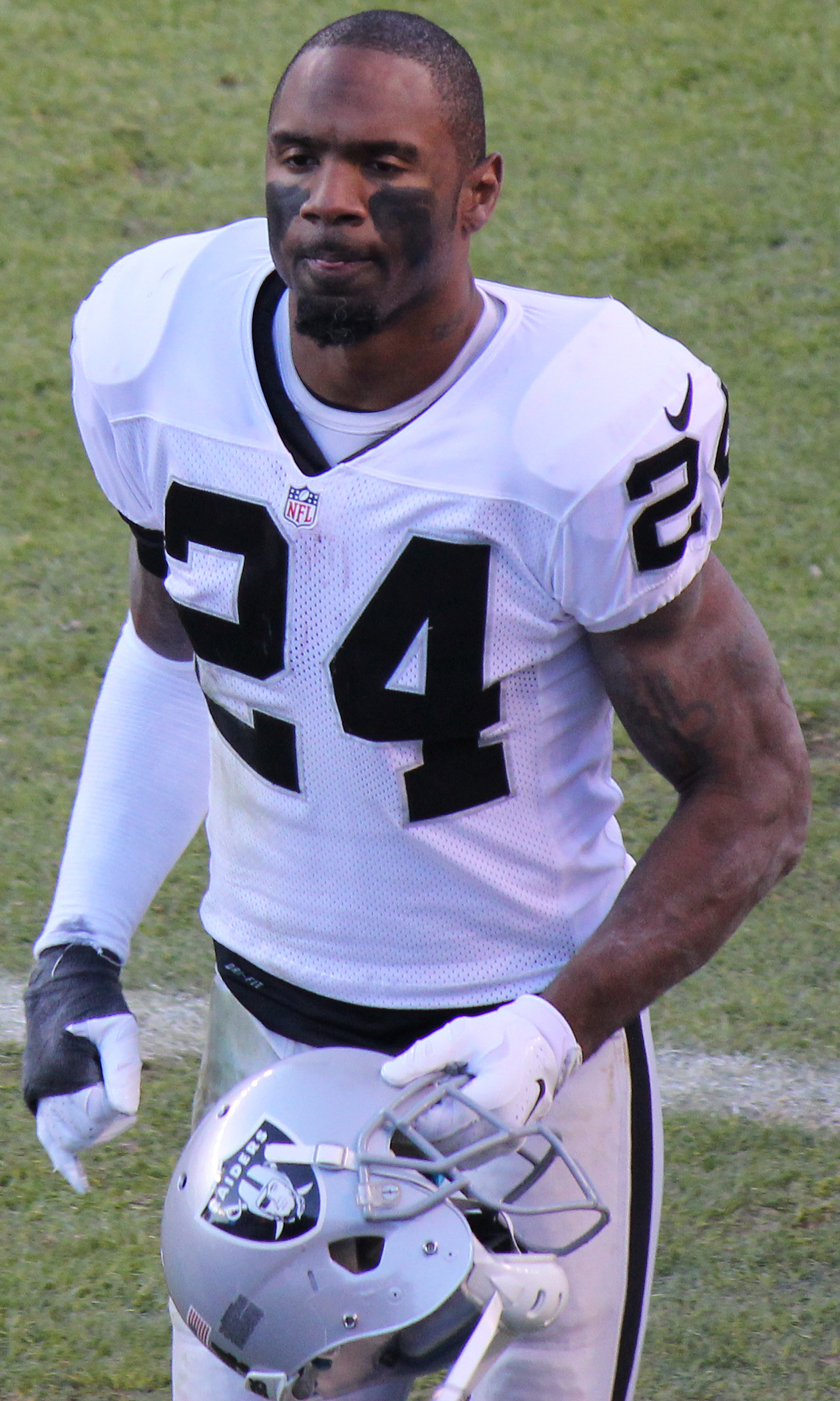
Charles Woodson
American football player (born 1976)
Charles Cameron Woodson (born October 7, 1976) is an American former professional football player in the National Football League (NFL) for 18 seasons with the Oakland Raiders and Green Bay Packers. He spent his first 14 seasons as a cornerback and his final four as a safety. Woodson played college football for the Michigan Wolverines, twice earning All-American honors. As a junior in 1997, he was a national champion and the only defensive player in college football history to win the Heisman Trophy.
Selected fourth overall by the Raiders in the 1998 NFL draft, Woodson received Pro Bowl selections during his first four seasons and two first-team All-Pro honors. Woodson left the Raiders after eight seasons to join the Packers, where he played his next seven seasons. During his Packers tenure, Woodson was named Defensive Player of the Year in 2009 and won Super Bowl XLV, while extending his Pro Bowl selections to eight and his first-team All-Pro honors to four. He returned to the Raiders for his last three seasons, earning his ninth Pro Bowl selection in his final season.
One of the NFL's most decorated players, Woodson is tied with Rod Woodson (no relation) and Darren Sharper for the most defensive touchdowns, second in interceptions returned for touchdowns, and tied with Ken Riley for the fifth-most interceptions. He is also one of the few players to appear in a Pro Bowl during three different decades. Woodson was inducted to the College Football Hall of Fame in 2018 and the Pro Football Hall of Fame in 2021. He became a limited partner of the Cleveland Browns in 2025.
Early life
Woodson was born in Fremont, Ohio. As a senior at Ross High School, Woodson was named Ohio's "Mr. Football". He finished his high school football career with the school's records for rushing yards (3,861) and scoring (466 points). In his senior season, he was a USA Today All-America selection and Parade High School All-American and recorded 2,028 yards and 230 points. All colleges recruited Woodson as a running back, while Michigan recruited him as a cornerback. In addition to playing football, Woodson also played basketball (point guard) and competed in track and field (relay sprinter and long jumper).
College career
Woodson attended the University of Michigan, where he played for coach Lloyd Carr's Wolverines teams from 1995 to 1997. He became the starter after the second game of his freshman season and played in 34 straight games. In addition to playing cornerback, he returned punts and occasionally played as a wide receiver.
Freshman season
In 1995, Woodson was selected as the Big Ten Freshman of the Year, as well as being named to the All-Big Ten First-team by conference coaches, and the second-team by the media. He led the team with five interceptions and eight takeaways.
Sophomore season
In 1996, Woodson set a Wolverine record for pass breakups in a season, with 15. For his efforts, he was named the Chevrolet Defensive Player of the Year and an AP First-team All-American. He was also a finalist for the Jim Thorpe Award and named to the All-Big Ten First-team by both the conference coaches and the media.
Junior season
In 1997, Woodson became the third Michigan player in program history to win the Heisman Trophy, joining Tom Harmon (1940) and Desmond Howard (1991). Woodson received 282 more voting points than runner-up Peyton Manning of Tennessee. He was the first primarily defensive player to win the prestigious award, with the only other defensive winner being two-way player Travis Hunter in 2024. Woodson led the Michigan Wolverines to an undefeated season and a share of the national championship in the same year. He also won the Bronko Nagurski Trophy, as the best defensive college player, as well as winning the Chevrolet Defensive Player of the Year award for a second consecutive season. Woodson was named to the All-Big Ten first-team for a third consecutive season, and was recognized as a unanimous first-team All-American. He also won the Big Ten Defensive Player of the Year, Big Ten Most Valuable Player and the Big Ten Male Athlete of the Year, amongst others.
Woodson finished his three-year collegiate career with 18 interceptions, currently second all-time in University of Michigan football history. Throughout college, Woodson was known for big plays, in big moments of games. As a freshman, he had two interceptions in a victory against the No. 2 ranked Ohio State Buckeyes. During his Heisman-winning junior year, he made an acrobatic one-handed sideline interception against the Michigan State Spartans. Woodson had two interceptions in the game. In a game against Ohio State, he returned a punt for a touchdown, made an interception in the endzone, and had a 37-yard reception on Michigan's only offensive touchdown scoring drive of the game. Woodson later stated that he tried to do Desmond Howard's famous "pose" after scoring the touchdown, but failed after his teammates mobbed him in the end zone. The win over the Buckeyes lifted Michigan to the Rose Bowl. Michigan played the Washington State Cougars in the Rose Bowl, where Woodson recorded another endzone interception, helping Michigan defeat the Cougars and win a share of the 1997 national championship.
Professional career
Oakland Raiders
Early NFL career
Woodson declared his eligibility for the NFL draft following his junior season at Michigan and was selected as the fourth overall pick in the 1998 draft by the Oakland Raiders.
After the 1998 season, Woodson was named the NFL Defensive Rookie of the Year by the Associated Press. He started all sixteen games, becoming the first rookie Raider since 1971 to do so. Woodson had 64 tackles that season. He was also third in the league in interceptions (with five), returned one interception for a touchdown against the Arizona Cardinals, and produced one forced fumble. Woodson was named to his first Pro Bowl.
In 1999, Woodson had his first career reception, a 19-yard catch, against the San Diego Chargers on November 14. On November 28, against the Kansas City Chiefs, he had a 15-yard interception return for a touchdown in the 37–34 loss. He finished the season with 61 total tackles and a fumble recovery to go along with the pick-six. Woodson was selected to his second Pro Bowl and was named All-Pro by the Associated Press.
In the 2000 season, Woodson started all sixteen games of the season but suffered a turf toe injury, which prevented him from practicing. He finished the year with a career-high 79 tackles, intercepted four passes, forced three fumbles, and recovered one fumble. He earned a third consecutive Pro Bowl nomination. He was named to the All-Pro team by Sports Illustrated, and second-team honors from the Associated Press.
In 2001, his fourth year in the NFL, Woodson started sixteen games. This was the fourth consecutive year Woodson played in every game of the season. Woodson finished with two sacks, one interception, one forced fumble, and one blocked field goal. Woodson returned punts for the first time in the NFL, returning four punts for 47 yards. On January 19, 2002, he participated in the Tuck Rule play against the New England Patriots in the postseason. He was named to his fourth consecutive Pro Bowl. He made All-Pro teams of The Sporting News and College and Pro Football Newsweekly and the All-AFC squad of Football News.
First Super Bowl appearance
In 2002, Woodson suffered his first major injury since his freshman year at Michigan, suffering from a shoulder injury which caused him to be inactive for eight games. The shoulder injury came in the first half of the second game of the season. Despite the injury Woodson played the remainder of the game and was able to force a fumble. After recovering from his shoulder injury, Woodson missed the last three games of the regular season, suffering from a cracked fibula bone in his right leg. Woodson started every Raider game in the 2003 NFL Playoffs, finishing with a start in Super Bowl XXXVII. In the Super Bowl, Woodson showed signs of his injury, but still recorded an interception in a losing effort against the Tampa Bay Buccaneers.
After losing the Super Bowl in the year prior, the Raiders finished the 2003 season with a dismal 4–12 record. Woodson became unhappy with new head coach Bill Callahan, and criticized him during the season. Woodson remained healthy for the entire season, starting in his first fifteen games. His contract was set to expire after the season. Woodson reached an agreement with Oakland and was labeled as a franchise player. The franchise tag set Woodson's contract with a minimum of the average salary for the top five cornerbacks in the NFL. Although being labeled as a franchise player, Woodson's contract was only for one year.
In the 2004 season, Woodson played the first 13 games of the season before suffering a leg injury which put him inactive in the last three weeks. He finished the season with 73 total tackles, 2.5 sacks, one interception, nine passes defensed, two forced fumbles, and one fumble recovery. After the season, Woodson again agreed to a one-year franchise tag deal.
In 2005, he started the first six games but broke his leg in the sixth week, which sidelined him for the rest of the year. He finished the season with 30 total tackles, one interception, four passes defensed, and one forced fumble.
Content sourced from Wikipedia under CC BY-SA 4.0


