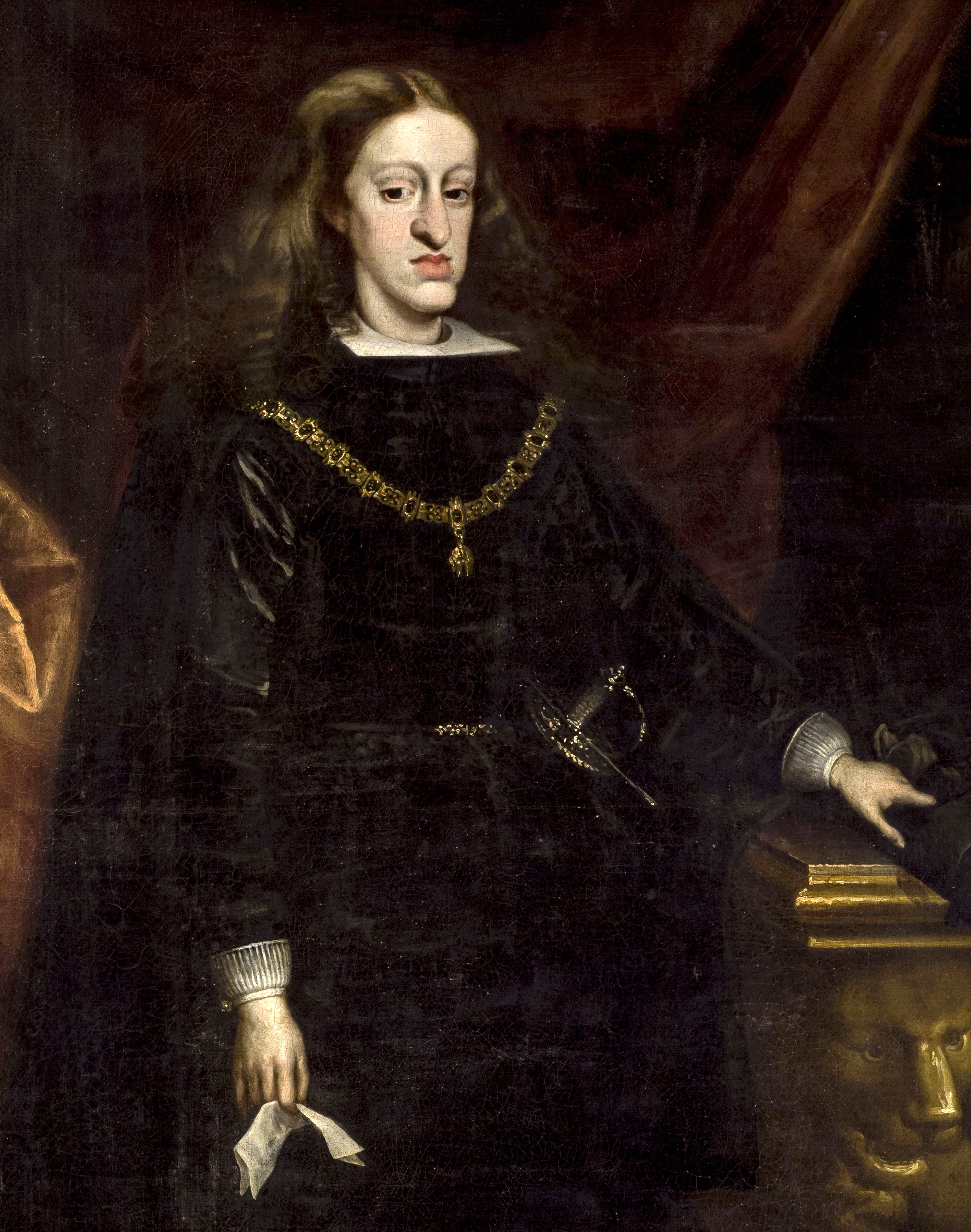
Charles II of Spain
King of Spain from 1665 to 1700
Charles II (6 November 1661 – 1 November 1700) was the king of Spain from 1665 to 1700. The last monarch from the House of Habsburg that had ruled Spain since 1516, his death without children resulted in the 1701 to 1714 War of the Spanish Succession.
For reasons still debated, Charles experienced lengthy periods of ill health throughout his life. This made the question of who would succeed him central to European diplomacy for much of his reign, with one historian writing that "from the day of his birth, they were waiting for his death".
The two candidates for the succession were Charles of Austria, from the House of Habsburg, and Philip of Anjou, the 16-year-old grandson of Louis XIV of France, from the House of Bourbon. Shortly before dying in November 1700, Charles made the latter his heir, but the acquisition of an undivided Spanish Empire by either threatened the European balance of power and resulted in war.
Birth and upbringing
Born 6 November 1661, Charles was the only surviving son of Philip IV of Spain and his second wife, his niece Mariana of Austria. Marriage within the same extended family was then common among the nobility, but the Spanish and Austrian Habsburgs were unusual in the extent to which they followed this practice. Of eleven marriages contracted by Spanish monarchs between 1450 and 1661, most contained some element of consanguinity, Philip and Mariana being one of two unions between an uncle and his niece. This policy may also have been driven by limpieza de sangre or "blood purity" statutes enacted in the early 16th century, which remained in force until the 1860s.
Intramarriage accentuated the so-called "Habsburg jaw", a physical characteristic common in both Spanish and Austrian Habsburgs. One contemporary reported this was so pronounced in Charles that he swallowed his food without thoroughly chewing, leading to frequent stomach problems. A 2019 study based on an analysis of Habsburg portraits concluded this feature was likely due to a recessive trait, but in the absence of genetic material, such claims remain speculative.
The precise causes of Charles's ill-health remain disputed. Based on an analysis of contemporary accounts, some modern researchers argue they may have been due to one or more autosomal recessive disorders, while others suggest an herpetic infection incurred as an infant, causing hydrocephalus. Neither his elder sister, Margaret, who married her maternal uncle Leopold I, nor their child and his niece Maria, had similar health issues.
After his birth, he was entrusted to the royal governess Mariana Engracia Álvarez de Toledo Portugal y Alfonso-Pimentel. Under her careful supervision, he survived childhood attacks of measles, chickenpox, rubella and smallpox, any one of which was then potentially fatal. He also had rickets, which left him unable to walk unaided until he was four and required him to wear leg braces until the age of five.
Despite these physical challenges, suggestions that Charles remained largely uneducated into his teens are incorrect. Ramos del Manzano, a legal expert from the University of Salamanca, was appointed his tutor when he was six. From the age of 12, he received lessons in music from Juan del Vado and mathematics from Jose Zaragoza, a professor at the Colegio Imperial de Madrid.
The extent of his physical and mental disabilities is hard to assess, since little is known for certain, and many claims are either unproven or incorrect. While prone to illness, he was extremely active physically, and contemporaries reported he spent much of his time hunting. One often cited example of his alleged mental incapacity is the period he spent sleeping with his father's disinterred body; this was in fact done under instructions from Mariana, whose doctors advised this would help him produce an heir.
Although reputedly subject to bouts of depression, his participation in government and reports from his council and observers including the French ambassador indicate his mental capacities remained intact. A report from 1691 submitted by an envoy of the Sultan of Morocco, relates that he was received by Charles himself, who played a full part in the discussions. Costanzo Operti, a Savoyard diplomat who attended regular audiences with Charles during the Nine Years' War, described him as affable and generous but shy and lacking self-confidence, characteristics noted by other foreign diplomats.
Reign
Regency years
Since Charles was a legal minor when Philip died on 17 September 1665, Mariana was appointed Queen Regent by the Council of Castile. The Spanish Empire remained an enormous global confederation, but its economic supremacy was increasingly challenged by England and the Dutch Republic, and its position in Europe seriously weakened by the expansionist policies and the power of Louis XIV of France.
Her ability to respond effectively to the challenges facing the Empire was hampered by an ongoing power struggle with John Joseph of Austria, hereafter referred to as Don Juan, Charles's older, illegitimate half-brother. In addition, enacting essential reforms was complicated since Spain was a personal union between the Crown of Castile and Crown of Aragon, each with very distinct political cultures and traditions. Infighting between those who ruled in Charles's name during his regency did little to help, but it is debatable how far they can be held responsible for long-term trends predating his reign. The monarchy proved remarkably resilient, and when Charles died, remained largely intact.
However, government finances were in perpetual crisis, the Crown declaring bankruptcy nine times between 1557 and 1666, including 1647, 1652, 1662, and 1666. Following the policy established by her husband Philip, Mariana ruled through a "valido", the first being her personal confessor and fellow Austrian, Juan Everardo Nithard. His most urgent task was to end the costly wars with France and Portugal, achieved in the 1668 treaties of Aix-la-Chapelle and Lisbon. Despite acknowledging their necessity, Don Juan forced Mariana to dismiss Nithard in February 1669, who replaced him with Fernando de Valenzuela. He was a member of the lower hidalgo class, so his appointment was deeply resented by the Grandees who normally filled such positions.
In 1673, Spain was drawn into the Franco-Dutch War, placing additional strain on the economy, and Don Juan renewed efforts to remove Mariana as Regent. A month before Charles became a legal adult on 6 November 1675, he indicated his intention to take control of government, supported by his brother. When the Regency Council requested a two-year extension of their office on 4 November, Charles initially refused, but was later pressured into accepting. He was also forced to issue a Royal Decree ordering Don Juan to leave Madrid.
Don Juan finally gained control of the government in January 1678 and exiled Valenzuela to the Philippines. His first action was to make peace with France in the 1678 Treaties of Nijmegen, with Spain ceding Franche-Comté and areas of the Spanish Netherlands returned in 1668. Seeking to minimise future conflict between the two countries, in August 1679 Don Juan brokered a match between Charles and the 17-year-old Marie Louise of Orléans, eldest niece of Louis XIV and daughter of Philippe I, Duke of Orléans. Arranging the marriage was Don Juan's last significant act; he died shortly before it took place in November 1679.
In February 1680, Juan Francisco de la Cerda, 8th Duke of Medinaceli became the new valido. He clashed with Marie-Louise over the alleged influence exerted over her by the French ambassador, Pierre de Villars, who was expelled from Madrid in 1681, badly affecting the relationship between the two. Medinaceli was further undermined by economic problems and the loss of Luxembourg following the 1683 War of the Reunions. In June 1684, he sought to bolster his support by appointing the Count of Oropesa as President of the Council of Castile, the second most powerful position in the state. However, continuing ill-health led him to resign in April 1685, with Oropesa taking over as de facto valido. He retained this position until 1690.
Economy
The so-called "Little Ice Age" of the 17th century was a period of crisis throughout Europe, leading to poor harvests and economic decline. Spain was especially affected, due in part to the parlous economic situation, particularly in Castile, where the population dropped from 6.5 million in 1600 to fewer than 5 million in 1680, whilst figures for Spain as a whole were 8.5 to 6.6 million. This was exacerbated by a series of wars with France and the need to defend the Empire, which were a constant drain on public expenditure. In 1663, Philip IV had converted state debt into government bonds (juros) but high rates of interest meant taxes were often assigned to creditors years in advance to pay current liabilities. Although silver bullion imports from the Americas increased, the vast majority went to paying off foreign debtors.
Content sourced from Wikipedia under CC BY-SA 4.0


