Cavitation
Low-pressure voids formed in liquids
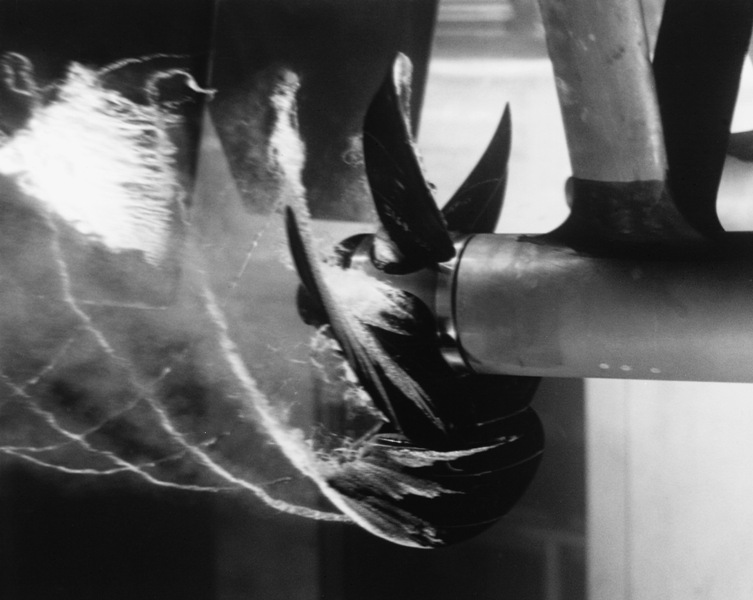
Cavitation in fluid mechanics and engineering normally is the phenomenon in which the static pressure of a liquid reduces to below the liquid's vapor pressure, leading to the formation of small vapor-filled cavities in the liquid. When subjected to higher pressure, these cavities, called "bubbles" or "voids", collapse and can generate shock waves that may damage machinery. As a concrete propeller example: The pressure on the suction side of the propeller blades can be very low and when the pressure falls to that of the vapour pressure of the working liquid, cavities filled with gas vapour can form. The process of the formation of these cavities is referred to as cavitation. If the cavities move into the regions of higher pressure (lower velocity), they will implode or collapse. These shock waves are strong when they are very close to the imploded bubble, but rapidly weaken as they propagate away from the implosion. Cavitation collapse is therefore a significant cause of wear in some engineering contexts. Collapsing voids that implode near to a hard surface cause cyclic stress through repeated implosion. This results in surface fatigue of the material, causing a type of damage also called "cavitation damage" or "cavitation erosion". The most common examples of this kind of wear are to pump impellers, and pipe bends where a sudden change in the direction of fast moving liquid occurs.
Cavitation is usually divided into two classes of behavior. Inertial (or transient) cavitation is the process in which a void or bubble in a liquid rapidly collapses, producing a shock wave. It occurs in nature in the strikes of mantis shrimp and pistol shrimp, as well as in the vascular tissues of plants. In manufactured objects, it can occur in control valves, pumps, propellers and impellers. Non-inertial cavitation is the process in which a bubble in a fluid is forced to oscillate in size or shape due to some form of energy input, such as an acoustic field. The gas in the bubble may contain a portion of a different gas than the vapor phase of the liquid. Such cavitation is often employed in ultrasonic cleaning baths and can also be observed in pumps, propellers, etc.
Since the shock waves formed by collapse of the voids are strong enough to cause significant damage to parts, cavitation is typically an undesirable phenomenon in machinery. It may be desirable if intentionally used, for example, to sterilize contaminated surgical instruments, break down pollutants in water purification systems, emulsify tissue for cataract surgery or kidney stone lithotripsy, or homogenize fluids. It is very often specifically prevented in the design of machines such as turbines or propellers, and eliminating cavitation is a major field in the study of fluid dynamics. However, it is sometimes useful and does not cause damage when the bubbles collapse away from machinery surfaces, such as in supercavitation.
Physics
Inertial cavitation
Inertial cavitation was first observed in the late 19th century, considering the collapse of a spherical void within a liquid. When a volume of liquid is subjected to a sufficiently low pressure, it may rupture and form a cavity. This phenomenon is coined cavitation inception and may occur behind the blade of a rapidly rotating propeller or on any surface vibrating in the liquid with sufficient amplitude and acceleration. A fast-flowing river can cause cavitation on rock surfaces, particularly when there is a drop-off, such as on a waterfall.
Vapor gases evaporate into the cavity from the surrounding medium; thus, the cavity is not a vacuum at all, but rather a low-pressure vapor (gas) bubble. Once the conditions which caused the bubble to form are no longer present, such as when the bubble moves downstream, the surrounding liquid begins to implode due its higher pressure, building up momentum as it moves inward. As the bubble finally collapses, the inward momentum of the surrounding liquid causes a sharp increase of pressure and temperature of the vapor within. The bubble eventually collapses to a minute fraction of its original size, at which point the gas within dissipates into the surrounding liquid via a rather violent mechanism which releases a significant amount of energy in the form of an acoustic shock wave and as visible light. At the point of total collapse, the temperature of the vapor within the bubble may be several thousand Kelvin, and the pressure several hundred atmospheres.
The physical process of cavitation inception is similar to boiling. The major difference between the two is the thermodynamic paths that precede the formation of the vapor. Boiling occurs when the local temperature of the liquid reaches the saturation temperature, and further heat is supplied to allow the liquid to sufficiently phase change into a gas. Cavitation inception occurs when the local pressure falls sufficiently far below the saturated vapor pressure, a value given by the tensile strength of the liquid at a certain temperature.
In order for cavitation inception to occur, the cavitation "bubbles" generally need a surface on which they can nucleate. This surface can be provided by the sides of a container, by impurities in the liquid, or by small undissolved microbubbles within the liquid. It is generally accepted that hydrophobic surfaces stabilize small bubbles. These pre-existing bubbles start to grow unbounded when they are exposed to a pressure below the threshold pressure, termed Blake's threshold. The presence of an incompressible core inside a cavitation nucleus substantially lowers the cavitation threshold below the Blake threshold.
The vapor pressure here differs from the meteorological definition of vapor pressure, which describes the partial pressure of water in the atmosphere at some value less than 100% saturation. Vapor pressure as relating to cavitation refers to the vapor pressure in equilibrium conditions and can therefore be more accurately defined as the equilibrium (or saturated) vapor pressure.
Non-inertial cavitation is the process in which small bubbles in a liquid are forced to oscillate in the presence of an acoustic field, when the intensity of the acoustic field is insufficient to cause total bubble collapse. This form of cavitation causes significantly less erosion than inertial cavitation, and is often used for the cleaning of delicate materials, such as silicon wafers.
Other ways of generating cavitation voids involve the local deposition of energy, such as an intense focused laser pulse (optic cavitation) or with an electrical discharge through a spark. These techniques have been used to study the evolution of the bubble that is actually created by locally boiling the liquid with a local increment of temperature.
Hydrodynamic cavitation
Hydrodynamic cavitation is the process of vaporisation, bubble generation and bubble implosion which occurs in a flowing liquid as a result of a decrease and subsequent increase in local pressure. Cavitation will only occur if the local pressure declines to some point below the saturated vapor pressure of the liquid and subsequent recovery above the vapor pressure. If the recovery pressure is not above the vapor pressure then flashing is said to have occurred. In pipe systems, cavitation typically occurs either as the result of an increase in the kinetic energy (through an area constriction) or an increase in the pipe elevation.
Hydrodynamic cavitation can be produced by passing a liquid through a constricted channel at a specific flow velocity or by mechanical rotation of an object through a liquid. In the case of the constricted channel and based on the specific (or unique) geometry of the system, the combination of pressure and kinetic energy can create the hydrodynamic cavitation cavern downstream of the local constriction generating high energy cavitation bubbles.
Based on the thermodynamic phase change diagram, an increase in temperature could initiate a known phase change mechanism known as boiling. However, a decrease in static pressure could also help one pass the multi-phase diagram and initiate another phase change mechanism known as cavitation. On the other hand, a local increase in flow velocity could lead to a static pressure drop to the critical point at which cavitation could be initiated (based on Bernoulli's principle). The critical pressure point is vapor saturated pressure. In a closed fluidic system where no flow leakage is detected, a decrease in cross-sectional area would lead to velocity increment and hence static pressure drop. This is the working principle of many hydrodynamic cavitation based reactors for different applications such as water treatment, energy harvesting, heat transfer enhancement, food processing, etc.
There are different flow patterns detected as a cavitation flow progresses: inception, developed flow, supercavitation, and choked flow. Inception is the first moment that the second phase (gas phase) appears in the system. This is the weakest cavitating flow captured in a system corresponding to the highest cavitation number. When the cavities grow and becomes larger in size in the orifice or venturi structures, developed flow is recorded. The most intense cavitating flow is known as supercavitation where theoretically all the nozzle area of an orifice is filled with gas bubbles. This flow regime corresponds to the lowest cavitation number in a system. After supercavitation, the system is not capable of passing more flow. Hence, velocity does not change while the upstream pressure increase. This would lead to an increase in cavitation number which shows that choked flow occurred.
Content sourced from Wikipedia under CC BY-SA 4.0


