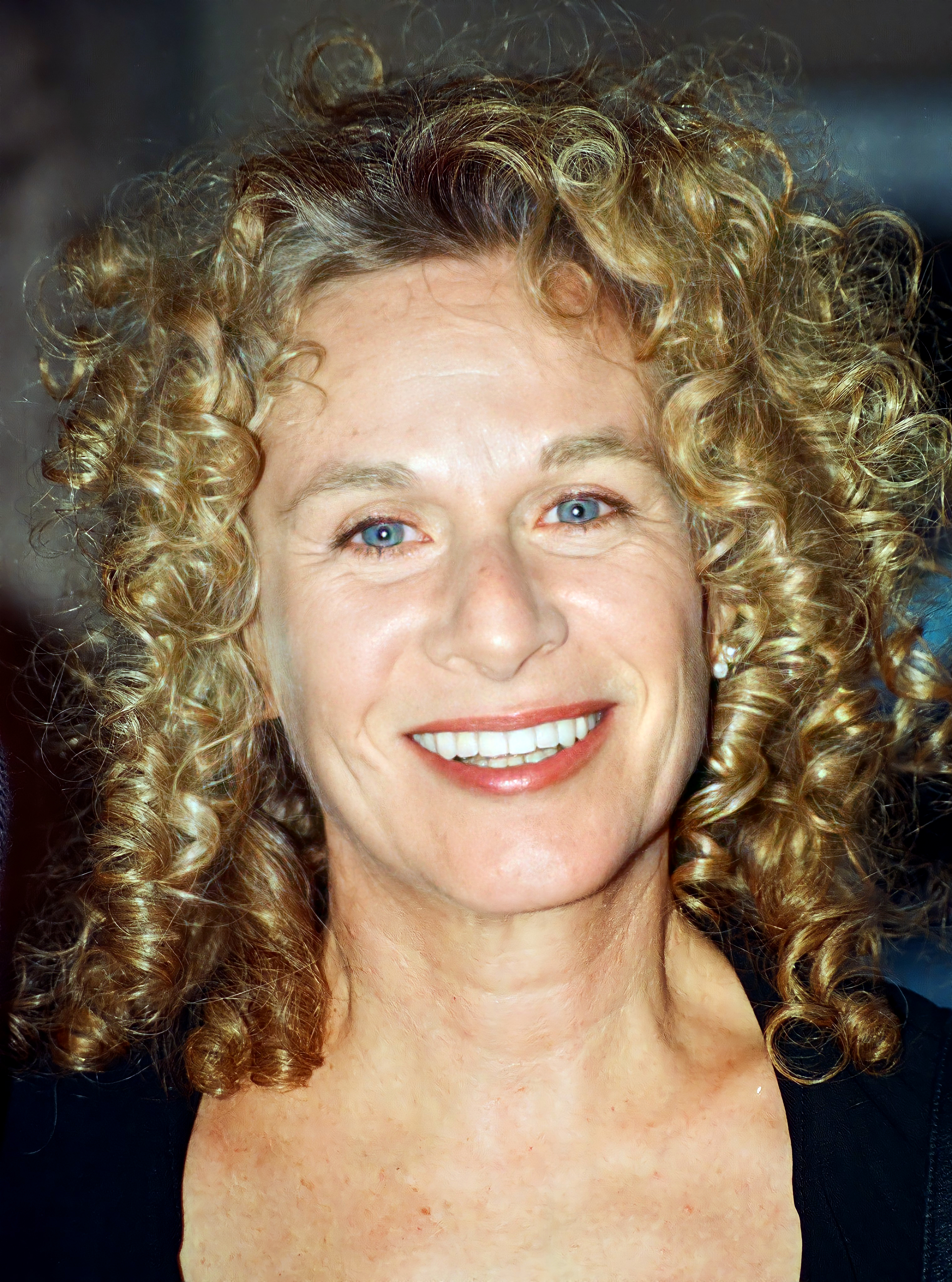
Carole King
American singer-songwriter and musician (born 1942)
Carole King Klein (born Carol Joan Klein; February 9, 1942) is an American singer-songwriter and musician renowned for her extensive contributions to popular music. She wrote or co-wrote 118 songs that charted on the Billboard Hot 100 during the latter half of the 20th century and 61 songs that reached the UK charts, establishing her as the most successful female songwriter on the UK singles charts from 1962 to 2005.
In the 1960s, King and her first husband, Gerry Goffin, composed over two dozen hit songs for various artists, many of which remain standards. She transitioned to a solo performing career in the 1970s, following her debut album Writer (1970) with the critically acclaimed Tapestry (1971), which topped the U.S. album chart for 15 weeks and stayed on the charts for over six years.
King has released 25 solo albums, with Tapestry being her most successful, and has sold over 75 million records worldwide. Her honors include four Grammy Awards, inductions into the Songwriters Hall of Fame and twice into the Rock and Roll Hall of Fame (as a performer and songwriter), the 2013 Library of Congress Gershwin Prize for Popular Song (as its first female recipient), and the 2015 Kennedy Center Honors.
Early life and education
King was born Carol Joan Klein on February 9, 1942, in Manhattan, New York City, to Jewish parents Eugenia (née Cammer), a teacher, and Sidney N. Klein, a firefighter.
King's parents met in an elevator in 1936 at Brooklyn College, where her father was a chemistry major and her mother was an English and drama major. They married in 1937 during the last years of the Great Depression. King's mother dropped out of college to run the household; her father also quit college and briefly took a job as a radio announcer. With the economy struggling, he then took a more secure job as a firefighter. After King was born, her parents settled in Brooklyn and were eventually able to buy a small two-story duplex where they could rent out the upstairs for income.
King's mother had learned to play piano as a child and would sometimes practice after buying a piano. When King developed an insatiable curiosity about music when she was three, her mother began teaching her basic piano skills without giving her actual lessons. When King was four, her parents discovered she had absolute pitch, which enabled her to name a note correctly just by hearing it. King's father enjoyed showing off his daughter's skill to visiting friends: "My dad's smile was so broad that it encompassed the lower half of his face. I enjoyed making my father happy and getting the notes right."
King's mother began giving her real music lessons when she was four with King climbing the stool, made higher still by a phone book. With her mother sitting beside her, King learned music theory and elementary piano technique, including how to read notation and execute proper note timing. King wanted to learn as much as possible: "My mother never forced me to practice. She didn't have to. I wanted so much to master the popular songs that poured out of the radio."
King began kindergarten when she was four, and after her first year, she was promoted directly to second grade, showing an exceptional facility with words and numbers. In the 1950s, she attended James Madison High School in the Midwood section of Brooklyn. She formed a band called the Co-Sines, changed her name from Carol Klein to Carole King, and made demo records with her friend Paul Simon for $25 a session. Her first official recording was the promotional single "The Right Girl", released by ABC-Paramount in 1958, which she wrote and sang to an arrangement by Don Costa.
King attended Queens College, where she met Gerry Goffin, who was to become her songwriting partner. When she was 17, they married in a Jewish ceremony on Long Island in August 1959 after King became pregnant with her first daughter, Louise. They quit college and took day jobs, Goffin working as an assistant chemist and King as a secretary. They wrote songs together in the evening.
Neil Sedaka, who had dated King when he was still in high school, had a hit in 1959 with "Oh! Carol". Goffin took the tune and wrote the playful response, "Oh! Neil", which King recorded and released as a single the same year. The B-side contained the Goffin-King song "A Very Special Boy". The single was not a success. After writing the Shirelles' 1960 Billboard No. 1 hit, "Will You Love Me Tomorrow" —the first No. 1 by a black girl group—Goffin and King gave up their daytime jobs to concentrate on writing. "Will You Love Me Tomorrow" became a pop standard.
Career
1960s
In the 1960s, with King composing the music and Goffin writing the lyrics, the two wrote a string of classic songs for a variety of artists. King and Goffin were also the songwriting team behind Don Kirshner's Dimension Records, which produced songs including "Chains" (later recorded by the Everly Brothers and the Beatles), "The Loco-Motion", "Keep Your Hands off My Baby" (both for their babysitter Little Eva), and "It Might as Well Rain Until September" which King recorded herself in 1962—her first success, which charted at 22 in the US and 3 in the UK (where it was her all-time greatest hit). King recorded a few follow-up singles in the wake of "September", with none charting particularly well; by 1966, her already sporadic recording career was entirely abandoned – albeit temporarily.
Other songs of King's early period (through 1967) include "Crying in the Rain" peaking at number six on the US Billboard Hot 100 in February 1962 for the Everly Brothers, "Half Way To Paradise" for Tony Orlando (recorded by Billy Fury in the UK), "Take Good Care of My Baby" for Bobby Vee, "Up on the Roof" for the Drifters, "I'm into Something Good" for Earl-Jean (later recorded by Herman's Hermits), "One Fine Day" for the Chiffons, and "Pleasant Valley Sunday" for the Monkees (inspired by their move to suburban West Orange, New Jersey), and the classic "(You Make Me Feel Like) A Natural Woman" for Aretha Franklin. The duo wrote several songs recorded by Dusty Springfield, including "Goin' Back" and "Some of Your Lovin'". They wrote at 1650 Broadway, alongside other songwriters associated with the Brill Building Sound.
By 1968, Goffin and King were divorced and not keeping in contact. King moved to Laurel Canyon, Los Angeles, with her two daughters, and reactivated her recording career by forming "The City", a music trio consisting of bassist Charles Larkey (her future husband) and Danny Kortchmar on guitar and vocals, with King herself on piano and vocals. The City produced one album, Now That Everything's Been Said (1968), but King's reluctance to perform live meant promotion and sales were limited. A change of distributors meant that the album was quickly deleted, and the group disbanded in 1969. The album was rediscovered by Classic Rock radio in the early 1980s, with the cut "Snow Queen" receiving nominal airplay for a few years. Cleveland's WMMS played it every few weeks between 1981 and 1985, and the long-out-of-print LP became sought after by fans of King who liked the edgy sound of the music.
1970s
While living in Laurel Canyon, King met James Taylor and Joni Mitchell, as well as Toni Stern, with whom she collaborated. King released her debut solo album, Writer, in 1970 for Lou Adler's Ode label, with Taylor playing acoustic guitar and providing backing vocals. It peaked at No. 84 on the Billboard Top 200. That same year, King played keyboard on B.B. King's album Indianola Mississippi Seeds.
King followed up Writer with her sophomore effort Tapestry (1971), which featured new songs as well as renewed versions of "Will You Love Me Tomorrow" and "(You Make Me Feel Like) A Natural Woman". The album was recorded concurrently with Taylor's Mud Slide Slim, with an overlapping set of musicians including King, Danny Kortchmar and Joni Mitchell. Both albums included "You've Got a Friend", which was a No. 1 hit for Taylor; King said in a 1972 interview that she "didn't write it with James or anybody really specifically in mind. But when James heard it he really liked it and wanted to record it".
Tapestry was an instant success. With numerous hit singles—including a Billboard No. 1 with "It's Too Late"—Tapestry held the number one spot on the albums chart for 15 consecutive weeks, remained on the chart for nearly six years, and has sold over 30 million copies worldwide. The album garnered four Grammy Awards, including Album of the Year, Best Pop Vocal Performance (Female), Record of the Year ("It's Too Late", lyrics by Toni Stern), and Song of the Year, with King becoming the first woman to win the award (for "You've Got a Friend"). The album appeared on Rolling Stone's 500 Greatest Albums of All Time list at No. 36. In addition, "It's Too Late" was ranked No. 469 on the magazine's list of the 500 Greatest Songs of All Time.
Content sourced from Wikipedia under CC BY-SA 4.0


