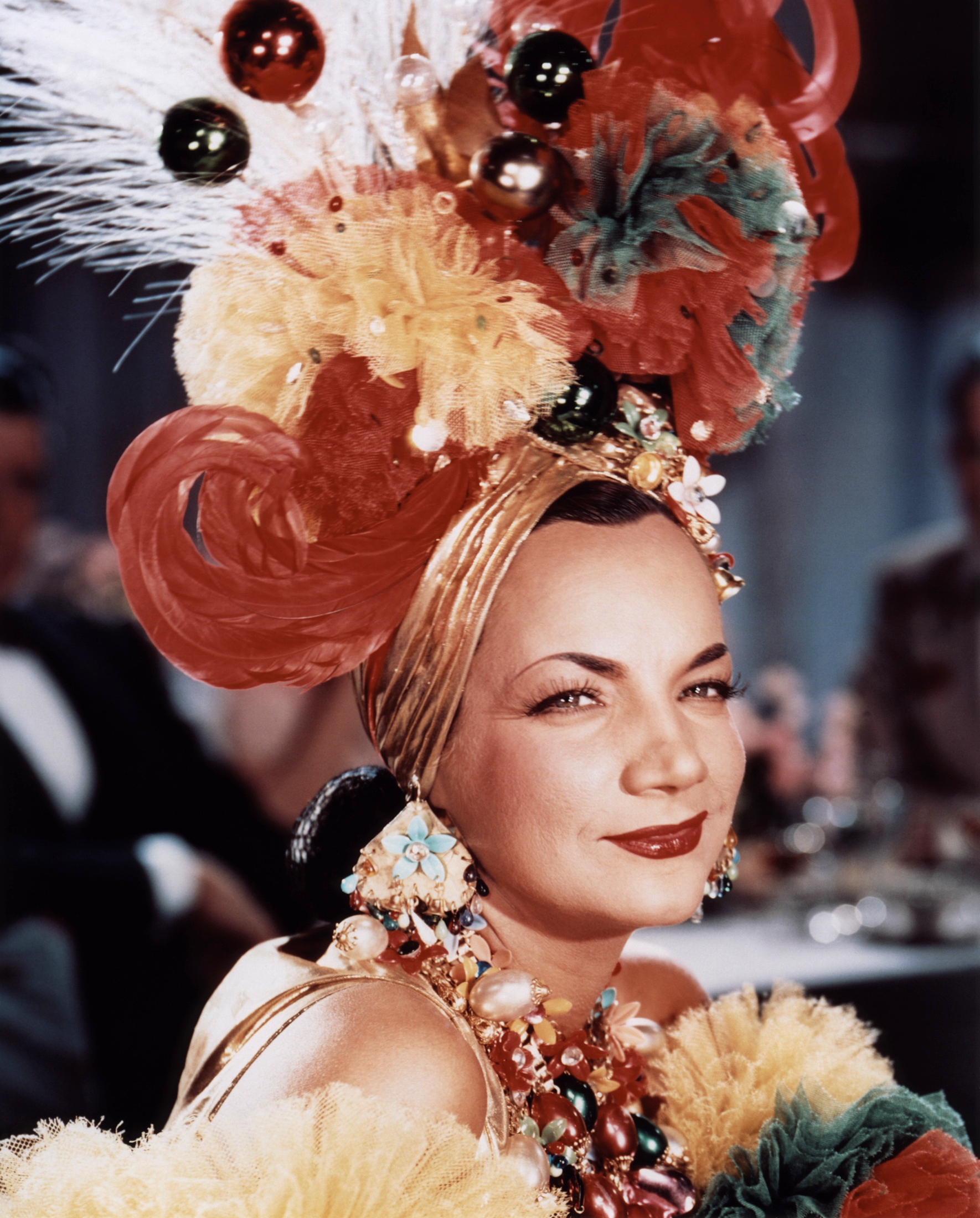
Carmen Miranda
Brazilian singer (1909–1955)
Maria do Carmo Miranda da Cunha (9 February 1909 – 5 August 1955), known professionally as Carmen Miranda (Portuguese pronunciation: [ˈkaʁmẽj miˈɾɐ̃dɐ]), was a Portuguese-born Brazilian singer, dancer, and actress. Nicknamed "the Brazilian Bombshell," she was known for her signature fruit hat outfits that she wore in her American films.
As a young woman, Miranda designed clothes and hats in a boutique before making her debut as a singer, recording with composer Josué de Barros in 1929. Miranda's 1930 recording of "Taí (Pra Você Gostar de Mim)", written by Joubert de Carvalho, catapulted her to stardom in Brazil as the foremost interpreter of samba.
During the 1930s, Miranda performed on Brazilian radio and appeared in five Brazilian chanchadas, films celebrating Brazilian music, dance and the country's carnival culture. Hello, Hello Brazil! and Hello, Hello, Carnival! embodied the spirit of these early Miranda films. The 1939 musical Banana da Terra (directed by Ruy Costa) gave the world her "Baiana" image, inspired by Afro-Brazilians from the north-eastern state of Bahia.
In 1939, Broadway producer Lee Shubert, after seeing Miranda perform at Cassino da Urca in Rio de Janeiro, offered her an eight-week contract to perform in The Streets of Paris. The following year she made her first Hollywood film, Down Argentine Way, co-starring Don Ameche and Betty Grable, and her exotic clothing and Brazilian Portuguese accent became her trademark. That year, she was voted the third-most-popular personality in the United States; she and her group, Bando da Lua, were invited to sing and dance for President Franklin D. Roosevelt. In 1941, she was the first Latin American star to be invited to leave her handprints and footprints in the courtyard of Grauman's Chinese Theatre and was the first South American honored with a star on the Hollywood Walk of Fame. In 1943, Miranda starred in Busby Berkeley's The Gang's All Here, which featured musical numbers with the fruit hats that became her trademark. By 1945, she was the highest-paid woman in the United States.
Miranda made 14 Hollywood films between 1940 and 1953. Although she was hailed as a talented performer, her popularity waned by the end of World War II. Miranda came to resent the stereotypical "Brazilian Bombshell" image she had cultivated and attempted to free herself of it with limited success. She focused on nightclub appearances and became a fixture on television variety shows. Despite being stereotyped, Miranda's performances popularized Brazilian music and increased American awareness of Latin culture. Miranda is considered the precursor of Brazil's 1960s Tropicalismo cultural movement. A museum was built in Rio de Janeiro in her honor and she was the subject of the documentary Carmen Miranda: Bananas Is My Business (1995).
Early life
Miranda was born Maria do Carmo Miranda da Cunha in 1909 in Várzea da Ovelha e Aliviada, a village in the northern Portuguese municipality of Marco de Canaveses. She was the second daughter of José Maria Pinto da Cunha (17 February 1887 – 21 June 1938) and Maria Emília Miranda (10 March 1886, Rio de Janeiro – 9 November 1971).
The family's emigration to Brazil was already scheduled; however, upon finding herself pregnant, Carmen Miranda's mother preferred to wait for her daughter's birth. In 1909, her father emigrated to Brazil and settled in Rio de Janeiro, where he opened a barber shop. Her mother followed in 1910 with their daughters, Olinda (1907–1931) and Carmen, who was less than a year old. Although Carmen never returned to Portugal, she retained her Portuguese nationality. In Brazil, her parents had four more children: Amaro (1912–1988), Cecilia (1913–2011), Aurora (1915–2005) and Óscar (1916–1998).
She was christened Carmen by her father because of his love for Bizet's Carmen. This passion for opera influenced his children, and Miranda's love for singing and dancing, at an early age. She was educated at the Convent of Saint Therese of Lisieux. Her father did not approve of Miranda's plans to enter show business; her mother supported her, despite being beaten when her father discovered that his daughter had auditioned for a radio show (she had sung at parties and festivals in Rio). Miranda's older sister, Olinda, developed tuberculosis and was sent to Portugal for treatment; the singer worked in a tie shop at age 14 to help pay her sister's medical bills. She then worked in a boutique (where she learned to make hats) and opened a successful hat business.
Career
In Brazil
Miranda was introduced to Josué de Barros, a composer and musician from Bahia, while she was working at her family's inn. With help from de Barros and Brunswick Records, she recorded her first single (the samba "Não vá Simbora") in 1929. Miranda's second single, "Prá Você Gostar de Mim" (also known as "Taí", and released in 1930), was a collaboration with Brazilian composer Joubert de Carvalho and sold a record 35,000 copies that year. She signed a two-year contract with RCA Victor in 1930, giving them exclusive rights to her image.
In 1933, Miranda signed a two-year contract with Rádio Mayrink Veiga, the most popular Brazilian station of the 1930s, and was the first contract singer in Brazilian radio history; for a year, in 1937, she moved to Rádio Tupi. She later signed a contract with Odeon Records, making her the highest-paid radio singer in Brazil at the time.
Miranda's rise to stardom in Brazil was linked to the growth of a native style of music: the samba. The samba and Miranda's emerging career enhanced the revival of Brazilian nationalism during the government of President Getúlio Vargas. Her gracefulness and vitality in her recordings and live performances gave her the nickname "Cantora do It". The singer was later known as "Ditadora Risonha do Samba", and in 1933 radio announcer Cesar Ladeira christened her "A Pequena Notável".
Her Brazilian film career was linked to a genre of musical films that drew on the nation's carnival traditions and the annual celebration and musical style of Rio de Janeiro, Brazil's capital at the time. Miranda performed a musical number in O Carnaval Cantado no Rio (1932, the first sound documentary on the subject) and three songs in A Voz do Carnaval (1933), which combined footage of street celebrations in Rio with a fictitious plot providing a pretext for musical numbers.
Miranda's next screen performance was in the musical Hello, Hello Brazil! (1935), in which she performed its closing number: the marcha "Primavera no Rio", which she had recorded for Victor in August 1934. Several months after the film's release, according to Cinearte magazine, "Carmen Miranda is currently the most popular figure in Brazilian cinema, judging by the sizeable correspondence that she receives". In her next film, Estudantes (1935), she had a speaking part for the first time. Miranda played Mimi, a young radio singer (who performs two numbers in the film) who falls in love with a university student (played by singer Mário Reis).
She starred in the next co-production from the Waldow and Cinédia studios, the musical Hello, Hello, Carnival! (1936), which contained a roll call of popular music and radio performers (including Miranda's sister, Aurora). A standard backstage plot permitted 23 musical numbers and, by contemporary Brazilian standards, the film was a major production. Its set reproduced the interior of Rio's plush Atlântico casino (where some scenes were filmed) and was a backdrop for some of its musical numbers. Miranda's stardom is evident in a film poster with a full-length photograph of her and her name topping the cast list.
Although she became synonymous with colorful fruit hats during her later career, she began wearing them only in 1939, and contrary to popular belief, they were never made from real fruit. Miranda appeared in the film Banana da Terra that year in a glamorous version of the traditional dress of a poor black girl in Bahia: a flowing dress and a fruit-hat turban. She sang "O Que É Que A Baiana Tem?"; which intended to empower a social class that was usually disparaged.
Producer Lee Shubert offered Miranda an eight-week contract to perform in The Streets of Paris on Broadway after seeing her perform in 1939 at Rio's Cassino da Urca. Although she was interested in performing in New York, she refused to accept the deal unless Shubert agreed to also hire her band, the Bando da Lua. He refused, saying that there were many capable musicians in New York who could back her. Miranda remained steadfast, feeling that North American musicians would not be able to authenticate the sounds of Brazil. Shubert compromised, agreeing to hire the six band members but not paying for their transport to New York. President Getúlio Vargas, recognizing the value to Brazil of Miranda's tour, announced that the Brazilian government would pay for the band's transportation on the Moore-McCormack Lines between Rio and New York. Vargas believed that Miranda would foster ties between the northern and southern hemispheres and act as a goodwill ambassador in the United States, increasing Brazil's share of the American coffee market. Miranda took the official sanction of her trip and her duty to represent Brazil to the outside world seriously. She left for New York on the SS Uruguay on 4 May 1939, a few months before World War II.
Content sourced from Wikipedia under CC BY-SA 4.0


