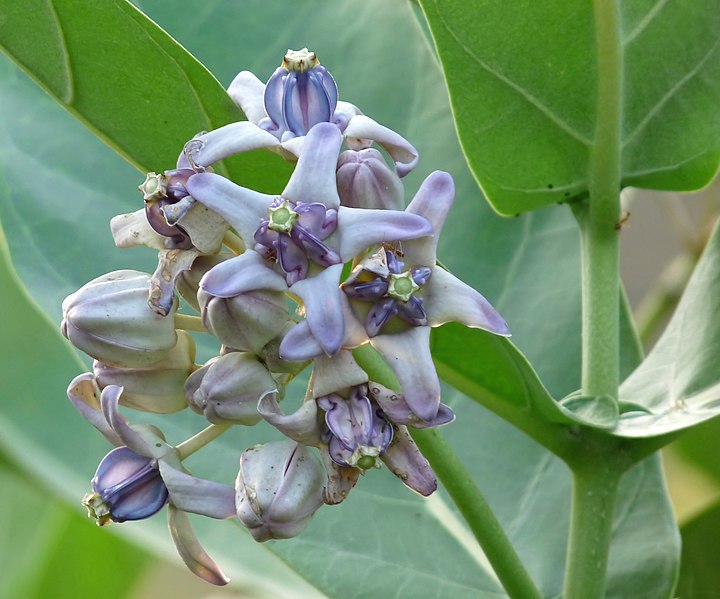
Calotropis gigantea
Species of plant
Why this is trending
Interest in “Calotropis gigantea” spiked on Wikipedia on 2026-02-25.
Categorised under Science & Nature, this article fits a familiar pattern. Science and technology topics tend to trend after breakthroughs, space missions, health announcements, or widely shared research findings.
GlyphSignal tracks these patterns daily, turning raw Wikipedia traffic data into a curated feed of what the world is curious about. Every spike tells a story.
Key Takeaways
- Calotropis gigantea , the crown flower , is a species of Calotropis native to Cambodia, Vietnam, Bangladesh, Indonesia, Malaysia, Philippines,Thailand, Sri Lanka, India, China, Pakistan, and Nepal.
- It has clusters of waxy flowers that are either white or lavender in colour.
- The aestivation found in calotropis is valvate i.
- The plant has oval, light green leaves and milky stem.
- The roots also contain Calotropone.
Calotropis gigantea, the crown flower, is a species of Calotropis native to Cambodia, Vietnam, Bangladesh, Indonesia, Malaysia, Philippines,Thailand, Sri Lanka, India, China, Pakistan, and Nepal.
It is a large shrub growing to 4 m (13 ft) tall. It has clusters of waxy flowers that are either white or lavender in colour. Each flower consists of five pointed petals and a small "crown" rising from the center which holds the stamens. The aestivation found in calotropis is valvate i.e. sepals or petals in a whorl just touch one another at the margin, without overlapping. The plant has oval, light green leaves and milky stem. The latex of Calotropis gigantea contains cardiac glycosides, fatty acids, and calcium oxalate. The roots also contain Calotropone.
Pollination
This plant plays host to a variety of insects and butterflies. It is the host plant for Hawaii's non-migratory monarch butterflies. Calotropis is an example of entomophily pollination (pollination by insects) and pollination is achieved with the help of bees. In Calotropis, gynostegium is present (formed by the fusion of stigma and androecium). The pollen are in a structure named pollinia which is attached to a glandular, adhesive disc at the stigmatic angle (translator mechanism). These sticky discs get attached to the legs of visiting bees that pull out pollinia when a bee moves away. When such a bee visits another flower, this flower might be pollinated by the pollinium.
Content sourced from Wikipedia under CC BY-SA 4.0


