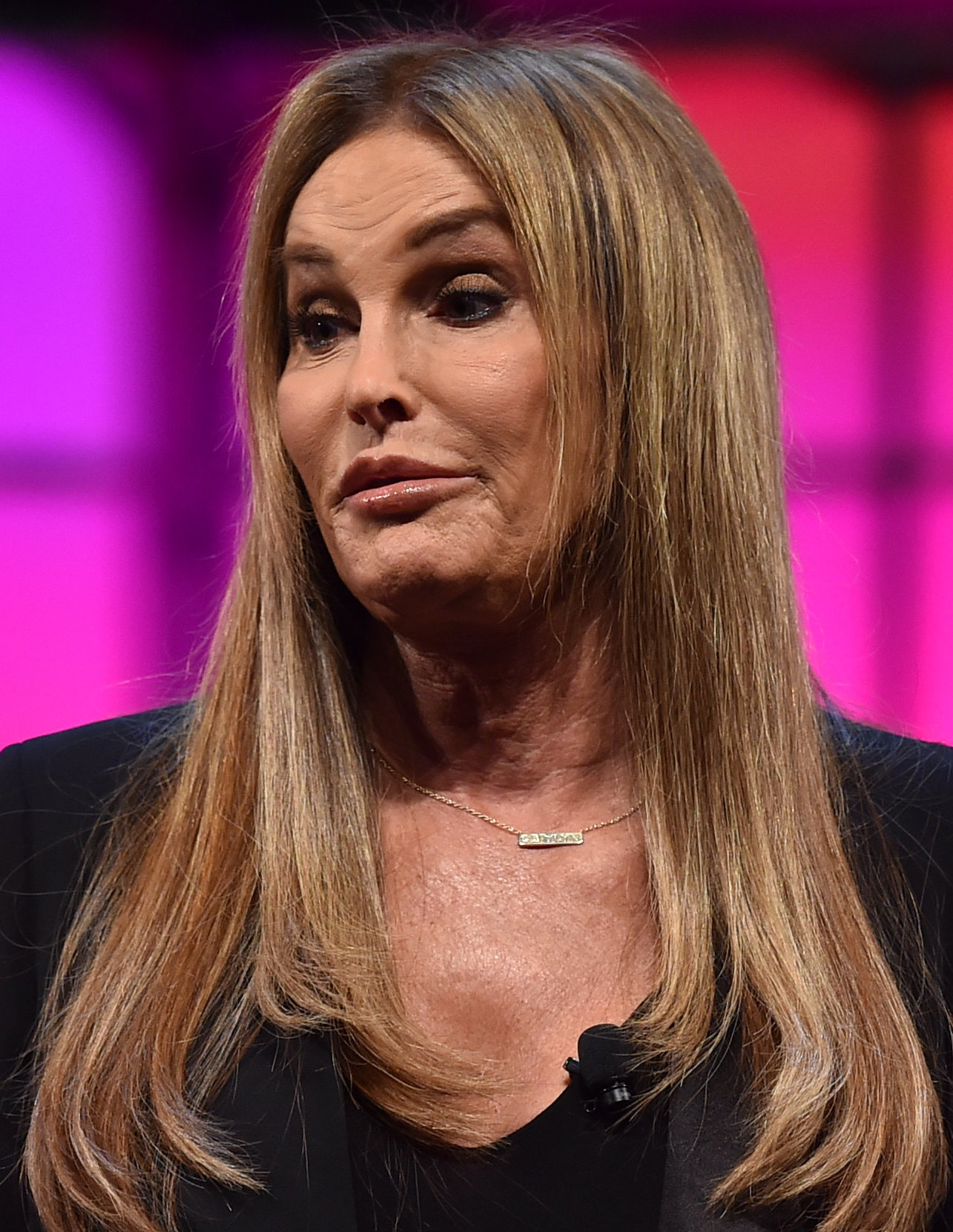
Caitlyn Jenner
American media personality and decathlete (born 1949)
Caitlyn Marie Jenner (born William Bruce Jenner, October 28, 1949), formerly known as Bruce Jenner, is an American media personality and retired Olympic gold medal-winning decathlete.
Jenner played college football for the Graceland Yellowjackets before incurring a knee injury that required surgery. Convinced by Olympic decathlete Jack Parker's coach, L. D. Weldon, to try the decathlon, she competed in decathlon for six years, culminating in winning the men's decathlon event at the 1976 Summer Olympics in Montreal, setting a third successive world record and gaining fame as "an all-American hero". Jenner established a career in television, film, writing, auto racing, business, and as a Playgirl cover model.
Jenner has six children with three successive wives – Chrystie Crownover, Linda Thompson, and Kris Jenner – and from 2007 to 2021 appeared on the reality television series Keeping Up with the Kardashians with Kris, their daughters Kendall and Kylie Jenner, and stepchildren Kourtney, Kim, Khloé, and Rob Kardashian.
Jenner publicly came out as transgender in April 2015, announcing her new name in July of that year. From 2015 to 2016, she starred in the reality television series I Am Cait, which focused on her gender transition. At the time of her coming out, she had been called the most famous transgender woman in the world. Jenner is a transgender rights activist, although her views on transgender issues have been criticized by many other LGBTQ+ activists.
A member of the Republican Party, Jenner ran in the 2021 California gubernatorial recall election, finishing 13th with one percent of the vote. Six months after the election, Jenner was hired by Fox News as an on-air contributor.
Early life
Caitlyn Marie Jenner was born on October 28, 1949, in Mount Kisco, New York, as William Bruce Jenner, and was known as Bruce until June 2015. Her parents are Esther Ruth (née McGuire) and William Hugh Jenner, who was an arborist originally from New Brunswick, Canada. She is of English, Scottish, Irish, Dutch, and Welsh descent. Jenner's younger brother, Burt, was killed in a car accident in Canton, Connecticut, on November 30, 1976, shortly after Jenner's success at the Olympic Games. As a child, Jenner was diagnosed with dyslexia.
Education
Jenner attended Sleepy Hollow High School in Sleepy Hollow, New York, for freshman and sophomore year and Newtown High School in Newtown, Connecticut, for junior and senior year, graduating in 1968. Jenner earned a football athletic scholarship and attended Graceland College in Lamoni, Iowa, but was forced to stop playing football because of a knee injury. Recognizing Jenner's potential, Graceland track coach L. D. Weldon encouraged Jenner to switch to the decathlon. Jenner debuted as a decathlete in 1970 in the Drake Relays decathlon in Des Moines, Iowa, finishing in fifth place. Jenner graduated from Graceland College in 1973 with a degree in physical education.
Decathlon career
Early career
At the 1972 U.S. Olympic Trials at Hayward Field in Eugene, Oregon, Jenner was eleventh after the first day in the men's decathlon, and climbed to fifth behind Steve Gough and Andrew Pettes with one event remaining on the Fourth of July. Needing to make up a 19-second gap on Gough in the 1500 meters, Jenner qualified for the Olympic team by finishing first, 22 seconds ahead of the others. This prompted the Eugene Register-Guard to ask: "Who's Jenner?" Following the trials, Jenner was tenth in the decathlon at the 1972 Summer Olympics in Munich, West Germany. By watching Soviet Mykola Avilov win the event, Jenner was inspired to start an intense training regimen. "For the first time, I knew what I wanted out of life and that was it, and this guy has it. I literally started training that night at midnight, running through the streets of Munich, Germany, training for the Games. I trained that day on through the 1976 Games, 6–8 hours a day, every day, 365 days a year."
After graduating from Graceland, Jenner married girlfriend Chrystie Crownover and moved to San Jose, California. Crownover provided most of the family income as a flight attendant for United Airlines. Jenner trained during the day and sold insurance at night, earning US$9,000 a year. In the era before professional athletes were allowed to compete in Olympic sports, this kind of training was unheard of. On the other hand, Soviet athletes were state sponsored, which gave them an advantage over amateur American athletes. During this period, Jenner trained at the San Jose City College (SJCC) and San Jose State University (SJSU) tracks. San Jose athletics centered on SJCC coach Bert Bonanno; at that time, the city was a hotbed for training and was called the "Track Capital of the World". Many other aspiring Olympic athletes also trained at San Jose; the list included Millard Hampton, Andre Phillips, John Powell, Mac Wilkins, and Al Feuerbach. Jenner's best events were on day two of the decathlon: hurdles, discus, pole vault, javelin, and 1500 meters.
Olympic success
Jenner was the American champion in the men's decathlon event in 1974, and was featured on the cover of Track & Field News magazine's August 1974 issue. While on tour in 1975, Jenner won the French national championship, and a gold medal at the 1975 Pan American Games, setting the tournament record with 8,045 points. This was followed by world records of 8,524 points at the U.S.A./U.S.S.R./Poland triangular meet in Eugene, Oregon, on August 9–10, 1975, breaking Avilov's record, and 8,538 points at the 1976 Olympic trials, also in Eugene. The second Eugene record was a hybrid score because of a timing system failure and it was wind aided. Still, Jenner was proud of what she described as "a nice little workout."
We got what we wanted. We scared the hell out of everybody in the world only a month away from the Games.
Of the 13 decathlons Jenner competed in between 1973 and 1976, the only loss was at the 1975 AAU National Championships, when a "no height" in the pole vault marred the score.
At the 1976 Olympic Games in Montreal, Jenner achieved personal bests in all five events on the first day of the men's decathlon – a "home run" – despite being in second place behind Guido Kratschmer of West Germany. Jenner was confident: "The second day has all my good events. If everything works out all right, we should be ahead after it's all over." Following a rainstorm on the second day, Jenner watched teammate Fred Dixon get injured in the 110 meter hurdles and so adopted a cautious approach to the hurdles and discus. Jenner then had personal bests in the pole vault and javelin. At that point, victory was virtually assured, and it remained to be seen by how much Jenner would improve the record. In the final event – the 1500 meters, which was seen live on national television – Jenner looked content to finish the long competition. Jenner sprinted the last lap, making up a 50-meter deficit and nearly catching the event favorite, Soviet Leonid Litvinenko, who was already well out of contention for the gold medal, and whose personal best had been eight seconds better than Jenner's personal best before the race. Jenner set a new personal best time and won the gold medal with a world-record score of 8,618 points.
Olympic world record performance:
Impact
After the event, Jenner took an American flag from a spectator and carried it during the victory lap, starting a tradition that became common among winning athletes. Abandoning the vaulting poles in the stadium, with no intention of ever competing again, Jenner stated that: "In 1972, I made the decision that I would go four years and totally dedicate myself to what I was doing, and then I would move on after it was over with. I went into that competition knowing that would be the last time I would ever do this." Jenner explained, "It hurts every day when you practice hard. Plus, when this decathlon is over, I got the rest of my life to recuperate. Who cares how bad it hurts?"
Jenner became a national hero and received the James E. Sullivan Award as the top amateur athlete in the United States. Jenner was named the Associated Press Male Athlete of the Year in 1976.
Jenner's 1976 world and Olympic record was broken by four points by Daley Thompson at the 1980 Olympics in Moscow. In 1985, Jenner's Olympic decathlon score was reevaluated against the IAAF's updated decathlon scoring table and was reported as 8,634 for comparative purposes. This converted mark stood as the American record until 1991, when it was surpassed by eventual gold medalist, and world record holder, Dan O'Brien of Dan & Dave fame. As of 2018, Jenner was ranked twenty-sixth on the world all-time list and ninth on the American all-time list.
Jenner was inducted into the United States National Track and Field Hall of Fame in 1980, the Olympic Hall of Fame in 1986, the Bay Area Sports Hall of Fame and the Connecticut Sports Hall of Fame in 1994, and the San Jose Sports Hall of Fame in 2010. For almost 20 years, San Jose City College hosted an annual Bruce Jenner Invitational competition.
Content sourced from Wikipedia under CC BY-SA 4.0


