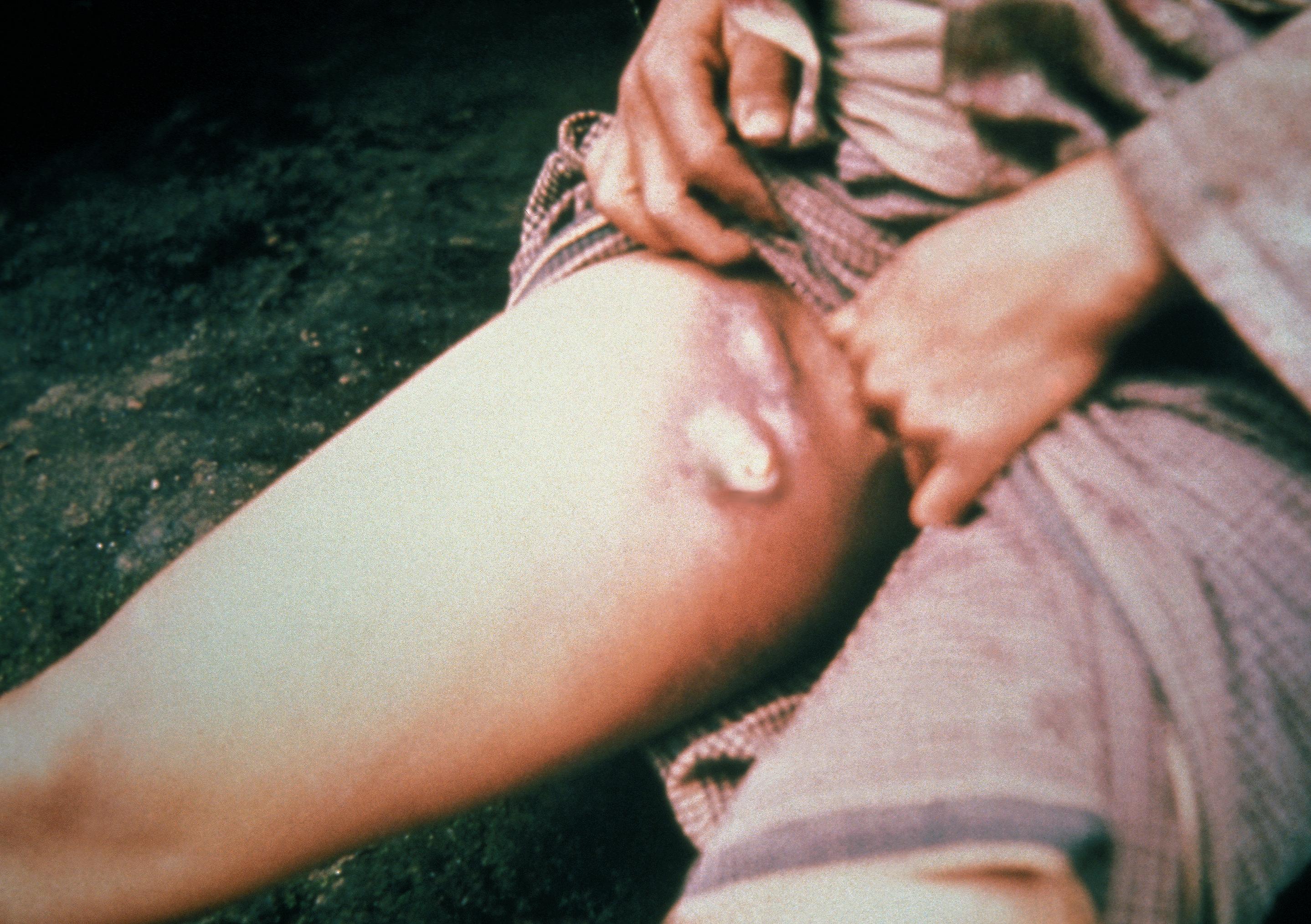
Bubonic plague
Human and animal disease
Bubonic plague is one of three types of plague caused by the bacterium Yersinia pestis. One to seven days after exposure to the bacteria, flu-like symptoms develop. These symptoms include fever, headaches, and vomiting, as well as swollen and painful lymph nodes occurring in the area closest to where the bacteria entered the skin. Acral necrosis, the dark discoloration of skin, is another symptom. Occasionally, swollen lymph nodes, known as "buboes", may break open.
The three types of plague are the result of the route of infection: bubonic plague, septicemic plague, and pneumonic plague. Bubonic plague is mainly spread by infected fleas from small animals. It may also result from exposure to the body fluids from a dead plague-infected animal. Mammals such as rabbits, hares, and some cat species are susceptible to bubonic plague, and typically die upon contraction. In the bubonic form of plague, the bacteria enter through the skin through a flea bite and travel via the lymphatic vessels to a lymph node, causing it to swell. Diagnosis is made by finding the bacteria in the blood, sputum, or fluid from lymph nodes.
Prevention is through public health measures such as not handling dead animals in areas where plague is common. While vaccines against the plague have been developed, the World Health Organization recommends that only high-risk groups, such as certain laboratory personnel and health care workers, get inoculated. Several antibiotics are effective for treatment, including streptomycin, gentamicin, and doxycycline.
Without treatment, plague results in the death of 30% to 90% of those infected. Death, if it occurs, is typically within 10 days. With treatment, the risk of death is around 10%. Globally between 2010 and 2015 there were 3,248 documented cases, which resulted in 584 deaths. The countries with the greatest number of cases are the Democratic Republic of the Congo, Madagascar, and Peru.
The plague is considered the likely cause of the Black Death that swept through Asia, Europe, and Africa in the 14th century and killed an estimated 50 million people, including about 25% to 60% of the European population. Because the plague killed so many of the working population, wages rose due to the demand for labor. Some historians see this as a turning point in European economic development. The disease is also considered to have been responsible for the Plague of Justinian, originating in the Eastern Roman Empire in the 6th century CE, as well as the third epidemic, affecting China, Mongolia, and India, originating in the Yunnan Province in 1855. The term bubonic is derived from the Greek word βουβών, meaning 'groin'.
Cause
The bubonic plague is an infection of the lymphatic system, usually resulting from the bite of an infected flea, Xenopsylla cheopis (the Oriental rat flea), though other flea species are able to carry the bubonic plague, such as Pulex irritans (the human flea) and Ceratophyllus fasciatus. Xenopsylla cheopis was the most effective flea species for transmission.
The flea is parasitic on house and field rats and seeks out other hosts when its rodent host dies. Rats were an amplifying factor to bubonic plague due to their common association with humans (living around and within dwellings) as well as the nature of their blood, which allows the rat to withstand a major concentration of the plague. The bacteria form aggregates in the gut of infected fleas, and this results in the flea regurgitating ingested blood, which is now infected, into the bite site of a rodent or human host. Once established, the bacteria rapidly spread to the lymph nodes of the host and multiply. The fleas that transmit the disease only directly infect humans when the rat population in the area is wiped out from a mass infection. Furthermore, in areas with a large population of rats, individual rats can harbor low levels (subclinical) of the plague infection without causing human outbreaks. With no new rat inputs being added to the population from other areas, the infection only spread to humans in very rare cases of overcrowding.
Signs and symptoms
After being transmitted via the bite of an infected flea, the Y. pestis bacteria become localized in an inflamed lymph node, where they begin to colonize and reproduce. Infected lymph nodes develop hemorrhages, which result in the death of tissue. Y. pestis bacilli can resist phagocytosis and even reproduce inside phagocytes and kill them. As the disease progresses, the lymph nodes can hemorrhage and become swollen and necrotic. Bubonic plague can progress to lethal septicemic plague in some cases. The plague is also known to spread to the lungs and become the disease known as the pneumonic plague. Symptoms appear two to seven days after getting bitten and they include:
- Chills
- General ill feeling (malaise)
- High fever >39 °C (102.2 °F)
- Muscle cramps
- Seizures
- Smooth, painful lymph gland swelling called a bubo, commonly found in the groin, but may occur in the armpits or neck, most often near the site of the initial infection (bite or scratch)
- Pain may occur in the area before the swelling appears
- Gangrene of the extremities such as toes, fingers, lips, and tip of the nose.
The best-known symptom of bubonic plague is one or more infected, enlarged, and painful lymph nodes, known as buboes. Buboes associated with the bubonic plague are commonly found in the armpits, upper femoral area, groin, and neck region. These buboes will grow and become more painful over time, often to the point of bursting. Symptoms include heavy breathing, continuous vomiting of blood (hematemesis), aching limbs, coughing, and extreme pain caused by the decay or decomposition of the skin while the person is still alive. Additional symptoms include extreme fatigue, gastrointestinal problems, spleen inflammation, lenticulae (black dots scattered throughout the body), delirium, coma, organ failure, and death. Organ failure is a result of the bacteria infecting organs through the bloodstream. Other forms of the disease include septicemic plague and pneumonic plague, in which the bacterium reproduces in the person's blood and lungs respectively.
Diagnosis
Laboratory testing is required in order to diagnose and confirm plague. Ideally, confirmation is through the identification of Y. pestis culture from a patient sample. Confirmation of infection can be done by examining serum taken during the early and late stages of infection. To quickly screen for the Y. pestis antigen in patients, rapid dipstick tests have been developed for field use.
Samples taken for testing include:
- Buboes: Swollen lymph nodes (buboes) characteristic of bubonic plague, a fluid sample can be taken from them with a needle.
- Blood: blood cultures test blood samples for bacteria to find source of infection
- Lungs: Spirometry test are used to screen the lungs for diseases that affect the airways. Chest X-rays of the lungs are also used as an effective method of diagnosis.
Prevention
Bubonic plague outbreaks are controlled by pest control and modern sanitation techniques. This disease uses fleas commonly found on rats as a vector to jump from animals to humans. The mortality rate is highest in the summer and early fall. The successful control of rat populations in dense urban areas is essential to outbreak prevention. One example is the use of a machine called the Sulfurozador, used to deliver sulphur dioxide to eradicate the pest that spread the bubonic plague in Buenos Aires, Argentina during the early 18th century. Targeted chemoprophylaxis, sanitation, and vector control also played a role in controlling the 2003 Oran outbreak of the bubonic plague. Another means of prevention in large European cities was a city-wide quarantine to not only limit interaction with people who were infected, but also to limit the interaction with the infected rats.
Treatment
Several classes of antibiotic are effective in treating bubonic plague. These include aminoglycosides such as streptomycin and gentamicin, tetracyclines (especially doxycycline), and the fluoroquinolone ciprofloxacin. Mortality associated with treated cases of bubonic plague is about 1–15%, compared to a mortality of 40–60% in untreated cases.
People potentially infected with the plague need immediate treatment and should be given antibiotics within 24 hours of the first symptoms to prevent death. Other treatments include oxygen, intravenous fluids, and respiratory support. People who have had contact with anyone infected by pneumonic plague are given prophylactic antibiotics. Using the broad-based antibiotic streptomycin has proven to be dramatically successful against the bubonic plague within 12 hours of infection.
Epidemiology
Globally between 2010 and 2015, there were 3,248 documented cases, which resulted in 584 deaths. The countries with the greatest number of cases are the Democratic Republic of the Congo, Madagascar, and Peru.
For over a decade since 2001, Zambia, India, Malawi, Algeria, China, Peru, and the Democratic Republic of the Congo had the most plague cases, with over 1,100 cases in the Democratic Republic of the Congo alone. From 1,000 to 2,000 cases are conservatively reported per year to the WHO. From 2012 to 2017, reflecting political unrest and poor hygienic conditions, Madagascar began to host regular epidemics.
Content sourced from Wikipedia under CC BY-SA 4.0


