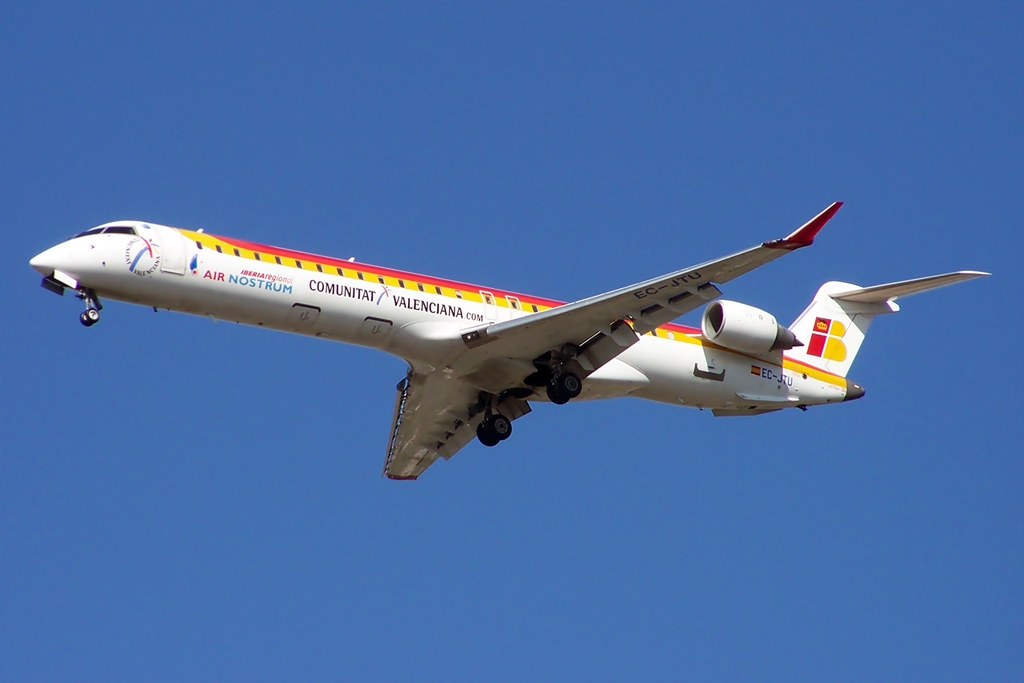
Bombardier CRJ700 series
Regional jet airliner series
The Bombardier CRJ700 series is a family of regional jet airliners that were designed and manufactured by Canadian transportation conglomerate Bombardier (formerly Canadair). Officially launched in 1997, the CRJ700 made its maiden flight on 27 May 1999, and was soon followed by the stretched CRJ900 variant. Several additional models were introduced, including the further elongated CRJ1000 and the CRJ550 and CRJ705, which were modified to comply with scope clauses. In 2020, the Mitsubishi Aircraft Corporation acquired the CRJ program and subsequently ended production of the aircraft.
Development of the CRJ700 series was launched in 1994 under the CRJ-X program, aimed at creating larger variants of the successful CRJ100 and 200, the other members of the Bombardier CRJ-series. Competing aircraft included the British Aerospace 146, the Embraer E-Jet family, the Fokker 70, and the Fokker 100.
In Bombardier’s product lineup, the CRJ-Series was marketed alongside the larger C-Series (now owned by Airbus and rebranded as the Airbus A220) and the Q-Series turboprop (now owned by De Havilland Canada and marketed as the Dash 8). In the late 2010s, Bombardier began divesting its commercial aircraft programs, and on 1 June 2020, Mitsubishi finalized the acquisition of the CRJ program. Bombardier continued manufacturing CRJ aircraft on behalf of Mitsubishi until fulfilling all existing orders in December 2020. While Mitsubishi continues to produce parts for existing CRJ operators, it currently has no plans to build new CRJ aircraft, having originally intended to focus on its SpaceJet aircraft, which has since been discontinued.
Development
Origins
During the early 1990s, Bombardier Aerospace became interested in developing larger variants of the CRJ 100 and 200 and associated design work commenced in 1994. The CRJ-X, as the new range was initially designated, sought to compete with larger regional jets such as the Fokker 70, Fokker 100 or the British Aerospace 146. The CRJ-X featured a stretched fuselage, a lengthened wing, and up-rated General Electric CF34-8C engines, while maintaining a common type-rating with the CRJ 100 and 200. Leading-edge extensions and high-lift slats improved the wing performance, other aerodynamic changes included an enlarged horizontal tailfin. By March 1995, low-speed wind tunnel testing confirmed a range of 1,530 nautical miles (2,830 km; 1,760 mi) in a 74-seat configuration intended for the North American market and 1,270 nautical miles (2,350 km; 1,460 mi) in a 72-seat configuration intended for the European market. First deliveries were planned for 1999.
In 1995, the development was projected to cost around C$300 million (US$200 million). In June 1996, Bombardier selected Rockwell Collins' Pro Line 4 avionics suite. During May 1996, General Electric formally launched the previously selected CF34-8C variant. Extensive redesigning resulted in the CRJ700 retaining only 15% of the CRJ200 airframe.
Launch
The CRJ-X launch was delayed by several months, due to negotiations with suppliers and subcontractors. During September 1996, Bombardier's board authorised sales of the CRJ-X. During January 1997, the CRJ-X was officially launched. In March 1997, four prototypes were planned for the CRJ700's flight-test program. On 27 May 1999, the first prototype CRJ700 made its maiden flight. At this point, type certification was expected for 2001. By 1999, Bombardier had invested C$650 million (US$440 million) to develop the 70-seat CRJ700, which was listed at $24–25 million.
A new final-assembly facility was established at Montréal-Mirabel International Airport, as the CRJ100/200's existing line had insufficient capacity. In January 2001, Transport Canada granted the CRJ700 its type approval. In May 2001, the U.S. Federal Aviation Administration certification for the CRJ700 was close, but required two minor avionics-related changes.
In September 1998, Bombardier considered developing an all-new 90-seat model, the BRJ-X, but ultimately opted for a stretched version of the CRJ-X, which became the CRJ900. It would share a type rating with the CRJ700, allowing pilots to transition between them with a three-day cross-crew qualification course. Development of the CRJ900 was underway by 1999, with Bombardier investing C$200 million for the CRJ900. The aircraft was initially priced at $28–29 million. The CRJ900's official launch was delayed in May 2000 due to contract negotiations, but it was formally introduced in July 2000. The aircraft was designed for existing CRJ200 and CRJ700 operators seeking a larger capacity jet. One of the CRJ700 prototypes was modified to represent the CRJ900 configuration, later joined by a second purpose-built test aircraft. The CRJ900 made its maiden flight on February 21, 2001, five months ahead of schedule, and the first aircraft was delivered in April 2003.
The CRJ1000, originally launched as the CRJ-900X in February 2007, was developed as a further stretch of the CRJ900 to accommodate up to 100 passengers. The CRJ1000 shares a high level of commonality with the CRJ700 and CRJ900, but featured an improved version of the General Electric CF34 engine, with enhanced high-pressure turbine performance achieved through optimized blade airfoil geometry, software upgrades, and improved cooling. The turbine nozzles were also redesigned to reduce the number of vanes from 48 to 34. The CRJ1000 also introduced a new cabin design with larger overhead luggage bins, larger windows, improved lighting, and redesigned ceiling panels and sidewalls. A prototype aircraft completed its first flight in 2008, followed by the production flight on 28 July 2009 in Montreal. One month into the flight-test program, a fault in the rudder controls was discovered, grounding the jet until February 2010, and deliveries were projected to begin by January 2011.
Further improvements
During 2007, Bombardier launched the CRJ900 NextGen, featuring improvements developed for the CRJ1000. The improvements include improvements to the GE CF34 engine which enhanced fuel economy by 5.5%, a redesigned cabin with larger overhead bins, and reduced costs by extending maintenance intervals. Mesaba Aviation (now Endeavor Air) operating at the time as Northwest Airlink (now Delta Connection), was the launch customer for the CRJ900 NextGen, and remains the largest operator of the CRJ900. A similar NextGen package was rolled out to the CRJ700 in 2008, with SkyWest Airlines as the launch customer.
During 2016, Bombardier further modernized the CRJ Series with the "Atmosphere" cabin, which included a more spacious entryway, larger overhead bins, larger windows situated higher upon the fuselage, a larger forward lavatory on the CRJ900 and CRJ1000, and LED accent lighting. Maintenance intervals were also further extended, with "A" checks occurring every 800 flight hours and "C" checks every 8,000 flight hours. A new engine nozzle provided an additional 1% fuel efficiency improvement.
Re-engine study
Throughout its production, the CRJ family competed with the Embraer E-Jet family series. However, Bombardier ultimately ruled out a re-engining the CRJ to compete with the Embraer E-Jet E2. Bombardier and General Electric studied a NG34 next generation engine using technologies from the GEnx, and even went as far as building a prototype core for testing. However, Bombardier felt that the certification costs and the added weight of newer, more efficient engines would negate potential fuel burn improvements on short-haul regional routes.
Sales history
During April 2000, a substantial early order, valued at US$10 billion, for the CRJ700 (and CRJ200) was issued by Delta Air Lines, involving 500 aircraft along with options for 406 more. Comair, operating as Delta Connection, placed an order of 14 CRJ900s; by November 2007, six of these had entered revenue service.
During September 2011, PLUNA received its 11th airplane (from an eventual total order of 15 with options). Estonian Air ordered three CRJ900 NextGen 88-seat aircraft. Also, SAS ordered 13 of these in March 2008. Iraqi Airways has ordered six Bombardier CRJ900 NextGen airliners and options on a further four of the type. In June 2010, Lufthansa ordered eight of the CRJ900 NextGen. In December 2012, Delta Air Lines ordered 40 CRJ900 NextGen worth $1.89 billion with 30 options.
During February 2012, Garuda Indonesia ordered six CRJ1000s and took options for another 18. Danish lessor Nordic Aviation Capital also ordered 12 for Garuda to operate, with delivery beginning in 2012.
According to Bombardier, by 2015, the CRJ series accounted for over 20% of all jet departures in North America; globally, the family operated in excess of 200,000 flights per month. Bombardier expected the 60–100-seat airliner market to represent 5,500 aircraft from 2018 through 2037.
Divestment
As of November 2018, following Bombardier's decisions to sell the CSeries to Airbus and the QSeries to Viking Air, the company was looking at "strategic options" to return the CRJ to profitability. Analysts suspected that it would decide to exit the commercial aircraft market altogether and refocus on business aircraft.
Content sourced from Wikipedia under CC BY-SA 4.0


