Biosphere 2
Closed ecological research center in Arizona
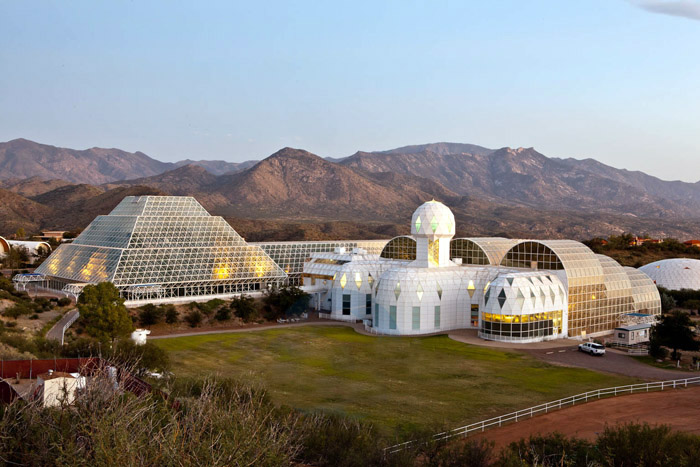
University of Arizona Biosphere 2 is an American Earth system science research facility located in Oracle, Arizona. Its mission is to serve as a center for research, outreach, teaching, and lifelong learning about Earth, its living systems, and its place in the universe. It is a 3.14-acre (1.27-hectare) structure originally built to be an artificial, materially closed ecological system, or vivarium. It remains the largest closed ecological system ever created. Constructed between 1987 and 1991, Biosphere 2 was planned to experiment with the viability of closed ecological systems to support and maintain human life in outer space as a substitute for Earth's biosphere.
It was designed to explore the web of interactions within life systems in a structure with different areas based on various biological biomes. In addition to the several biomes and living quarters for people, there was an agricultural area and work space to study the interactions between humans, farming, technology and the rest of nature as a new kind of laboratory for the study of the global ecology. Its mission was a two-year closure experiment with a crew of eight humans. Long-term it was seen as a precursor to gaining knowledge about the use of closed biospheres in space colonization. As an experimental ecological facility it allowed the study and manipulation of a mini biospheric system.
Its seven biome areas were a 1,900-square-meter (20,000 sq ft) rainforest, an 850-square-meter (9,100 sq ft) ocean with a coral reef, a 450-square-meter (4,800 sq ft) mangrove wetlands, a 1,300-square-metre (14,000 sq ft) savannah grassland, a 1,400-square-meter (15,000 sq ft) fog desert, and two anthropogenic biomes: a 2,500-square-meter (27,000 sq ft) agricultural system and a human habitat with living spaces, laboratories and workshops. Below ground was an extensive part of the technical infrastructure. Heating and cooling water circulated through independent piping systems and passive solar input through the glass space frame panels covering most of the facility, and electrical power was supplied into Biosphere 2 from an onsite natural gas power plant.
Biosphere 2 was only used twice for its original intended purposes as a closed-system experiment: once from 1991 to 1993, and the second time from March to September 1994. Both attempts ran into problems including low amounts of food and oxygen, die-offs of many animals and plants included in the experiment (though this was anticipated since the project used a strategy of deliberately "species-packing" anticipating losses as the biomes developed), group dynamic tensions among the resident crew, outside politics, and a power struggle over management and direction of the project. The second closure experiment achieved total food sufficiency and did not require injection of oxygen before the experiment ended early.
In June 1994, during the middle of the second experiment, the managing company, Space Biosphere Ventures, was dissolved, and the facility was left in limbo. Columbia University assumed management of the facility in 1995 and used it to run experiments until 2003. It then appeared to be in danger of being demolished to make way for housing and retail stores, but was taken over for research by the University of Arizona in 2007. The University of Arizona took full ownership of the structure in 2011. Research continues at the facility while also being a place that is open to the public.
Biosphere 2 is one of two enclosed artificial ecosystems in the Americas that are open to the public, the other being the Montreal Biodome.
Planning and construction
The Biosphere 2 project was launched in 1984 by businessman and billionaire philanthropist Ed Bass and systems ecologist John P. Allen, with Bass providing US$150 million in funding until 1991. Bass and Allen had met in the 1970s at the Synergia Ranch, a counterculture community led by Allen, who advocated Buckminster Fuller's "Spaceship Earth" concept and explored the idea of biospheres as a refuge from disasters such as nuclear war. Several other former members of Synergia Ranch also joined the Biosphere 2 project.
Construction was carried out between 1987 and 1991 by Space Biosphere Ventures, a joint venture whose principal officers were John P. Allen, inventor and executive chairman; Margaret Augustine, CEO; Marie Harding, vice-president of finance; Abigail Alling, vice president of research; Mark Nelson, director of space and environmental applications, William F. Dempster, director of system engineering, and Norberto Alvarez-Romo, vice president of mission control.
It was named "Biosphere 2" because it was meant to be the second fully self-sufficient biosphere, after the Earth itself ("Biosphere 1").
Location
The glass and spaceframe facility is located in Oracle, Arizona, at the base of the Santa Catalina Mountains, about 50 minutes north of Tucson. Its elevation is around 4,000 feet (1,200 m) above sea level.
Engineering
The above-ground physical structure of Biosphere 2 was made of steel tubing and high-performance glass and steel frames. The frame and glazing materials were designed and made to specification by a firm run by a one-time associate of Buckminster Fuller, Peter Jon Pearce (Pearce Structures, Inc.). The window seals and structures had to be designed to be almost perfectly airtight, such that the air exchange would be extremely low, permitting tracking of subtle changes over time. The patented airtight sealing methods, developed by Pearce and William Dempster, achieved a leak rate of less than 10% per year. Without such tight closure, the slow decline of oxygen which occurred at a rate of less than 0.25% per month during the first two-year closure experiment might not have been detected.
During the day, the heat from the sun caused the air inside to expand and during the night it cooled and contracted. To avoid having to deal with the huge forces that maintaining a constant volume would create, the structure had large diaphragms kept in domes called "lungs" or variable volume structures.
Since opening a window was not an option, the structure also required a sophisticated system to regulate temperatures within desired parameters, which varied for the different biomic areas. Though cooling was the largest energy need, heating had to be supplied in the winter and closed loop pipes and air handlers were key parts of the energy system. An energy center on site provided electricity and heated and cooled water, employing natural gas and backup generators, ammonia chillers and water cooling towers.
First mission
The first closed mission lasted from September 26, 1991, to September 26, 1993. The crew were: medical doctor and researcher Roy Walford, as well as Jane Poynter, Taber MacCallum, Mark Nelson, Sally Silverstone, Abigail Alling, Mark Van Thillo, and Linda Leigh.
The agricultural system produced 83% of the total diet, which included crops of bananas, papayas, sweet potatoes, beets, peanuts, lablab and cowpea beans, rice, and wheat. Especially during the first year, the eight inhabitants reported continual hunger. Calculations indicated that Biosphere 2's farm was among the highest producing in the world "exceeding by more than five times that of the most efficient agrarian communities of Indonesia, southern China, and Bangladesh".
They consumed the same low-calorie, nutrient-dense diet that Roy Walford had studied in his research on extending lifespan through diet. Medical markers indicated the health of the crew during the two years was excellent. They showed the same improvement in health indices such as lowering of blood cholesterol, blood pressure, and enhancement of immune system. They lost an average of 16% of their pre-entry body weight before stabilizing and regaining some weight during their second year. Subsequent studies showed that the biospherians' metabolism became more efficient at extracting nutrients from their food as an adaptation to the low-calorie, high-nutrient diet.
Some of the domesticated animals that were included in the agricultural area during the first mission included: four African pygmy goat does and one billy; 35 hens and three roosters (a mix of Indian jungle fowl (Gallus gallus), Japanese silky bantam, and a hybrid of these); two sows and one boar Ossabaw dwarf pigs; and tilapia fish grown in a rice and azolla pond system originating millennia ago in China.
A strategy of "species-packing" was practiced to ensure that food webs and ecological function could be maintained if some species did not survive. The fog desert area became more chaparral in character due to condensation from the space frame. The savannah was seasonally active; its biomass was cut and stored by the crew as part of their management of carbon dioxide. Rainforest pioneer species grew rapidly, but trees there and in the savannah suffered from etiolation and weakness caused by lack of stress wood, normally created in response to winds in natural conditions. Corals reproduced in the ocean area, and crew helped maintain ocean system health by hand-harvesting algae from the corals, manipulating calcium carbonate and pH levels to prevent the ocean from becoming too acidic, and by installing an improved protein skimmer to supplement the algae turf scrubber system originally installed to remove excess nutrients. The mangrove area developed rapidly but with less understory than a typical wetland, possibly because of reduced light levels. Nevertheless, it was judged to be a successful analogue to the Everglades area of Florida where the mangroves and marsh plants were collected.
Content sourced from Wikipedia under CC BY-SA 4.0


