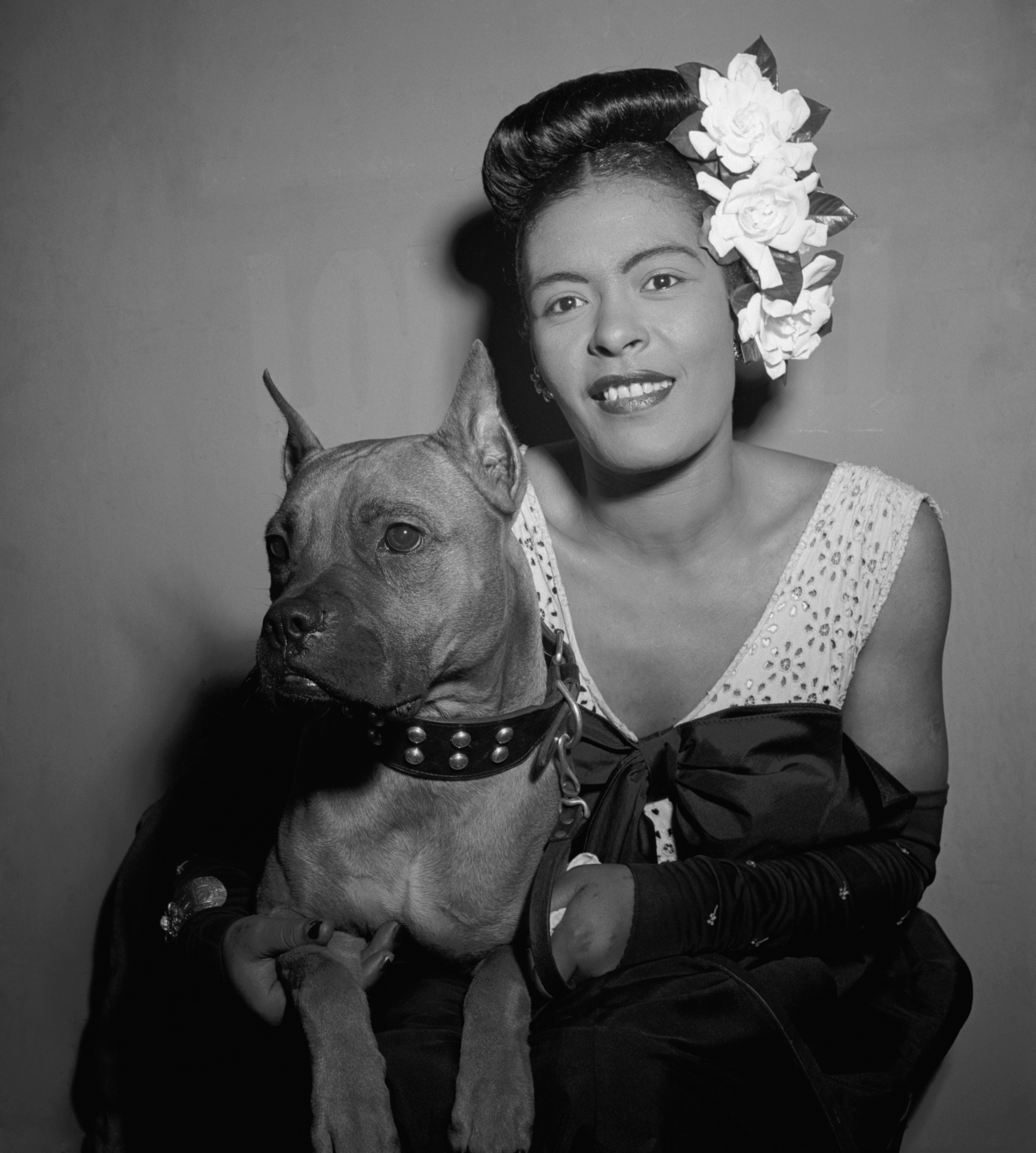
Billie Holiday
American jazz singer (1915–1959)
Billie Holiday (born Eleanora Fagan; April 7, 1915 – July 17, 1959) was an American jazz and swing music singer. Nicknamed "Lady Day" by her friend and music partner, Lester Young, Holiday made significant contributions to jazz music and pop singing. Her vocal style, strongly influenced by jazz instrumentalists, inspired a new way of manipulating phrasing and tempo. Holiday was known for her vocal delivery and improvisational skills.
After a turbulent childhood, Holiday began singing in nightclubs in Harlem where she was heard by producer John Hammond, who liked her voice. Holiday signed a recording contract with Brunswick in 1935. Her collaboration with Teddy Wilson produced the hit "What a Little Moonlight Can Do", which became a jazz standard. Throughout the 1930s and 1940s, Holiday had mainstream success on labels such as Columbia and Decca. However, by the late 1940s, she was beset with legal troubles and drug abuse. After a short prison sentence, Holiday performed a sold-out concert at Carnegie Hall. She was a successful concert performer throughout the 1950s, with two further sold-out shows at Carnegie Hall. Because of personal struggles and an altered voice, Holiday's final recordings were met with mixed reaction, but were mild commercial successes. Her final album, Lady in Satin, was released in 1958. Holiday died of cirrhosis and heart failure on July 17, 1959, at age 44.
Holiday won four Grammy Awards, all of them posthumously, for Best Historical Album. She was inducted into the Grammy Hall of Fame and the National Rhythm & Blues Hall of Fame. In 2000, Holiday was also inducted into the Rock and Roll Hall of Fame as an early influence; their website states that "Billie Holiday changed jazz forever". She was named one of the 50 Great Voices by NPR and was ranked fourth on the Rolling Stone list of "200 Greatest Singers of All Time" (2023). Several films about Holiday's life have been released, most recently The United States vs. Billie Holiday (2021).
Life and career
1915–1929: Childhood
Eleanora Fagan was born on April 7, 1915, in Philadelphia to African American unwed teenage couple Clarence Halliday and Sarah Julia "Sadie" Fagan (née Harris). Her mother moved to Philadelphia at age 19, after being evicted from her parents' home in the Sandtown-Winchester neighborhood of Baltimore, Maryland, for becoming pregnant. With no support from her parents, Sarah made arrangements with her older married half-sister, Eva Miller, for Holiday to stay with her in Baltimore.
Shortly after Holiday was born, her father abandoned his family to pursue a career as a jazz banjo player and guitarist. Some historians have disputed Holiday's paternity, as a copy of her birth certificate in the Baltimore archives lists her father as "Frank DeViese". Other historians consider this an anomaly, probably inserted by a hospital or government worker. DeViese lived in Philadelphia, and Sadie, then known by her maiden name Harris, may have met him through her work. Harris married Philip Gough in 1920, but the marriage only lasted a few years.
Holiday grew up in Baltimore and had a very difficult childhood. Her mother often took what were then known as "transportation jobs", serving on passenger railroads. Holiday was raised largely by Eva Miller's mother-in-law, Martha Miller, and suffered from her mother's absences and being in others' care for her first decade of life. Holiday's autobiography, Lady Sings the Blues, published in 1956, is inconsistent regarding details of her early life, but much was confirmed by Stuart Nicholson in his 1995 biography of the singer.
At the age of nine Holiday attended school at Saint Frances Academy in Baltimore, frequently skipping classes, which resulted in her being brought before the juvenile court at age nine. She was sent to the House of the Good Shepherd, a Catholic reform school for girls, where the nuns locked her in a room with a dead girl overnight as punishment for misbehavior. The experience traumatized her, and for years she would "dream about it and wake up hollering and screaming". After nine months, she was released on October 3, 1925, to her mother. Sadie had opened a restaurant, the East Side Grill, and they worked long hours there. She dropped out of school at age 11.
On December 24, 1926, Harris came home to discover a neighbor attempting to rape Holiday. She successfully fought back, and he was arrested. Officials sent Holiday back to the House of the Good Shepherd under protective custody as a state witness in the rape case. Holiday was released in February 1927, when she was nearly 12. She found a job running errands in a brothel, and she scrubbed marble steps as well as kitchen and bathroom floors of neighborhood homes. Around this time, she first heard the records of Louis Armstrong and Bessie Smith. In particular, Holiday cited "West End Blues" as an intriguing influence, pointing specifically to the scat section duet with the clarinet as her favorite part. By the end of 1928, Holiday's mother moved to Harlem, New York, again leaving Holiday with Martha Miller. By early 1929, Holiday had joined her mother in Harlem.
1929–1935: Early career
As a young teenager, Holiday started singing in nightclubs in Harlem. She took her professional pseudonym from Billie Dove, an actress she admired, and Clarence Halliday, her father. At the outset of her career, she spelled her last name "Halliday", her father's birth surname, but eventually changed it to "Holiday", his performing name. The young singer teamed up with a neighbor, tenor saxophone player Kenneth Hollan. They were a team from 1929 to 1931, performing at clubs such as the Grey Dawn, Pod's and Jerry's on 133rd Street, and the Brooklyn Elks Club. Benny Goodman recalled hearing Holiday in 1931 at the Bright Spot. As her reputation grew, she played in many clubs, including the Mexico's and the Alhambra Bar and Grill, where she met Charles Linton, a vocalist who later worked with Chick Webb. It was also during this period that she connected with her father, who was playing in Fletcher Henderson's band.
Late in 1932, 17-year-old Holiday replaced the singer Monette Moore at Covan's, a club on West 132nd Street. Producer John Hammond, who loved Moore's singing and had come to hear her, first heard Holiday there in early 1933. Hammond arranged for Holiday to make her recording debut at age 18, in November 1933, with Benny Goodman. She recorded two songs: "Your Mother's Son-In-Law" and "Riffin' the Scotch", the latter being her first hit. "Son-in-Law" sold 300 copies, and "Riffin' the Scotch", released on November 11, sold 5,000 copies. Hammond was impressed by Holiday's singing style and said of her, "Her singing almost changed my music tastes and my musical life, because she was the first girl singer I'd come across who actually sang like an improvising jazz genius." Hammond compared Holiday favorably to Armstrong and said she had a good sense of lyric content at a young age.
In 1935, Holiday had a small role as a woman abused by her lover in Duke Ellington's musical short film Symphony in Black: A Rhapsody of Negro Life. She sang "Saddest Tale" in her scene.
1935–1938: Recordings with Teddy Wilson
In 1935, Holiday was signed to Brunswick by John Hammond to record pop tunes with pianist Teddy Wilson in the swing style for the growing jukebox trade. They were allowed to improvise on the material. Holiday's improvisation of melody to fit the emotion was highly skillful. Their first collaboration included "What a Little Moonlight Can Do" and "Miss Brown to You". "What a Little Moonlight Can Do" has been deemed her "claim to fame". Brunswick did not favor the recording session because producers wanted Holiday to sound more like Cleo Brown. However, after "What a Little Moonlight Can Do" was successful, the company began considering Holiday an artist in her own right. She began recording under her own name a year later for Vocalion in sessions produced by Hammond and Bernie Hanighen. Hammond said the Wilson-Holiday records from 1935 to 1938 were a great asset to Brunswick. According to Hammond, Brunswick was broke and unable to record many jazz tunes. Wilson, Holiday, Young, and other musicians came into the studio without written arrangements, reducing the recording cost. Brunswick paid Holiday a flat fee rather than royalties, which saved the company money. "I Cried for You" sold 15,000 copies, which Hammond called "a giant hit for Brunswick.... Most records that made money sold around three to four thousand."
Another frequent accompanist was tenor saxophonist Lester Young, who had been a boarder at her mother's house in 1934 and with whom Holiday had a rapport. Young said, "I think you can hear that on some of the old records, you know. Some time I'd sit down and listen to 'em myself, and it sound like two of the same voices ... or the same mind, or something like that." Young nicknamed her "Lady Day", and she called him "Prez".
Content sourced from Wikipedia under CC BY-SA 4.0


