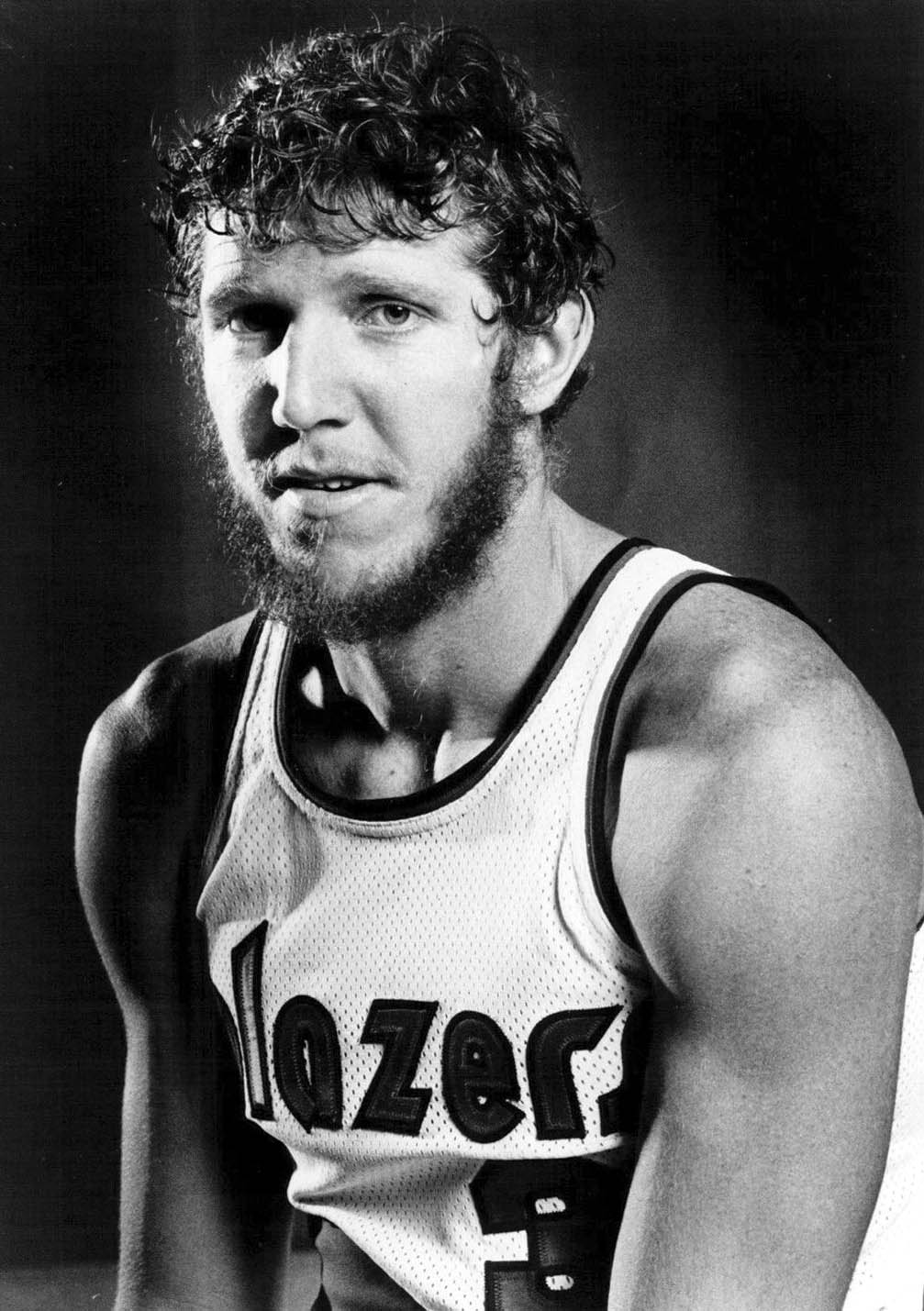
Bill Walton
American basketball player and sportscaster (1952–2024)
William Theodore Walton III (November 5, 1952 – May 27, 2024) was an American basketball player and television sportscaster. He played collegiately for the UCLA Bruins and professionally in the National Basketball Association (NBA) for the Portland Trail Blazers, San Diego / Los Angeles Clippers, and Boston Celtics. He is a member of the Naismith Memorial Basketball Hall of Fame and the National Collegiate Basketball Hall of Fame.
Walton rose to prominence in the early 1970s as UCLA's starting center for coach John Wooden. The 6-foot-11-inch (2.11 m) Walton won three consecutive national college player of the year awards (1972–1974), while leading UCLA to NCAA championships in 1972 and 1973 and an 88-game winning streak. After being selected as the first overall pick in the 1974 NBA draft, Walton led the Portland Trail Blazers to the team's first and only NBA championship in 1977, earning the NBA Finals Most Valuable Player Award. The following season, Walton was the 1978 NBA Most Valuable Player (MVP).
Walton's professional career, however, was significantly hampered by foot injuries, requiring numerous surgeries (Walton underwent 37 orthopedic surgeries in his lifetime). As a result, Walton only played in 468 out of 1,148 possible regular season games across his 14-year NBA career. After his MVP season, Walton sat out the 1978–79 season and was then signed by the Clippers, for whom he played four injury-plagued seasons. His career was rehabilitated during two seasons with the Celtics at the end of his career. Playing as a backup center behind Robert Parish, Walton earned the NBA Sixth Man of the Year Award in the 1985–86 season and contributed significantly to the Celtics' playoff run that year, culminating in his second NBA championship. He was named to the NBA's 50th and 75th anniversary teams.
After retiring from the NBA, Walton overcame stuttering and embarked on a second career as a sportscaster, working both as a studio analyst and color commentator with several networks and teams. He earned an Emmy Award in 1991.
Early life
Walton was born and raised in La Mesa, California, a suburb of San Diego, the son of Gloria Anne (née Hickey) and William Theodore "Ted" Walton Jr. He was raised with siblings Bruce, Cathy, and Andy. The Walton home was on a hillside on Colorado Avenue, just below Lake Murray.
Walton's father was a music teacher and social worker, and his mother was a librarian. His parents had interests in art, literature, politics, and music. Walton took music lessons, and although his parents were not sports-oriented, Walton followed in the footsteps of his older brother Bruce, who had gravitated toward sports. When the Walton children were in junior high and high school, their father formed an informal family band: Bruce played trombone, Bill played baritone horn, Andy played the saxophone, and Cathy played drums (or flute or tuba).
Walton first played organized basketball under Frank "Rocky" Graciano, who coached at Walton's Catholic elementary school. Walton said that Graciano "made it [basketball] fun and really emphasized the joy of playing the team game. I was a skinny, scrawny guy. I stuttered horrendously, couldn't speak at all. I was a very shy, reserved player and a very shy, reserved person. I found a safe place in life in basketball."
High school career
Walton played high school basketball at Helix High School in La Mesa alongside his older brother Bruce, who was also a star on the school's football team and would later go on to play for the Dallas Cowboys. During games with the two Waltons on the court, any tough physical treatment laid out on the younger Bill would be matched back by the 6 ft 6 in (1.98 m), 300 pounds (136 kg) Bruce in turn.
"When those opposing teams would try to get physical with me, Bruce would do whatever it took to protect me," Walton recalled. "He went on to play for the Dallas Cowboys. Bruce and I are the only brother combination in history to ever play in the Super Bowl and to win the NBA championship."
"When they would begin to rough up Bill, I would look at coach and he would give me a nod." recalled Bruce. "Yes," said Gloria Walton, "then when the referee wasn't looking, Bruce would give the player an elbow and let him know that the skinny guy was his kid brother."
Walton's struggle with injury and pain began while at Helix, where he broke an ankle, a leg, several bones in his feet, and underwent knee surgery. Before his sophomore season, Walton underwent surgery to repair torn cartilage on his left knee. Because of his recovery from the knee surgery, Walton played most of his sophomore year on the junior varsity team. Coach Gordon Nash promoted him to the varsity team the end of the season. But, he played in only six games and did not start any of them.
Between his sophomore and junior years of high school (age 15–16), Walton grew from 6 ft 1 in (1.85 m) to 6 ft 7 in (2.01 m). Coach Nash played Bill and Bruce Walton together in the paint. Bill was taller, but frail as he had not filled out his growing frame. Bill was unable to play a complete game without resting. "He would simply get too tired", recalled Nash. "When that happened, he'd tell me and I'd take him out."
While Walton was in high school in 1967, the NBA expansion San Diego Rockets came to town. The Rockets had no set practice facility and would often play pick-up games at Helix High School. Rocket players learned that to get into the Helix gym they could call the teenage Walton, who had his own gym key. Walton recalled Elvin Hayes calling and telling his mother, "Tell Billy, Big E is calling and we need him to open the gym tonight. I said, 'Mom, that's Big E! Give me the phone!' I was never so embarrassed in my life. Elvin and I are still close friends. All of those guys, all still my friends to this very day."
"We had the best gym in San Diego and all the Rockets players wanted to go there," Walton reflected. "They had some great teams with Elvin Hayes and Calvin Murphy and future head coaches and broadcasters such as Pat Riley, Rick Adelman, Rudy Tomjanovich, Jim Barnett, and Stu Lantz. All these guys treated me—little Billy—like I was part of the team. They couldn't have been nicer, and I became their friend."
Championships and national records
Walton overcame all obstacles and led Helix to 49 consecutive victories in his two varsity seasons. Helix won the California Interscholastic Federation (CIF) Championship in both 1969 and 1970, finishing 29–2 in 1968–69 and 33–0 in 1969–70. He graduated at about 6 ft 11 in (2.11 m) tall. Walton averaged 29 points and 25 rebounds, as Helix finished 33–0 in his senior season.
As a senior in 1969–70, Walton made 384 of 490 shot attempts, 78.3 percent, still the all-time national record. In addition, Walton's 825 rebounds that season ranks No 3 all-time. His 25.0 rebounds per game in a season ranks No. 7 all-time.
In 1970, Walton was featured in "Faces in the Crowd" in the January 26 issue of Sports Illustrated, his first national media recognition.
"It was a dream come true to be a part of a special team," Walton said. "Helix is where it all began. It was a humbling honor and privilege to be on the same squad as true legends Monroe Nash, Wilbur Strong, Phil Edwards, and Bruce Menser. I'm the luckiest guy on earth."
Hall of Fame Coach Denny Crum, then an assistant coach at University of California, Los Angeles (UCLA) under John Wooden, was sent to watch Walton play. Crum first saw Walton in 1968 as a high school junior and was at first dubious when hearing of Walton, but went to scout him anyway. "I came back and told Coach Wooden that this Walton kid was the best high school player I'd ever seen," Crum recalled.
College career
Beginning in elementary and high school, Walton had loyally followed UCLA's basketball team on the radio. He was recruited by many colleges, but quickly accepted UCLA's scholarship offer to play basketball for the Bruins and Coach Wooden. Wooden became a lifetime mentor to Walton.
Said Walton of Coach Wooden: "I was John Wooden's easiest recruit. I became his worst nightmare. I drove the poor guy to an early grave when he was 99. I had three different periods of my life in my relationship with him: (1) when I was a high school student and he was recruiting me; (2) when I played for him when I was 17 to 21; (3) and then 36 years of being his friend. I had no idea what we had at UCLA. I thought everybody had the same thing: great parents, great schools, great neighborhoods, great colleges, great coaches. Then I joined the NBA. And I realized immediately that I had just absolutely blown this whole deal with John Wooden. And so I spent the rest of my life, first of all, trying to make it up to him; and second of all, no longer [bringing] consternation into his life."
Walton played for UCLA under Coach Wooden from 1971 to 1974. His older brother Bruce played football at UCLA, enrolling a year ahead of Bill. Bill Walton led the Bruins to two consecutive 30–0 seasons and the NCAA men's basketball record 88-game winning streak. The UCLA streak contributed to a personal winning streak of 142 games that lasted almost five years, in which Walton's high school, UCLA freshman (freshmen were ineligible for the varsity at that time) and UCLA varsity teams did not lose a game from the middle of his junior year of high school to the middle of his senior year in college.
Content sourced from Wikipedia under CC BY-SA 4.0


