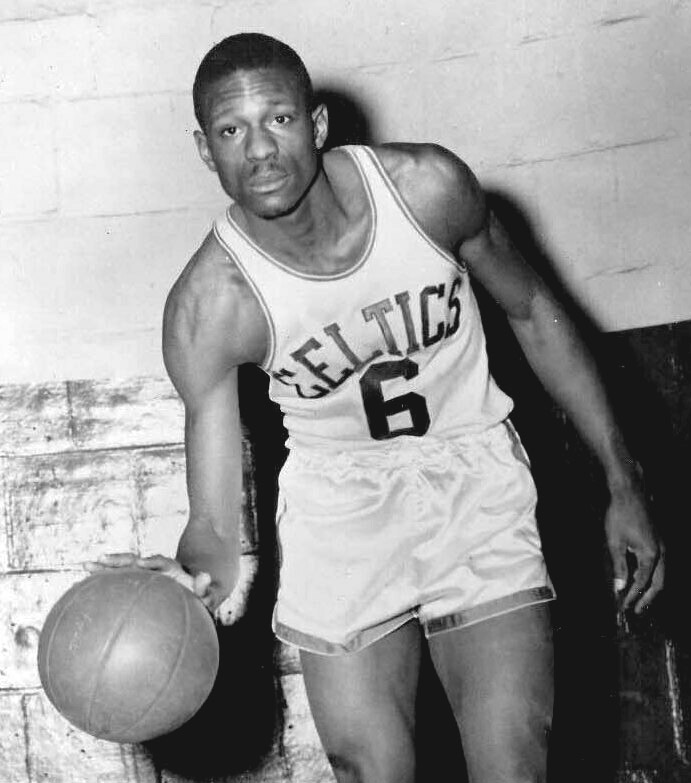
Bill Russell
American basketball player and coach (1934–2022)
William Felton Russell (February 12, 1934 – July 31, 2022) was an American professional basketball player who played center for the Boston Celtics of the National Basketball Association (NBA) from 1956 to 1969. He was the centerpiece of the Celtics dynasty that played for 12 NBA championships and won 11 during his 13-year career. Russell is widely considered one of the greatest basketball players of all time.
Russell played college basketball for the San Francisco Dons, leading them to consecutive NCAA championships in 1955 and 1956. He was named NCAA tournament Most Outstanding Player (MOP), and captained the gold medal-winning U.S. national basketball team at the 1956 Summer Olympics. These victories along with his NBA championships made Russell one of only eight players in the history of basketball to achieve the Triple Crown.
After being chosen by the St. Louis Hawks with the second overall pick in the 1956 NBA draft, Russell was traded to the Boston Celtics for Celtics center Ed Macauley and small forward Cliff Hagan. With Russell as their starting center and defensive anchor, the Celtics went on to win their first NBA championship in 1957 and won an NBA record eight consecutive championships from 1959 to 1966. A five-time NBA Most Valuable Player (MVP) and a 12-time NBA All-Star, Russell's rebounding, defense, and leadership made him one of the dominant players of his era. Standing at 6 ft 10 in (2.08 m) tall, with a 7-foot-4-inch (2.24 m) arm span, his shot-blocking and man-to-man defense were major reasons for the Celtics' dominance during his career. Russell also led the NBA in rebounds four times, had a dozen consecutive seasons of 1,000 or more rebounds, and remains second all-time in both total rebounds and rebounds per game. Russell played in the wake of black pioneers Earl Lloyd, Chuck Cooper, and Sweetwater Clifton, and he was the first black player to achieve superstar status in the NBA. During the final three seasons of his career (1966–1969), he served as player-coach of the Celtics, becoming the first black NBA coach to win a championship. Russell ended his playing career and left his position as Celtics coach after helping the Celtics win the 1969 NBA championship.
Russell served as head coach and general manager of the Seattle SuperSonics from 1973 to 1977. He also coached the Sacramento Kings from 1987 to 1988. Russell also worked as a color commentator and authored several books.
Russell was inducted into the Naismith Memorial Basketball Hall of Fame in 1975, was one of the founding inductees into the National Collegiate Basketball Hall of Fame in 2006 and was enshrined in the FIBA Hall of Fame in 2007. He was selected into the NBA 25th Anniversary Team in 1971 and the NBA 35th Anniversary Team in 1980, was named as one of the 50 Greatest Players in NBA History in 1996 (being one of only four players to receive all three honors), and was selected to the NBA 75th Anniversary Team in 2021. In 2009, the NBA renamed the NBA Finals MVP Award in his honor. In 2011, Barack Obama awarded Russell the Presidential Medal of Freedom for his accomplishments on the court and in the civil rights movement. In 2021, Russell was inducted into the Naismith Memorial Basketball Hall of Fame a second time in recognition of his coaching career. Shortly after his death in 2022, the NBA retired Russell's #6 jersey league-wide, making him the only player in NBA history to receive that honor, as well as the third person in North American major professional sports to have their jersey number retired league-wide, behind Jackie Robinson and Wayne Gretzky.
Early life
Family
William Felton Russell was born on February 12, 1934, to Charles Russell and Katie Russell in West Monroe, Louisiana. Like many Southern towns and cities of that time, Monroe was segregated, and the Russells often struggled with racism in their daily lives. Russell's father was once refused service at a gas station until the staff had taken care of all the white customers first. When he attempted to leave and find a different station, the attendant stuck a shotgun in his face and threatened to kill him if he did not stay and wait his turn. In another incident, Russell's mother was walking outside in a fancy dress when a white policeman accosted her. He told her to go home and remove the dress, which he described as "white woman's clothing".
During World War II, the Second Great Migration began, with large numbers of Black people leaving the South to find jobs in the rest of the U.S. When Russell was eight years old, his father moved the family to Oakland, California. While there, they fell into poverty and Russell spent his childhood living in a series of public housing projects.
His father was said to be a "stern, hard man" who initially worked in a paper factory as a janitor, which was what sports journalist John Taylor called a typical "Negro Job"—low-paid and not intellectually challenging. When World War II broke out, the elder Russell became a truck driver. Russell was closer to his mother Katie than to his father, and he received a major emotional blow when she suddenly died when he was 12 years old. His father gave up his trucking job and became a steelworker to be closer to his children. Russell stated that his father became his childhood hero, later followed up by Minneapolis Lakers superstar George Mikan, whom he met when he was in high school. Of Russell, the college basketball player, Mikan said: "Let's face it, he's the best. He's so good, he scares you."
Russell's older brother was playwright Charlie L. Russell.
Initial exposure to basketball
During his early years Russell struggled to develop his skills as a basketball player. Although he was a good runner and jumper and had large hands, he did not understand the game and was cut from the team at Herbert Hoover Junior High School. As a freshman at McClymonds High School in Oakland, Russell was almost cut again; as he saw Russell's raw athletic potential, coach George Powles encouraged him to work on his fundamentals. After Russell was cut from the junior varsity basketball team as a junior in high school, Powles gave him a spot on the varsity team and bought him a yearlong community center membership. Since Russell's previous experiences with white authority figures were often negative, warm words from Powles reassured him. Frank Robinson, a future member of the Baseball Hall of Fame, was one of Russell's high school basketball teammates.
Russell soon became noted for his unusual style of defense. He later recalled: "To play good defense ... it was told back then that you had to stay flatfooted at all times to react quickly. When I started to jump to make defensive plays and to block shots, I was initially corrected, but I stuck with it, and it paid off." In an autobiographical account, Russell said that while on a California High School All-Stars tour, he became obsessed with studying and memorizing other players' moves, e.g., footwork such as which foot they moved first on which play, as preparation for defending against them, which included practicing in front of a mirror at night. Russell described himself as an avid reader of Dell Magazines' 1950s sports publications, which he used to scout opponents' moves for the purpose of defending against them.
Russell was ignored by college recruiters and did not receive an offer until recruiter Hal DeJulio from the University of San Francisco (USF) watched him play in a high school game. DeJulio was unimpressed by Russell's meager scoring and "atrocious fundamentals", but he sensed that the young Russell had an extraordinary instinct for the game, especially in the clutch. Russell eagerly accepted the offer. Sports journalist John Taylor described the scholarship offer as a watershed event in Russell's life because Russell realized that basketball was his chance to escape poverty and racism, and he swore to make the best of it. Russell graduated from McClymonds in 1952.
College career
University of San Francisco
Basketball
Russell started college at USF in 1952. He averaged 20 points per game on the Dons' freshman basketball team, and made his varsity debut on December 1, 1953. He became the starting center for coach Phil Woolpert, who emphasized defense and deliberate half-court play, which favored Russell's exceptional defensive skills. Woolpert's choice of how to deploy his players was unaffected by their skin color. In 1954, he became the first coach of a major college basketball program to start three African-American players: K. C. Jones, Hal Perry, and Russell. In his USF years, Russell took advantage of his relative lack of bulk to guard other players than the opposing center: using his quickness and speed, he would double-up on forwards and aggressively challenge their shots. Russell played on USF's varsity team from 1953 to 1956.
Content sourced from Wikipedia under CC BY-SA 4.0


