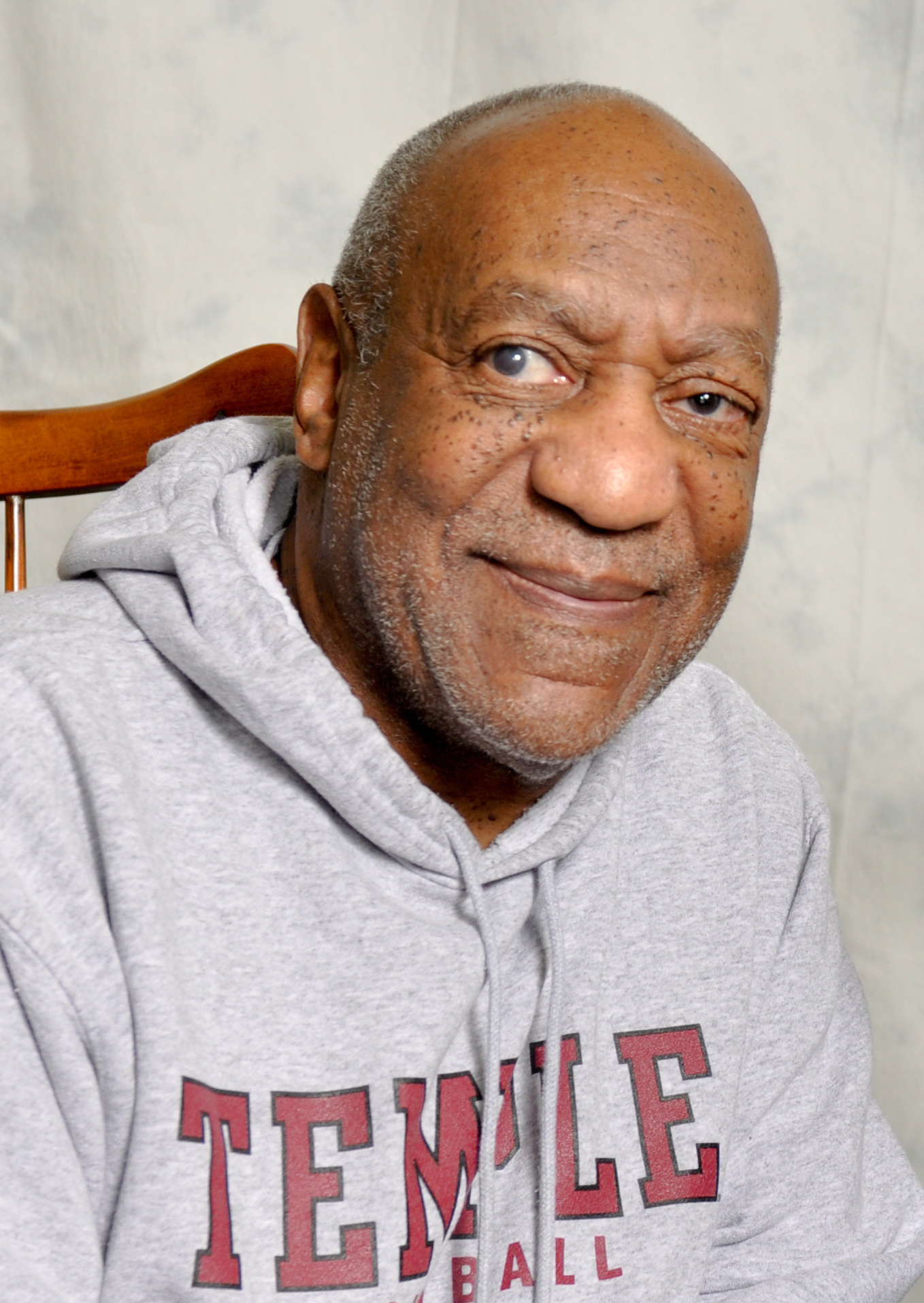
Bill Cosby
American entertainer (born 1937)
William Henry Cosby Jr. ( KOZ-bee; born July 12, 1937) is an American former comedian, actor, and media personality. Often deemed a trailblazer for African Americans in the entertainment industry, Cosby was a film, television, and stand-up comedy star, with his longest-running live-action role being that of Cliff Huxtable in the sitcom The Cosby Show (1984–1992). He also released several stand-up comedy albums and was a popular spokesperson in advertising for decades. Cosby was well known in the United States for his fatherly image and gained a reputation as "America's Dad". Starting in 2014, dozens of allegations of sexual assault were made against him, ending his career and sharply diminishing his status as a pop culture icon by the time of his incarceration in 2018.
Cosby began his career as a stand-up comic at the Hungry I nightclub in San Francisco in 1961, and primarily performed observational comedy in a conversational style. He released numerous standup specials starting with Bill Cosby Is a Very Funny Fellow...Right! (1963) and starred in the comedy film Bill Cosby: Himself (1983). Cosby still holds the record for winning the most Grammy Awards for Best Comedy Album, with seven wins. His acting career began with a starring role in the NBC secret-agent show I Spy (1965–1968), which broke new ground for African Americans when he made history by winning three Primetime Emmy Awards for Best Actor in a Drama Series, becoming the first black actor to do so.
Cosby made his film debut starring in Man and Boy (1971) followed by Hickey & Boggs (1972), Uptown Saturday Night (1974), Let's Do It Again (1975), A Piece of the Action (1977), Leonard Part 6 (1987), and Ghost Dad (1990). He produced and starred in a series of television sitcoms such as The Bill Cosby Show (1969–1971), Fat Albert and the Cosby Kids (1972–1985) and The Cosby Show (1984–1992) as well as its spin-off A Different World (1987–1993), The Cosby Mysteries (1994–1995), and Cosby (1996–2000). He hosted Kids Say the Darndest Things (1998–2000). During his prolific career he advertised numerous products including the Jell-O ice pop treats Pudding Pop.
Over 60 women have accused Cosby of various offenses, including rape, drug-facilitated sexual assault, sexual battery, child sexual abuse and sexual harassment. Those allegations gained traction in 2014 after fellow comedian Hannibal Buress mentioned the allegations in a comedy set that went viral. Cosby has maintained his innocence. Although he had received numerous awards and honorary degrees, several of them were revoked following the allegations. Reruns of The Cosby Show and other programs featuring Cosby were pulled from syndication. In 2018, he was convicted of aggravated sexual assault against Andrea Constand. He was imprisoned until the conviction was vacated in June 2021 by the Supreme Court of Pennsylvania on the grounds that Cosby's 5th Amendment and 14th Amendment due process rights had been violated. In 2022, Cosby was found liable for having sexually assaulted Judy Huth when she was 16 years of age.
Early life and further education
William Henry Cosby Jr. was born on July 12, 1937, in Philadelphia. He is one of four sons of Anna Pearl (née Hite), a maid, and William Henry Cosby Sr., who served as a mess steward in the U.S. Navy.
Cosby was the class president as well as captain of both the baseball and track-and-field teams at Mary Channing Wister Public School in Philadelphia. Teachers noted his propensity for joking around instead of studying, and he described himself as the class clown. Cosby attended Philadelphia's Central High School, a magnet school and academically rigorous college prep school, where he ran track and played baseball, football, and basketball. He transferred to Germantown High School but failed the tenth grade.
In 1956, Cosby enlisted in the Navy and served as a hospital corpsman at the Marine Corps Base Quantico in Virginia; at Naval Station Argentia in Newfoundland, Canada; and at the National Naval Medical Center in Maryland. He worked in physical therapy with Navy and Marine Corps personnel who were injured during the Korean War. He served until 1960 and became a petty officer 3rd class.
Cosby earned his high school equivalency diploma (HSED) through correspondence courses and was awarded a track-and-field scholarship to Temple University in 1961. At Temple, he studied physical education while he ran track and played fullback on the college's football team. Cosby began bartending at a Philadelphia club, where he earned bigger tips by making the customers laugh. He then began performing on stage and left his university studies to pursue a career in comedy.
Cosby resumed his formal education in 1971. Temple University granted him his bachelor's degree on the basis of what it referred to as life experience. He then began graduate work at UMass Amherst, receiving his Master of Arts (MA) degree in 1972.
He returned to UMass Amherst, and in 1976, while producing Fat Albert and the Cosby Kids, he earned his Doctor of Education (Ed.D.) degree. His dissertation was titled An Integration of the Visual Media Via 'Fat Albert And The Cosby Kids' into the Elementary School Curriculum as a Teaching Aid and Vehicle to Achieve Increased Learning.
Career
Stand-up comedy
Cosby lined up stand-up jobs at clubs in Philadelphia and then in New York City, where he appeared at The Gaslight Cafe beginning in 1961. He booked dates in cities such as Chicago, Las Vegas, San Francisco, and Washington, D.C. On July 28, 1964, he received national exposure on NBC's The Tonight Show. This led to a recording contract with Warner Bros. Records which, in 1964, released his debut LP, Bill Cosby Is a Very Funny Fellow...Right!, the first of a series of comedy albums. His album To Russell, My Brother, Whom I Slept With was number one on Spin magazine's list of "The 40 Greatest Comedy Albums of All Time", calling it "stand-up comedy's masterpiece".
Cosby's comedy genres included observational comedy, satire, surreal humor and deadpan. While many comics of the time were using the growing freedom of that decade to explore controversial and sometimes risqué material, Cosby was making his reputation with humorous recollections of his childhood. Many Americans wondered about the absence of race as a topic in Cosby's stories. As Cosby's success grew, he had to defend his choice of material regularly; as he argued, "A white person listens to my act and he laughs and he thinks, 'Yeah, that's the way I see it too.' Okay. He's white. I'm Negro. And we both see things the same way. That must mean that we are alike. Right? So I figure this way I'm doing as much for good race relations as the next guy."
In 1983, Cosby released the live comedy performance film Bill Cosby: Himself, in which he gave his views ranging from marriage to parenthood. The film also showcased Cosby's conversational style of stand-up comedy; for most of the performance, Cosby was seated center-stage, only getting up to emphasize a joke. Nearly all of Cosby's routine in the film concerned the trials and tribulations of parenting, frequently illustrated with anecdotes involving his own family. Many of the comedic routines presented in the film were precursors to Cosby's most popular sitcom, The Cosby Show. The film was well regarded by comedians and critics, with some calling it "the greatest stand up concert movie ever." Rolling Stone placed Cosby's concert film Bill Cosby: Himself as number 8 on its list of "The 25 Best Stand-Up Specials of All Time", acknowledging the significance of the film while still saying: "Yes, it's damned near impossible to watch anything the tainted comedian has done and not think of the headlines, the heckling, the revelations and what is, by any definition, monstrous behavior." They also placed Cosby at number 8 on their list of "The Best Stand-up Comics of All Time", saying: "Bill Cosby is not likely to perform again; listening to his records will never have that gentle, sweet sense of nostalgia for anyone; and while it is impossible to disconnect the performer from the man, scrubbing his name from the annals of stand-up would be impossible."
Cosby performed his first TV stand-up special in 30 years, Bill Cosby: Far from Finished, on Comedy Central on November 23, 2013. His last show of the "Far from Finished" tour was performed at the Cobb Energy Performing Arts Centre in Atlanta on May 2, 2015. In 2014, Cosby was set to release his new standup special Bill Cosby 77 on Netflix. The release of the film was canceled due to allegations of sexual assault against Cosby. His last known standup performance prior to his conviction was held at the LaRose Jazz Club in Philadelphia on January 23, 2018.
Content sourced from Wikipedia under CC BY-SA 4.0


