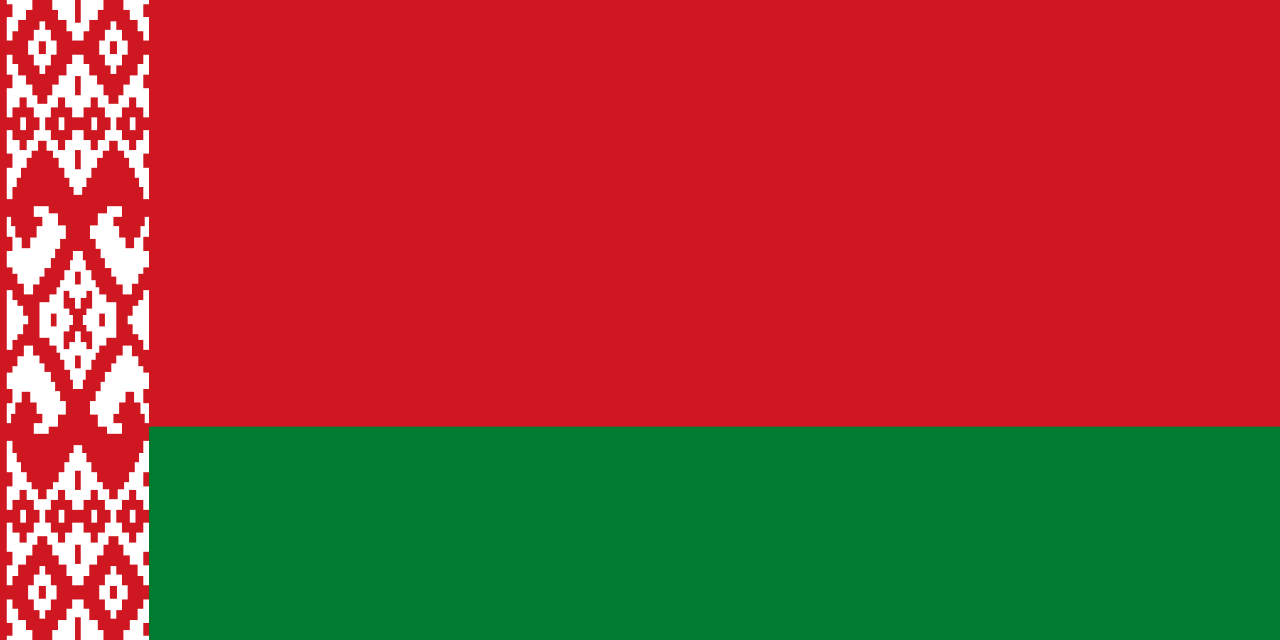
Belarus
Country in Eastern Europe
Belarus, officially the Republic of Belarus, is a landlocked country in Eastern Europe. It is bordered by Russia to the east and northeast, Ukraine to the south, Poland to the west, and Lithuania and Latvia to the northwest. Belarus spans an area of 207,600 square kilometres (80,200 sq mi) with a population of 9.1 million. The country has a hemiboreal climate and is administratively divided into six regions. Minsk is the capital and largest city; it is administered separately as a city with special status.
For most of the medieval period, the lands of modern-day Belarus were ruled by independent city-states such as the Principality of Polotsk. Around 1300 these lands came fully under the Grand Duchy of Lithuania and subsequently by the Polish–Lithuanian Commonwealth; this period lasted for 500 years until the 1792–1795 partitions of Poland-Lithuania placed Belarus within the Russian Empire for the first time. In the aftermath of the Russian Revolution in 1917, different states arose competing for legitimacy amid the Civil War, ultimately ending in the rise of the Byelorussian SSR, which became a founding constituent republic of the Soviet Union in 1922. After the Polish-Soviet War (1918–1921), Belarus lost almost half of its territory to Poland. Much of the borders of Belarus took their modern shape in 1939, when some lands of the Second Polish Republic were reintegrated into it after the Soviet invasion of Poland, and were finalised after World War II. During World War II, military operations devastated Belarus, which lost about a quarter of its population and half of its economic resources. In 1945, the Byelorussian SSR became a founding member of the United Nations, along with the Soviet Union. The republic was home to a widespread and diverse anti-Nazi insurgent movement which dominated politics until well into the 1970s, overseeing Belarus's transformation from an agrarian to an industrial economy.
The parliament of the republic proclaimed the sovereignty of Belarus on 27 July 1990, and during the dissolution of the Soviet Union, Belarus gained independence on 25 August 1991. Following the adoption of a new constitution in 1994, Alexander Lukashenko was elected Belarus's first president in the country's first and only free election after independence, serving as president ever since. Lukashenko heads a highly centralised authoritarian government. Belarus ranks low in international measurements of freedom of the press and civil liberties. It has continued several Soviet-era policies, such as state ownership of large sections of the economy. In 2000, Belarus and Russia signed a treaty for greater cooperation, forming the Union State.
The country has been a member of the United Nations since its founding and has joined the CIS, the CSTO, the EAEU, the OSCE, and the Non-Aligned Movement. It has shown no aspirations of joining the European Union but maintains a bilateral relationship with the bloc, and also participates in the Baku Initiative. Belarus is among the only three European countries (along with Russia and Kosovo) not a member of the Council of Europe; it attempted to join in 1993 but was refused admission because of electoral malpractice and serious human rights concerns (Belarus is the only European country that continues to use capital punishment). Its limited relationship with the Council was suspended after the 2022 Russian invasion of Ukraine from its territory in April of that year.
Etymology
The name Belarus is closely related with the term Belaya Rus', i.e., White Rus'. There are several claims to the origin of the name White Rus'. An ethno-religious theory suggests that the name used to describe the part of old Ruthenian lands within the Grand Duchy of Lithuania that had been populated mostly by Slavs who had been Christianized early, as opposed to Black Ruthenia, which was predominantly inhabited by pagan Balts. An alternative explanation for the name comments on the white clothing the local Slavic population wears. A third theory suggests that the old Rus' lands that were not conquered by the Tatars (i.e., Polotsk, Vitebsk, and Mogilev) had been referred to as White Rus'. A fourth theory suggests that the color white was associated with the west, and Belarus was the western part of Rus' in the 9th to 13th centuries.
The name Rus' is often conflated with its Latin forms Russia and Ruthenia, thus Belarus is often referred to as White Russia or White Ruthenia. The name first appeared in German and Latin medieval literature; the chronicles of Jan of Czarnków mention the imprisonment of Lithuanian grand duke Jogaila and his mother at "Albae Russiae, Poloczk dicto" in 1381. The first known use of White Russia to refer to Belarus was in the late-16th century by Englishman Sir Jerome Horsey, who was known for his close contacts with the Russian royal court. During the 17th century, the Russian tsars used the term to describe the lands added from the Grand Duchy of Lithuania.
The term Belorussia (Russian: Белоруссия, the latter part similar but spelled and stressed differently from Россия, Russia) first rose in the days of the Russian Empire, and the Russian Tsar was usually styled "the Tsar of All the Russias", as Russia or the Russian Empire was formed by three parts of Russia—the Great, Little, and White. This asserted that the territories are all Russian and all the peoples are also Russian; in the case of the Belarusians, they were variants of the Russian people.
After the Bolshevik Revolution in 1917, the term White Russia caused some confusion, as it was also the name of the military force that opposed the red Bolsheviks. During the period of the Byelorussian SSR, the term Byelorussia was embraced as part of a national consciousness. In western Belarus under Polish control, Byelorussia became commonly used in the regions of Białystok and Grodno during the interwar period.
The term Byelorussia (its names in other languages such as English being based on the Russian form) was used officially only until 1991. Officially, the full name of the country is Republic of Belarus (Рэспубліка Беларусь, Республика Беларусь, Respublika Belarus). In Russia, the usage of Belorussia is still very common.
In Lithuanian, besides Baltarusija (White Russia), Belarus is also called Gudija. The etymology of the word Gudija is not clear. By one hypothesis the word derives from the Old Prussian name Gudwa, which, in turn, is related to the form Żudwa, which is a distorted version of Sudwa, Sudovia. Sudovia, in its turn, is one of the names of the Yotvingians. Another hypothesis connects the word with the Gothic Kingdom that occupied parts of the territory of modern Belarus and Ukraine in the 4th and 5th centuries. The self-naming of Goths was Gutans and Gytos, which are close to Gudija. Yet another hypothesis is based on the idea that Gudija in Lithuanian means "the other" and may have been used historically by Lithuanians to refer to any people who did not speak Lithuanian.
History
Early history
From 5000 to 2000 BC, the Bandkeramik predominated in what now constitutes Belarus, and the Cimmerians as well as other pastoralists roamed through the area by 1,000 BC. The Zarubintsy culture later became widespread at the beginning of the 1st millennium. In addition, remains from the Dnieper–Donets culture were found in Belarus and parts of Ukraine. The region was first permanently settled by Baltic tribes in the 3rd century. Around the 5th century, the area was taken over by the Slavs. The takeover was partially due to the lack of military coordination of the Balts, but their gradual assimilation into Slavic culture was peaceful. Invaders from Asia, among whom were the Huns and Avars, swept through c. 400–600 AD, but were unable to dislodge the Slavic presence.
Kievan Rus'
In the 9th century, the territory of modern Belarus became part of Kievan Rus', a vast East Slavic state ruled by the Rurikids. Upon the death of its ruler Yaroslav the Wise in 1054, the state split into independent principalities. The Battle on the Nemiga River in 1067 was one of the more notable events of the period, the date of which is considered the founding date of Minsk.
Many early principalities were virtually razed or severely affected by a major Mongol invasion in the 13th century, but the lands of modern-day Belarus avoided the brunt of the invasion and eventually joined the Grand Duchy of Lithuania. There are no sources of military seizure, but the annals affirm the alliance and united foreign policy of Polotsk and Lithuania for decades.
Content sourced from Wikipedia under CC BY-SA 4.0


