Baltimore
Largest city in Maryland, U.S.
Baltimore, also known as Baltimore City, is the most populous city in the U.S. state of Maryland. It is the 30th-most populous U.S. city with a population of 585,708 at the 2020 census and estimated at 568,271 in 2024, while the Baltimore metropolitan area at 2.86 million residents is the 22nd-largest metropolitan area in the nation. The city is also part of the Washington–Baltimore combined statistical area, which had a population of 9.97 million in 2020. Baltimore was designated as an independent city by the Constitution of Maryland in 1851. Though not located under the jurisdiction of any county in the state, it forms part of the Central Maryland region together with the surrounding county that shares its name.
The land that is present-day Baltimore was once used as hunting ground by Paleo-Indians. In the early 1600s, the Susquehannock began to hunt there. People from the Province of Maryland established the Port of Baltimore in 1706 to support the tobacco trade with Europe and established the Town of Baltimore in 1729. During the American Revolutionary War, the Second Continental Congress briefly moved its deliberations to the Henry Fite House from December 1776 to February 1777 prior to the capture of Philadelphia to British troops, which permitted Baltimore to serve briefly as the nation's capital before it returned to Philadelphia. The Battle of Baltimore was pivotal during the War of 1812, culminating in the British bombardment of Fort McHenry, during which Francis Scott Key wrote a poem that became "The Star-Spangled Banner", which was designated as the national anthem in 1931. During the Pratt Street Riot of 1861, the city was the site of some of the earliest violence associated with the American Civil War.
The Baltimore and Ohio Railroad, the nation's oldest, was built in 1830 and reinforced Baltimore's status as a transportation hub, giving producers in the Midwest and Appalachia access to the city's port. Baltimore's Inner Harbor was the second-leading port of entry for immigrants to the U.S. after New York's Ellis Island, making Baltimore a major manufacturing center. After a decline in heavy industry and restructuring of the rail industry, Baltimore has shifted to a service-oriented economy. Johns Hopkins Hospital and University are now the city's top employers. Baltimore is also home to the Baltimore Orioles of Major League Baseball and the Baltimore Ravens of the National Football League. It is ranked as a Gamma− world city by the Globalization and World Cities Research Network.
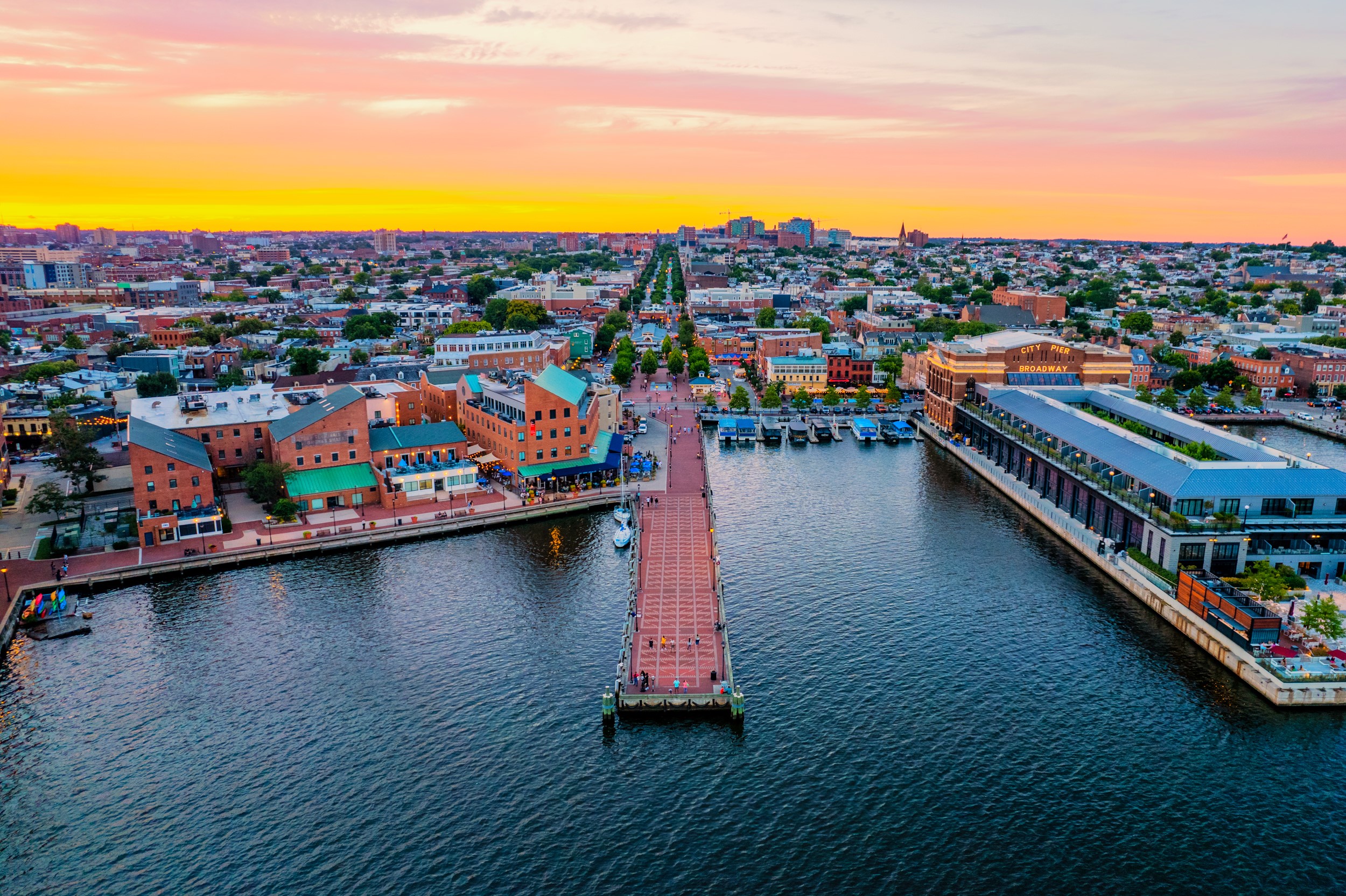
The city is home to some of the earliest National Register Historic Districts in the nation, including Fell's Point, Federal Hill, and Mount Vernon. Baltimore has more public statues and monuments per capita than any other city in the U.S. Nearly one third of the buildings (over 65,000) are designated as historic in the National Register, more than any other U.S. city. Baltimore has 66 National Register Historic Districts and 33 local historic districts.
Etymology
The city is named after Cecil Calvert, 2nd Baron Baltimore, an English politician and lawyer who was a founding proprietor of the Province of Maryland. The Calverts took the title Barons Baltimore from Baltimore Manor, an estate they were granted by the Crown in County Longford as part of the plantations of Ireland. Baltimore is an anglicization of Baile an Tí Mhóir, meaning "town of the big house" in Irish.
History
Pre-settlement
The Baltimore area was inhabited by Native Americans since at least the 10th millennium BC, when Paleo-Indians first settled in the region. One Paleo-Indian site and several Archaic period and Woodland period archaeological sites have been identified in Baltimore, including four from the Late Woodland period. In December 2021, several Woodland period Native American artifacts were found in Herring Run Park in northeast Baltimore, dating 5,000 to 9,000 years ago. The finding followed a period of dormancy in Baltimore City archaeological findings which had persisted since the 1980s. During the Late Woodland period, the archaeological culture known as the Potomac Creek complex resided in the area from Baltimore south to the Rappahannock River in present-day Virginia.
17th century
In the early 1600s, the immediate Baltimore vicinity was sparsely populated, if at all, by Native Americans. The Baltimore County area northward was used as hunting grounds by the Susquehannock living in the lower Susquehanna River valley. This Iroquoian-speaking people "controlled all of the upper tributaries of the Chesapeake" but "refrained from much contact with Powhatan in the Potomac region" and south into Virginia. Pressured by the Susquehannock, the Piscataway tribe, an Algonquian-speaking people, stayed well south of the Baltimore area and inhabited primarily the north bank of the Potomac River in what are now Charles and southern Prince George's counties in the coastal areas south of the Fall Line.
European colonization of Maryland began in earnest with the arrival of the merchant ship The Ark carrying 140 colonists at St. Clement's Island in the Potomac River on March 25, 1634. Europeans then began to settle the area further north, in what is now Baltimore County. Since Maryland was a colony, Baltimore's streets were named to show loyalty to the mother country, e.g. King, Queen, King George and Caroline streets. The original county seat, known today as Old Baltimore, was located on Bush River within the present-day Aberdeen Proving Ground. The colonists engaged in sporadic warfare with the Susquehannock, whose numbers dwindled primarily from new infectious diseases, such as smallpox, endemic among the Europeans. In 1661 David Jones claimed the area known today as Jonestown on the east bank of the Jones Falls stream.
18th century
The colonial General Assembly of Maryland created the Port of Baltimore at old Whetstone Point, now Locust Point, in 1706 for the tobacco trade. The Town of Baltimore, on the west side of the Jones Falls, was founded on August 8, 1729, when the Governor of Maryland signed an act allowing "the building of a Town on the North side of the Patapsco River". Surveyors began laying out the town on January 12, 1730. By 1752 the town had just 27 homes, including a church and two taverns. Jonestown and Fells Point had been settled to the east. The three settlements, covering 60 acres (24 ha), became a commercial hub, and in 1768 were designated as the county seat.
The first printing press was introduced to the city in 1765 by Nicholas Hasselbach, whose equipment was later used in the printing of Baltimore's first newspapers, The Maryland Journal and The Baltimore Advertiser, first published by William Goddard in 1773.
Baltimore grew swiftly in the 18th century, its plantations producing grain and tobacco for sugar-producing colonies in the Caribbean. The profit from sugar encouraged the cultivation of cane in the Caribbean and the importation of food by planters there. Since Baltimore was the county seat, a courthouse was built in 1768 to serve both the city and county. Its square was a center of community meetings and discussions.
Baltimore established its public market system in 1763. Lexington Market, founded in 1782, is one of the oldest continuously operating public markets in the United States today. Lexington Market was also a center of slave trading. Enslaved Black people were sold at numerous sites through the downtown area, with sales advertised in The Baltimore Sun. Both tobacco and sugar cane were labor-intensive crops.
In 1774, Baltimore established the first post office system in what became the United States, and the first water company chartered in the newly independent nation, Baltimore Water Company, 1792.
Baltimore played a part in the American Revolution. City leaders such as Jonathan Plowman Jr. led many residents to resist British taxes, and merchants signed agreements refusing to trade with Britain. The Second Continental Congress met in the Henry Fite House from December 1776 to February 1777, effectively making the city the capital of the United States during this period.
Baltimore, Jonestown, and Fells Point were incorporated as the City of Baltimore in 1796–1797.
19th century
The city remained a part of surrounding Baltimore County and continued to serve as its county seat from 1768 to 1851, after which it became an independent city.
The British bombardment of Baltimore in 1814 inspired the U.S. national anthem, "The Star-Spangled Banner", and the construction of the Battle Monument, which became the city's official emblem. A distinctive local culture started to take shape, and a unique skyline peppered with churches and monuments developed. Baltimore acquired its moniker "The Monumental City" after an 1827 visit to Baltimore by President John Quincy Adams. At an evening function, Adams gave the following toast: "Baltimore: the Monumental City—May the days of her safety be as prosperous and happy, as the days of her dangers have been trying and triumphant."
Content sourced from Wikipedia under CC BY-SA 4.0


