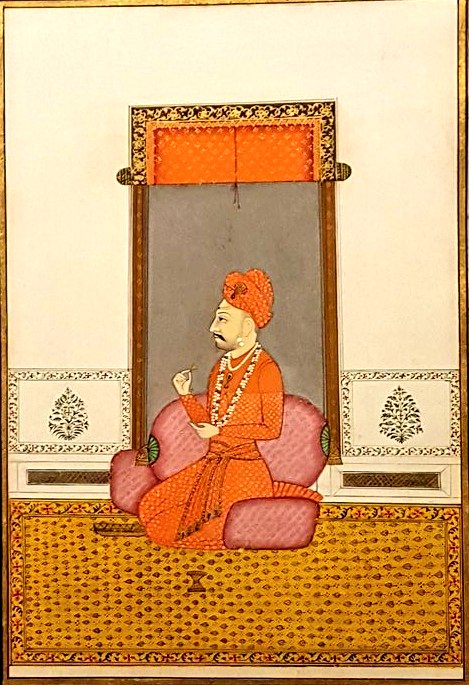
Bajirao I
Peshwa of the Maratha Empire from 1720 to 1740
Bajirao I (born Visaji, Marathi: [ˈbaːdʑiɾaːʋ bəˈlːaːɭ̆]; 18 August 1700 – 28 April 1740) was the 7th Peshwa of the Maratha Empire.
In the Deccan region, the Nizam of Hyderabad emerged as a significant threat. Bajirao then led a campaign against the Nizam in which Nizam suffered a decisive defeat at Palkheda. This victory solidified the Marathas’ authority in the Deccan region. In Bundelkhand, he rescued the Bundela ruler Chhatrasal from a Mughal siege, gaining independence for Bundelkhand. Gratefully, Chhatrasal granted Bajirao a jagir and his daughter's hand in marriage.
In the 1730s, Bajirao asserted Maratha tax rights in Gujarat, defeating rebel Trimbak Rao Dabhade in 1731 at Battle of Dabhoi; he also engaged in a diplomatic mission to persuade Rajput courts for chauth payments. Further efforts to establish Maratha dominance saw him responsible for the Battle of Delhi (1737) which may be said to mark the pinnacle of his military career. He secured the important territory of Malwa after defeating the combined forces of Mughal-Nizam-Nawab of Awadh in Battle of Bhopal (1737).
Bajirao's adventurous life has been picturized in Indian cinema and also featured in novels. Bajirao had two wives Kashibai and Mastani. Bajirao's relationship with his second wife Mastani is a controversial subject; very little is known with certainty about it. She was generally referenced cryptically in books, letters or documents from that era.
Early life
Bajirao was born into the Bhat family in Sinnar, near Nashik. His father Balaji Vishwanath was the Peshwa of Shahu I and his mother was Radhabai Barve. Bajirao had a younger brother, Chimaji Appa, and two younger sisters, Anubai and Bhiubai. Anubai was married to Venkatrao Ghorpade (Joshi) of Ichalkaranji and Bhiubai was married to Abaji Naik Joshi of Baramati.
Being born in a Brahmin family, his education included reading, writing and learning Sanskrit however, he did not remain confined to his books. Bajirao displayed a passion for the military at an early age and often accompanied his father on military campaigns. He was with his father when his father was imprisoned by Damaji Thorat before being released for a ransom. Bajirao had been on the expedition to Delhi in 1719 with his father and was convinced the Mughal Empire was disintegrating and would be unable to resist northward Maratha expansion. When Balaji Vishwanath died in 1720, Shahu appointed the 20-year-old Bajirao as Peshwa despite opposition from other chieftains.
Personal life
Bajirao's first wife was Kashibai, the daughter of Mahadji Krishna Joshi and Bhawanibai of Chas (a wealthy banking family). Bajirao always treated his wife Kashibai with love and respect. Their relationship was healthy and happy. They had four sons: Balaji Bajirao (also called Nanasaheb), Ramachandra Rao, Raghunath Rao and Janardhan Rao, who died at an early age. Nanasaheb was appointed Peshwa by Shahu in 1740, succeeding his father.
Bajirao took Mastani as his wife, the daughter of Rajput king Chhatrasal, born from his Muslim concubine. The relationship was a political one, arranged to please Chhatrasal. Mastani had a son, Krishna Rao, in 1734. Since his mother was Muslim, Hindu priests refused to conduct the upanayana ceremony and he became known as Shamsher Bahadur. After the deaths of Bajirao and Mastani in 1740, Kashibai raised six-year-old Shamsher Bahadur as her own. Shamsher received a portion of his father's dominion of Banda and Kalpi. In 1761, he and his army fought alongside the Peshwa in the Third Battle of Panipat between the Marathas and the Afghans. Wounded in the battle, Shamsher died several days later in Deeg.
Bajirao moved his base of operations from Saswad to Pune in 1728, laying the foundation for the transformation of the kasba into a large city. He began the construction of Shaniwar Wada on 10 January 1730.
Bajirao was appointed Peshwa, succeeding his father, by Shahu on 17 April 1720. By the time of his appointment, the Mughal emperor Muhammad Shah had upheld Maratha claims to the territories held by Shivaji at his death. A treaty gave the Marathas the right to collect taxes (chauth) in the Deccan's six provinces. Bajirao convinced Shahu that the Maratha Empire had to go on the offensive against its enemies to defend itself. He believed the Mughal Empire was in decline, and wanted to take advantage of the situation with aggressive expansion into North India. Bajirao compared the Mughals' declining fortune to a tree which, if attacked at its roots, would collapse. He is reported to have said:
Let us strike at the trunk of the withering tree and the branches will fall off themselves. Listen but to my counsel and I shall plant the Maratha flag on the walls of Attock.
As a new Peshwa, however, he faced several challenges. Bajirao promoted young men like himself, such as Malhar Rao Holkar, Ranoji Shinde, the Pawar brothers and Fateh Singh Bhosle, as commanders; these men did not belong to families who were hereditary Deshmukhs in the Deccan sultanates.
The Mughal viceroy of the Deccan, Asaf Jah I, Nizam of Hyderabad, had created a de facto autonomous kingdom in the region. He challenged Shahu 's right to collect taxes on the pretext that he did not know whether Shahu or his cousin, Sambhaji II of Kolhapur, was the rightful heir to the Maratha throne. The Marathas needed to assert their rights over the nobles of newly acquired territories in Malwa and Gujarat. Several nominally-Maratha areas were not actually under the Peshwa's control; for example, the Siddis controlled the Janjira fort.
Military campaigns and wars
The Nizam
At the outset of Bajirao's Peshwa rule, the Mughal leaders, led by Nizam-ul-Mulk, rebelled against the Sayyid Brothers. To quell the uprising, the Sayyid brothers sought assistance from the Marathas. However, in the Battle of Balapur, where Bajirao, Malhar Rao Holkar, and Khanderao Dabhade were present, the combined forces of the Sayyid Brothers and the Marathas were defeated by the Nizam's forces. Sankarji Malhar was captured as a prisoner of war, marking Bajirao's first significant military engagement as Peshwa.
On 4 January 1721, Bajirao met Nizam of Hyderabad at Chikhalthana to resolve their disputes. However, the Nizam refused to recognize the Maratha right to collect taxes from the Deccan provinces. He was made vizier of the Mughal Empire in 1721 by emperor Muhammad Shah, who, alarmed at his increasing power, transferred him from the Deccan to Awadh in 1723. The Nizam rebelled against the order, resigned as vizier and marched towards the Deccan. The emperor sent an army against him, which the Nizam defeated at the Battle of Sakhar-kheda; this forced the emperor to recognise him as viceroy of the Deccan. The Marathas, led by Bajirao, helped the Nizam win this battle. For his valor, Bajirao was honored with a robe, a 7,000-man mansabdari, an elephant, and a jewel. After the battle, the Nizam tried to appease the Maratha Chhatrapati Shahu and the Mughal emperor; in reality, however, he wanted to carve out a sovereign kingdom and considered the Marathas his rivals in the Deccan.
In 1725, the Nizam sent an army to clear Maratha revenue collectors from the Carnatic region. The Marathas dispatched a force under Fateh Singh Bhosle to counter him; Bajirao accompanied Bhosle, but according to Stewart Gordon, Bajirao did not command the army. According to Govind Sakharam Sardesai, Bajirao personally led the campaign under Shahu's command. In contrast, Stewart Gordon's account suggests that Bajirao was present during the campaign but did not assume command.
In the Deccan, Sambhaji II of Kolhapur State had become a rival claimant to the title of Maratha King. The Nizam took advantage of the internal dispute, refusing to pay the chauth because it was unclear who was the real Chhatrapati (Shahu or Sambhaji II) and offering to arbitrate. Shripatrao Pant Pratinidhi advised Shahu to begin negotiations and agree to arbitration. Sambhaji II was supported by Chandrasen Jadhav, who had fought Bajirao's father a decade earlier. Bajirao convinced Shahu to refuse the Nizam's offer and instead launch an assault.
Content sourced from Wikipedia under CC BY-SA 4.0


