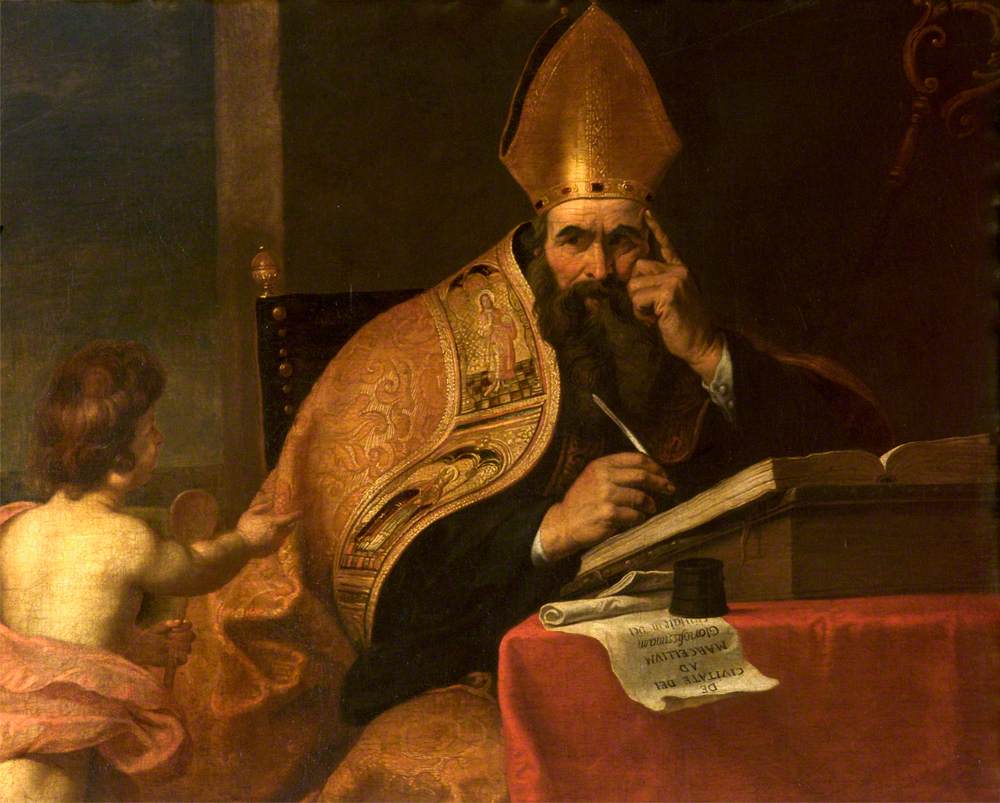
Augustinians
Members of religious orders that follow the Rule of Saint Augustine
Augustinians are members of several religious orders that follow the Rule of Saint Augustine, written about 400 A.D. by Augustine of Hippo. There are two distinct types of Augustinians in Catholic religious orders dating back to the 12th–13th centuries:
- Various congregations of Canons Regular follow the Rule of Saint Augustine, embracing the evangelical counsels and leading a semi-monastic life, while remaining committed to pastoral care appropriate to their primary vocation as priests. They generally form one large community which might serve parishes in the vicinity, and are organized into autonomous congregations.
- Several orders of friars who live a mixed religious life of contemplation and apostolic ministry. The largest and most familiar is the Order of Saint Augustine (O.S.A.), founded in 1244 and originally known as the Hermits of Saint Augustine (O.E.S.A.). They are commonly known as the Austin Friars in England. Two other orders, the Order of Augustinian Recollects (O.A.R.) and the Discalced Augustinians (O.A.D.), were once part of the original Order under a single Prior General. The Recollects, begun in 1588 as a reform movement in Spain to recover the Order's eremitical roots, became autonomous in 1612. At the 100th General Chapter of the Order held in Rome in May 1592, those seeking reform of their way of life came to be called the Discalced (barefoot) and were authorized to seek their goals as an semi-independent branch. They were raised to the status of a separate mendicant Order in 1610.
There are also some Anglican religious orders created in the 19th century that follow Augustine's rule. These are composed only of women in several different communities of Augustinian nuns.
Charism
In a religious community, "charism" is the particular contribution that each religious order, congregation or family and its individual members, embodies. The teaching and writing of Augustine, the Augustinian Rule, and the lives and experiences of Augustinians over sixteen centuries help define the ethos and special charism of the order.
The pursuit of truth through learning is key to the Augustinian ethos, balanced by the injunction to behave with love towards one another. These same imperatives of affection and fairness have driven the order in its international missionary outreach. This balanced pursuit of love and learning has energised the various branches of the order into building communities founded on mutual affection and intellectual advancement.
Augustine spoke passionately of God's "beauty so ancient and so new", and his fascination with beauty extended to music. He taught that "whoever sings prays twice" (Qui cantat, bis orat) and music is also a key part of the Augustinian ethos. Contemporary Augustinian musical foundations include the Augustinerkirche in Vienna, where orchestral masses by Mozart and Schubert are performed every week, as well as the boys' choir at Sankt Florian in Austria, a school conducted by Augustinian canons, a choir now over 1,000 years old.
Augustinians have also produced a formidable body of scholarly works.
Background
Augustinian friars believe that Augustine of Hippo, first with some friends and afterward as bishop with his clergy, led a monastic community life. Regarding the use of property or possessions, Augustine did not make a virtue of poverty, but of sharing. Their manner of life led others to imitate them. Instructions for their guidance were found in several writings of Augustine, especially in De opere monachorum, mentioned in ancient codices of the eighth or ninth century as the "Rule of St. Augustine". Between 430 and 570 this life-style was carried to Europe by monks and clergy fleeing the persecution of the Vandals. In the thirteenth century, the various eremitical groups that composed the Augustinian Hermits faced the threat of suppression by the papacy based on their lack of antiquity. To overcome this, the friars forged a historical connection to St Augustine, and made an especial point to demonstrate that they received the Rule directly from Augustine himself. The Augustinian rule was in use by a wide range of groups across early and high medieval Europe, and there is no historical evidence that the Augustinian Friars were in any way founded by St Augustine himself. Rather, the friars invented these links after the Order was threatened with suppression in 1274 at the Second Council of Lyons.
While in early medieval times the rule was overshadowed by other Rules, particularly that of St. Benedict, this system of life for cathedral clergy continued in various locations throughout Europe for centuries, and they became known as Canons regular (i.e. cathedral clergy living in community according to a rule). Augustine's Rule appears again in practice in the eleventh century as a basis for the reform of monasteries and cathedral chapters.
Several groups of canons were established under various disciplines, all with the Augustinian Rule as their basis. It was adopted by the Canons Regular of the Abbey of St. Victor in Paris, as well as the Norbertines. The instructions contained in Augustine's Rule formed the basis of the Rule that, in accordance with the decree of the Lateran Synod of 1059, was adopted by canons who desired to practice a common apostolic life, hence the title of Canons Regular of Saint Augustine.
Orders, groups, and societies
Canons Regular
The Canons Regular follow the more ancient form of religious life which developed toward the end of the first millennium and thus predates the founding of the friars. They represent a clerical adaptation of monastic life, as it grew out of an attempt to organize communities of clerics to a more dedicated way of life, as St. Augustine himself had done. Historically it paralleled the lay movement of monasticism or the eremitical life from which the friars were later to develop. In their tradition, the canons added the commitment of religious vows to their primary vocation of pastoral care. As the canons became independent of the diocesan structures, they came to form their own monastic communities. Orders of Augustine canons regular include the Canons Regular of Premontre, the Canons Regular of the Lateran, the Canons Regular of the Holy Cross and Canons Regular of St. Augustine (CRSA).
Augustinian Friars
The 2008 Constitutions of the Order of St. Augustine states that the Order of Saint Augustine is composed of the following:
- a) friars, whether professed or novices, who are members of the various Circumscriptions of the Order (meaning a Province, Vicariate, or Delegation).
- b) the contemplative nuns belonging to the monasteries of the order.
- c) the members of the Augustinian Secular Fraternities, legitimately established by the Prior General.
In addition to these three branches, the Augustinian family also includes other groups: a) religious institutes, both male and female, formally aggregated to the order by a decree of the Prior General (this would include the Augustinians of the Assumption, the Sisters of St. Rita, etc.); b) other groups of lay Augustinians; c) lay faithful affiliated to the Order.
The Augustinian, or Austin, friars (OSA), are a mendicant order. As consecrated religious, they pray the Liturgy of the Hours throughout the day. This Latin Church order, while a contemplative Order, differs from traditional monastic orders in three ways. 1) They do not take vows of stability, meaning that they can live in one house (called a friary or sometimes a monastery) typically for several years before being moved into a different community of the order. 2) They are engaged in apostolic activity, such as mission work, education, prison ministries, etc. The order is under the supervision of a Prior General in Rome, and as an international order they are divided into various Provinces throughout the world, with each Province being led by a Prior Provincial. (3) As an order, they have a special commitment to corporate poverty as opposed to simply the poverty professed by the individual friar. While this is not currently legislated as it was in the origins of the order, this is to be a distinguishing mark of their lives as a community.
As consecrated religious, Augustinians profess the evangelical counsels of chastity, poverty, and obedience. They follow the Rule of St. Augustine, written sometime between 397 and 403 for a monastic community Augustine founded in Hippo (in modern day Algeria), and which takes as its inspiration the early Christian community described in the Acts of the Apostles, particularly Acts 4:32: "The community of believers was of one heart and mind, and no one claimed that any of his possessions was his own, but they had everything in common." (NAB).
By decree of the Holy See, the Augustinian Order was historically granted what was known as exempt status, which made it directly dependent on the Pope, meaning that bishops had no jurisdiction with regard to the internal affairs of the order. This is now expressed by saying that the order is an institute of pontifical right.
Content sourced from Wikipedia under CC BY-SA 4.0


