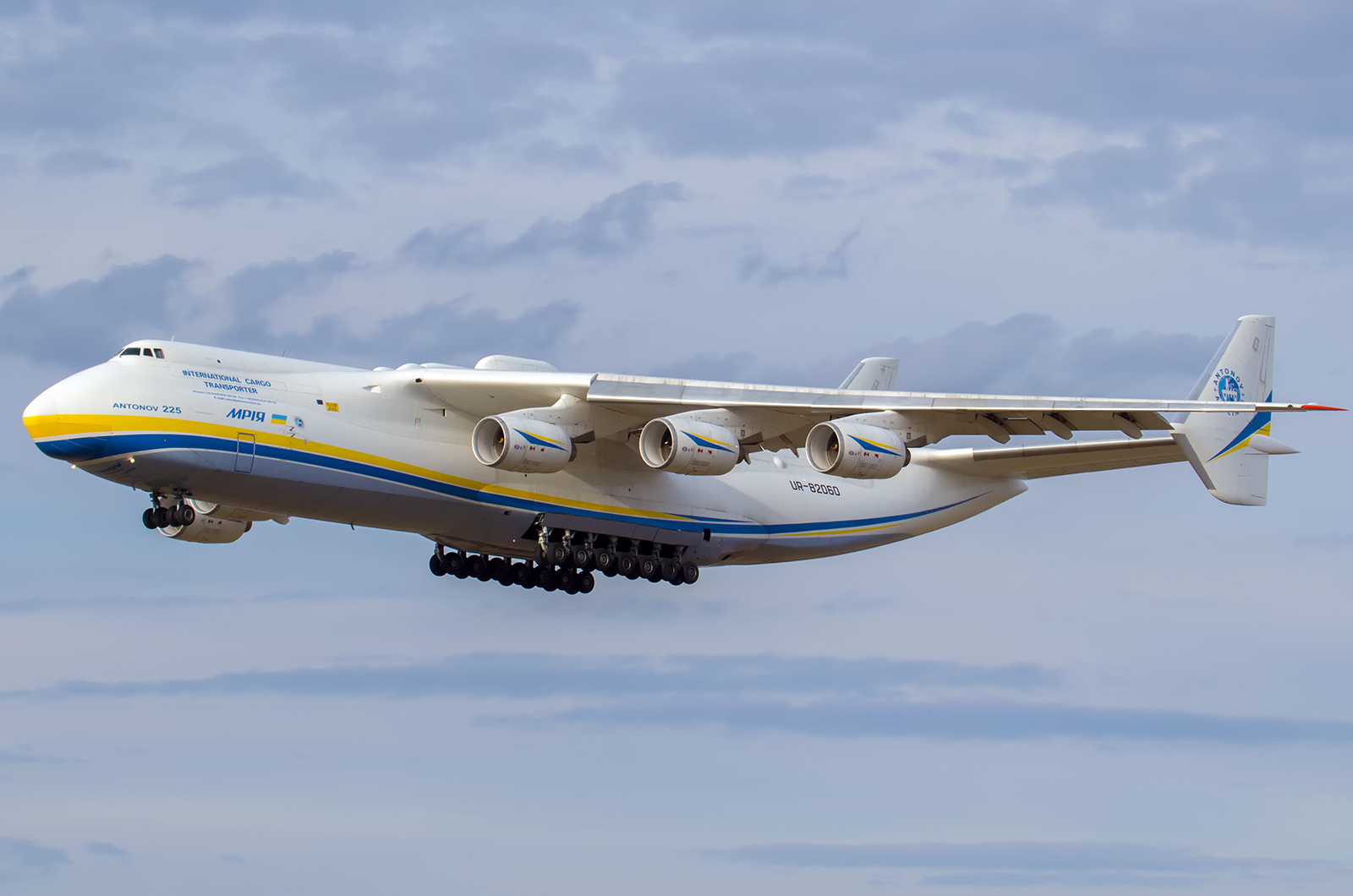
Antonov An-225 Mriya
Soviet/Ukrainian heavy strategic cargo aircraft
The Antonov An-225 Mriya (Ukrainian: Антонов Ан-225 Мрія meaning dream; NATO reporting name: Cossack) was a large strategic airlift cargo aircraft designed and produced by the Antonov Design Bureau in the Soviet Union.
It was originally developed during the 1980s as an enlarged derivative of the Antonov An-124 airlifter for transporting Buran spacecraft. On 21 December 1988, the An-225 performed its maiden flight; only one aircraft was ever completed, although a second airframe with a slightly different configuration was partially built. After a brief period of use in the Soviet space program, the aircraft was mothballed during the early 1990s. Towards the turn of the century, it was decided to refurbish the An-225 and reintroduce it for commercial operations, carrying oversized payloads for the operator Antonov Airlines. Multiple announcements were made regarding the potential completion of the second airframe, though its construction largely remained on hold due to a lack of funding. By 2009, it had reportedly been brought up to 60–70% completion.
With a maximum takeoff weight of 640 tonnes (705 short tons), the An-225 held several records, including heaviest aircraft ever built and largest wingspan of any operational aircraft. It was commonly used to transport objects once thought impossible to move by air, such as 130-ton generators, wind turbine blades, and diesel locomotives. Additionally, both Chinese and Russian officials had announced separate plans to adapt the An-225 for use in their respective space programmes. The Mriya routinely attracted a high degree of public interest, attaining a global following due to its size and its uniqueness.
The only completed An-225 was destroyed in the Battle of Antonov Airport in 2022 during the Russian invasion of Ukraine. In 2022, Ukrainian president Volodymyr Zelenskyy announced plans to complete the second An-225 to replace the destroyed aircraft.
Development
Work on the Antonov An-225 began in 1984 at the request of the Soviet government for a large airlifter to replace the Myasishchev VM-T. The specifics of this request included the ability to carry a maximum payload of 231,838 kilograms (511,116 lb), both externally and internally, while operating from any runway of at least 3,500 metres (11,500 ft). As originally set out, the mission and objectives were broadly identical to that of the United States' Shuttle Carrier Aircraft, having been designed to airlift the Energia rocket's boosters and the Buran-class orbiters for the Soviet space program. Furthermore, a relatively short timetable for the delivery of the completed aircraft meant that development would have to proceed at a rapid pace.
Accordingly, the Antonov Design Bureau produced a derivative of their existing Antonov An-124 Ruslan airlifter. The aircraft was stretched via the addition of fore and aft fuselage barrel sections, while a new, enlarged wing centre was designed that facilitated the carriage of an additional pair of Progress D-18T turbofan engines, increasing the total from four to six powerplants. A completely new tail was also required to handle the wake turbulence generated by the bulky external loads that would be carried on the aircraft's upper fuselage. Despite the novelty of its scale, the design of the An-225 was largely conventional. The lead designer of the An-225 (and the An-124) was Viktor Tolmachev.
On 21 December 1988, the An-225 performed its maiden flight. It made its first public appearance outside the Soviet Union at the 1989 Paris Air Show where it was presented carrying a Buran orbiter. One year later, it performed a flying display for the public days at the Farnborough Air Show. While two aircraft had been ordered, only a single An-225, (registration CCCP-82060, later UR-82060) was finished. It could carry ultra-heavy and oversized freight weighing up to 250,000 kg (550,000 lb) internally or 200,000 kg (440,000 lb) on the upper fuselage. Cargo on the upper fuselage could be up to 70 m (230 ft) in length.
A second An-225 was partially built during the late 1980s for the Soviet space program; however, work on the airframe was suspended following the collapse of the Soviet Union. By 2000, the need for an additional An-225 capacity had become apparent; in September 2006, it was decided that the second An-225 would be completed, a feat that was initially scheduled for around 2008. However, the work was repeatedly delayed. By August 2009, it was reported that it had not been completed and that work had been abandoned. In May 2011, the Antonov CEO reportedly stated that the completion of the second An-225, which would have a carrying capacity of 250 tons, requires at least $300 million; upon the provision of sufficient financing, its completion could be achieved in three years. According to different sources, the second aircraft was 60–70% complete by 2016.
The revival of space activities involving the An-225 was repeatedly announced and speculated upon throughout its life. During the early 2000s, studies were conducted into the production of an even larger An‑225 derivative, the eight-engined Antonov An-325, which was intended to be used in conjunction with Russia's in-development MAKS space plane. In April 2013, the Russian government announced plans to revive Soviet-era air launch projects that would use a purpose-built modification to the An-225 as a midair launchpad.
In May 2017, Airspace Industry Corporation of China (AICC)'s president, Zhang You-Sheng, told a BBC reporter that AICC had first considered cooperating with Antonov in 2009 and had made contact with them two years later. AICC intends to modernize the second unfinished An-225 and develop it into an air launch to orbit platform for commercial satellites at altitudes up to 12,000 m (39,000 ft). The aviation media cast doubt on the production restart, speculating that the ongoing Russo-Ukrainian war would prevent various necessary components that would have been sourced from Russia from being delivered; it may be possible that China could manufacture them instead. That project did not move forward but UkrOboronProm, the parent company of Antonov, had continued to seek partners to finish the second airframe.
On 25 March 2020, the first An-225 commenced a series of test flights from Hostomel Airport near Kyiv, after more than a year out of service, for the installation of a domestically designed power management and control system.
Design
The Antonov An-225 was a strategic airlift cargo aircraft that retained many similarities with the preceding An‑124 airlifter that it was derived from. It had a longer fuselage and cargo deck due to the addition of fuselage barrel extensions that were fitted both fore and aft of the wings. The wings, which were anhedral, also received root extensions to increase their span. The flight control surfaces were controlled via fly-by-wire and powered by triple-redundant hydraulics. Furthermore, the empennage of the An-225 was a twin tail with an oversized, swept-back horizontal stabilizer, having been redesigned from the single vertical stabilizer of the An-124. The use of a twin tail arrangement was essential to enable the aircraft to carry its bulky external loads that would generate wake turbulence, disturbing the airflow around a conventional tail.
The An-225 was powered by a total of six Progress D-18T turbofan engines, two more than the An-124, the addition of which was facilitated by the redesigned wing root area. An increased-capacity landing gear system with 32 wheels was designed, some of which are steerable; these enable the airlifter to turn within a 60-metre-wide (200 ft) runway. Akin to its An-124 predecessor, the An-225 incorporated a nose gear designed to "kneel" so cargo can be more easily loaded and unloaded. Additional measures to ease loading and unloading activities included the four overhead cargo cranes that could move along the whole length of the cargo hold, each of which was capable of lifting up to 5,000 kilograms (11,000 lb). To facilitate the attachment of external loads, such as the Buran orbiter, various mounting points were present along the upper surface of the fuselage.
Unlike the An-124, the An-225 was not intended for tactical airlifting and was not designed for short-field operations. Accordingly, the An-225 does not have a rear cargo door or ramp, as are present on the An-124, these features having been eliminated in order to save weight. The cargo hold was 1,300 m3 (46,000 cu ft) in volume; 6.4 m (21 ft) wide, 4.4 m (14 ft) high, and 43.35 m (142 ft 3 in) long—longer than the first flight of the Wright Flyer. The cargo hold, which was pressurized and furnished with extensive soundproofing, could contain up to 80 standard-dimension cars, 16 intermodal containers, or up to 250,000 kilograms (551,150 lb) of general cargo.
The flight deck of the An-225 was at the front of the upper deck, which was accessed via a ladder from the lower deck. This flight deck was largely identical to that of the An-124, save for the presence of additional controls to manage the additional pair of engines. To the rear of the flight deck was an array of compartments which, amongst other things, accommodated the crew stations for the aircraft's two flight engineers, navigator, and communication specialist, along with off-duty rest areas, including beds, which facilitated long range missions to be flown. Even when fully loaded, the An-225 was capable of flying non-stop across great distances, such as between New York and Los Angeles.
Content sourced from Wikipedia under CC BY-SA 4.0


