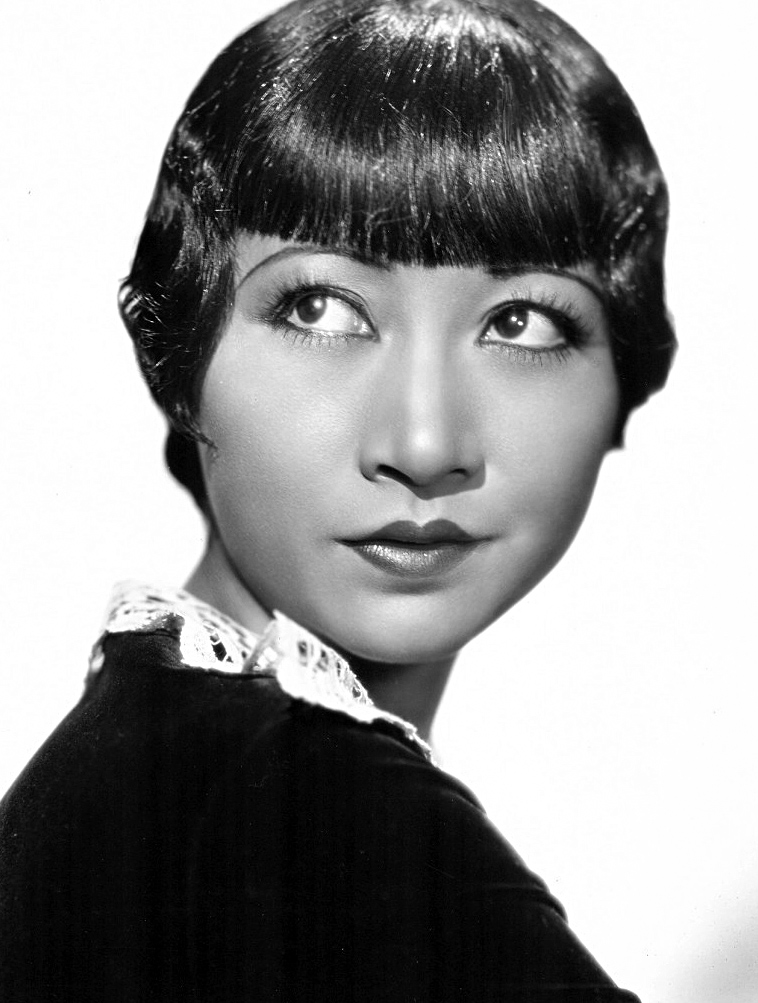
Anna May Wong
American actress (1905–1961)
Wong Liu Tsong (January 3, 1905 – February 3, 1961), known professionally as Anna May Wong, was an American actress, considered the first Chinese American film star in Hollywood, as well as the first Chinese American actress to gain international recognition. Her varied career spanned vaudeville, silent film, sound film, television, stage, and radio.
Born in Los Angeles to second-generation Taishanese Chinese American parents, Wong became engrossed in films and decided at the age of 11 that she would become an actress. Her first role was as an extra in the movie The Red Lantern (1919). During the silent film era, she acted in The Toll of the Sea (1922), one of the first films made in color, and in Douglas Fairbanks' The Thief of Bagdad (1924). Wong became a fashion icon and had achieved international stardom in 1924. Wong had been one of the first to embrace the flapper look. In 1934, the Mayfair Mannequin Society of New York voted her the "world's best dressed woman." In the 1920s and 1930s, Wong was acclaimed as one of the top fashion icons.
Frustrated by the stereotypical supporting roles she reluctantly played in Hollywood, Wong left for Europe in March 1928, where she starred in several notable plays and films, among them Piccadilly (1929). She spent the first half of the 1930s traveling between the United States and Europe for film and stage work. Wong was featured in films of the early sound era, and went on to appear in Daughter of the Dragon (1931), with Marlene Dietrich in Josef von Sternberg's Shanghai Express (1932), Java Head (1934), and Daughter of Shanghai (1937).
In 1935, Wong was dealt the most severe disappointment of her career, when Metro-Goldwyn-Mayer refused to consider her for the leading role of the Chinese character O-Lan in the film version of Pearl S. Buck's novel The Good Earth. MGM instead cast Luise Rainer to play the leading role in "yellowface". One biographer believes that the choice was due to the Hays Code anti-miscegenation rules requiring the wife of a white actor, Paul Muni (ironically playing a Chinese character in yellowface) to be played by a white actress. But the 1930–1934 Hays Code of the Motion Picture Producers and Distributors of America insisted only that "miscegenation (sex relationship between the white and black races) was forbidden" and said nothing about other interracial marriages. Other biographers have not corroborated this theory, including historian Shirley Jennifer Lim's Anna May Wong: Performing the Modern. MGM screen-tested Wong for the supporting role of Lotus, the seductress, but it is ambiguous whether she refused the role on principle or was rejected.
Wong spent the next year touring China, visiting her family's ancestral village, studying Chinese culture, and documenting the experience on film at a time when prominent female directors in Hollywood were few.
In the late 1930s, she starred in several B movies for Paramount Pictures, portraying Chinese and Chinese Americans in a positive light.
She paid less attention to her film career during World War II, when she devoted her time and money to help the Chinese cause against Japan. Wong returned to the public eye in the 1950s in several television appearances.
In 1951, Wong made history with her television show The Gallery of Madame Liu-Tsong, the first-ever U.S. television show starring an Asian-American. She had been planning to return to film in Flower Drum Song when she died in 1961, at the age of 56, from a heart attack. For decades after her death, Wong was remembered principally for the stereotypical "Dragon Lady" and demure "Butterfly" roles that she was often given. Her life and career were re-evaluated in the years around the centennial of her birth, in three major literary works and film retrospectives.
Biography
Early life
Anna May Wong was born Wong Liu Tsong (黃柳霜, Liu Tsong literally meaning "willow frost") on January 3, 1905, on Flower Street in Los Angeles, one block north of Chinatown, in an integrated community of Chinese, Irish, German and Japanese residents. She was the second of seven children born to Wong Sam-sing, owner of the Sam Kee Laundry, and his second wife, Lee Gon-toy.
Wong's parents were second-generation Chinese Americans; her maternal and paternal grandparents had arrived in the U.S. no later than 1855. Her paternal grandfather, A Wong Wong, was a merchant who owned two stores in Michigan Bluffs, a gold-mining area in Placer County. He had come from Chang On, a village near Taishan, Guangdong Province, China, in 1853. Anna May's father spent his youth traveling between the U.S. and China, where he married his first wife and fathered a son in 1890. He returned to the U.S. in the late 1890s and in 1901, while continuing to support his family in China, he married a second wife, Anna May's mother. Anna May's older sister Lew-ying (Lulu) was born in 1902, and Anna May in 1905, followed by six more children: James (1907–1971), Mary (1910–1940), Frank (1912–1989), Roger (1915–1983), Marietta (1919–1920), and Richard Wong (1922–2007).
In 1910, the family moved to a neighborhood on Figueroa Street where they were the only Chinese people on their block, living alongside mostly Mexican and Eastern European families. The two hills separating their new home from Chinatown helped Wong to assimilate into American culture. She attended public school with her older sister at first, but then when the girls became the target of racial taunts from other students, they moved to a Presbyterian Chinese school. Classes were taught in English, but Wong attended a Chinese-language school afternoons and on Saturdays.
About that same time, U.S. motion picture production began to relocate from the East Coast to the Los Angeles area. Movies were shot constantly in and around Wong's neighborhood. She began going to nickelodeon movie theaters and quickly became obsessed with the "flickers", missing school and using lunch money to attend the cinema. Her father was not happy with her interest in films, feeling that it interfered with her studies, but Wong decided to pursue a film career regardless. At the age of nine, she constantly begged filmmakers to give her roles, earning herself the nickname "C.C.C." or "Curious Chinese Child". By the age of 11, Wong had come up with her stage name of Anna May Wong, formed by joining both her English and family names.
Early career
Wong was working at Hollywood's Ville de Paris department store when Metro Pictures needed 300 female extras to appear in Alla Nazimova's film The Red Lantern (1919). Without her father's knowledge, a friend of his with movie connections helped her land an uncredited role as an extra carrying a lantern.
Wong worked steadily for the next two years as an extra in various movies, including Priscilla Dean and Colleen Moore pictures. While still a student, Wong came down with an illness identified as St. Vitus's Dance which caused her to miss months of school. She was on the verge of emotional collapse when her father took her to a practitioner of traditional Chinese medicine. The treatments proved successful, though Wong later claimed this had more to do with her dislike of the methods. Other Chinese thought such as Confucianism and particularly Taoism and the teachings of Laozi had a strong influence on Wong's personal philosophy throughout her life. The family's religious life also included Christian thought, in the form of Presbyterianism, and as an adult she was a Christian Scientist for some time. However, she never officially joined the church, and her interest in it waned as she became involved with the New Thought Unity Church.
Finding it difficult to keep up with both her schoolwork and her passion, Wong dropped out of Los Angeles High School in 1921 to pursue a full-time acting career. Reflecting on her decision, Wong told Motion Picture Magazine in 1931: "I was so young when I began that I knew I still had youth if I failed, so I determined to give myself 10 years to succeed as an actress."
In 1921, Wong received her first screen credit for Bits of Life, the first anthology film, in which she played the wife of Lon Chaney's character, Toy Ling, in a segment entitled "Hop". She later recalled it fondly as the only time she played the role of a mother; her appearance earned her a cover photo on the British magazine Picture Show.
At the age of 17, Wong played her first leading role, in the early Metro two-color Technicolor movie The Toll of the Sea. Written by Frances Marion, the story was based loosely on Madama Butterfly. Variety magazine singled Wong out for praise, noting her "extraordinarily fine" acting. The New York Times commented, "Miss Wong stirs in the spectator all the sympathy her part calls for and she never repels one by an excess of theatrical 'feeling'. She has a difficult role, a role that is botched nine times out of ten, but hers is the tenth performance. Completely unconscious of the camera, with a fine sense of proportion and remarkable pantomimic accuracy ... She should be seen again and often on the screen."
Content sourced from Wikipedia under CC BY-SA 4.0


