Algebraic notation (chess)
Method to convey chess moves
Algebraic notation is the standard method of chess notation, used for recording and describing moves. It is based on a system of coordinates to identify each square on the board uniquely. It is now almost universally used by books, magazines, newspapers and software, and is the only form of notation recognized by FIDE, the international chess governing body.
An early form of algebraic notation was invented by the Syrian player Philip Stamma in the 18th century. In the 19th century, it came into general use in German chess literature and was subsequently adopted in Russian chess literature. Descriptive notation, based on abbreviated natural language, was generally used in English language chess publications until the 1980s. Similar descriptive systems were in use in Spain and France. A few players still use descriptive notation, but it is no longer recognized by FIDE, and may not be used as evidence in the event of a dispute.
The term "algebraic notation" may be considered a misnomer, as the system is unrelated to algebra.
Naming the squares
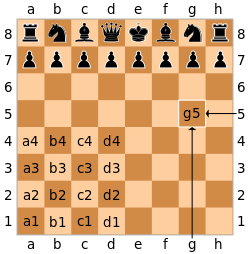
Each square of the board is identified by a unique coordinate pair—a letter and a number—from White's point of view. The vertical columns of squares, called files, are labeled a through h from White's left (the queenside) to right (the kingside). The horizontal rows of squares, called ranks, are numbered 1 to 8 starting from White's side of the board. Thus each square has a unique identification of file letter followed by rank number. For example, the initial square of White's king is designated as "e1".
Naming the pieces
Each piece type (other than pawns) is identified by an uppercase letter. English-speaking players use the letters K for king, Q for queen, R for rook, B for bishop and N for knight. Different initial letters are used by other languages.
In modern chess literature, especially that intended for an international audience, the language-specific letters are usually replaced by universally recognizable piece symbols; for example, ♞c6 in place of Nc6. This style is known as figurine algebraic notation. The Unicode Miscellaneous Symbols set includes all the symbols necessary for figurine algebraic notation.
Notation for moves
In standard (or short-form) algebraic notation, each move of a piece is indicated by the piece's uppercase letter, plus the coordinates of the destination square. For example, Be5 (bishop moves to e5), Nf3 (knight moves to f3). For pawn moves, a letter indicating pawn is not used, only the destination square is given. For example, c5 (pawn moves to c5).
Captures
When a piece makes a capture, an "x" is inserted immediately before the destination square. For example, Bxe5 (bishop captures the piece on e5). When a pawn makes a capture, the file from which the pawn departed is used to identify the pawn. For example, exd5 (pawn on the e-file captures the piece on d5).
En passant captures are indicated by specifying the capturing pawn's file of departure, the "x", the destination square (not the square of the captured pawn) and (optionally) the suffix "e.p." indicating the capture was en passant. For example, exd6 e.p.
Sometimes a multiplication sign (×) or a colon (:) is used instead of "x", either in the middle (B:e5) or at the end (Be5:). Some publications, such as the Encyclopaedia of Chess Openings (ECO), omit any indication that a capture has been made; for example, Be5 instead of Bxe5; ed6 instead of exd6 or exd6 e.p.
When it is unambiguous to do so, a pawn capture is sometimes described by specifying only the files involved (exd or even ed). These shortened forms are sometimes called abbreviated algebraic notation or minimal algebraic notation.
Disambiguating moves
When two (or more) identical pieces can move to the same square, the moving piece is uniquely identified by specifying the piece's letter, followed by (in descending order of preference):
- the file of departure (if they differ);
- the rank of departure (if the files are the same but the ranks differ).
If neither file nor rank alone is sufficient to identify the piece (such as when three or more pieces of the same type can move to the same square), then both are specified (double disambiguation).
In the diagram, both black rooks could legally move to f8, so the move of the d8-rook to f8 is disambiguated as Rdf8. For the white rooks on the a-file which could both move to a3, it is necessary to provide the rank of the moving piece, i.e., R1a3.
In the case of the white queen on h4 moving to e1, neither the rank nor file alone are sufficient to disambiguate from the other white queens. As such, this move is written Qh4e1.
As above, an "x" can be inserted to indicate a capture; for example, if the final case were a capture, it would be written as Qh4xe1.
Pawn promotion
When a pawn promotes, the piece promoted to is indicated at the end. For example, a pawn on e7 promoting to a queen on e8 may be variously rendered as e8Q, e8=Q, e8(Q), e8/Q etc.
Castling
Castling is indicated by the special notations 0-0 (for kingside castling) and 0-0-0 (queenside castling). O-O and O-O-O (letter O rather than digit 0) are also commonly used.
Check
A move that places the opponent's king in check usually has the symbol "+" appended. Alternatively, sometimes a dagger (†) or the abbreviation "ch" is used. Some publications indicate a discovered check with an abbreviation such as "dis ch", or with a specific symbol. Double check is usually indicated the same as check, but is sometimes represented specifically as "dbl ch" or "++", particularly in older chess literature. Some publications such as ECO omit any indication of check.
Checkmate
Checkmate at the completion of moves is represented by the symbol "#" in standard FIDE notation and PGN. The word mate is commonly used instead; occasionally a double dagger (‡) or a double plus sign (++) is used, although the double plus sign is also used to represent "double check" when a king is under attack by two enemy pieces simultaneously. A checkmate is represented by "≠" (the not equal sign) in the macOS chess application. In Russian and ex-USSR publications, where captures are indicated by ":", checkmate can also be represented by "X" or "x".
Draw offer
FIDE specifies draw offers to be recorded by an equals sign with parentheses "(=)" after the move on the score sheet. This is not usually included in published game scores.
End of game
The notation 1–0 at the completion of moves indicates that White won, 0–1 indicates that Black won and ½–½ indicates a draw. In case of forfeit, the scores 0–0, ½–0 and 0–½ are also possible. In case of loss by default, results are +/−, −/+ or −/−.
Except in the case of checkmate, there is no information in the notation regarding the circumstance of the final result. Merely 1–0 or 0–1 is written whether a player resigned, lost due to time control or forfeited; in the case of a draw ½–½ is written whether the draw was decided by mutual agreement, repetition, stalemate, 50-move rule or dead position. Sometimes direct information is given by words such as "resigns", "draw agreed" etc., but this is not considered part of the notation, rather a part of the narrative text.
Similar notations
Besides standard (or short form) algebraic notation already described, several similar systems have been used.
Content sourced from Wikipedia under CC BY-SA 4.0


