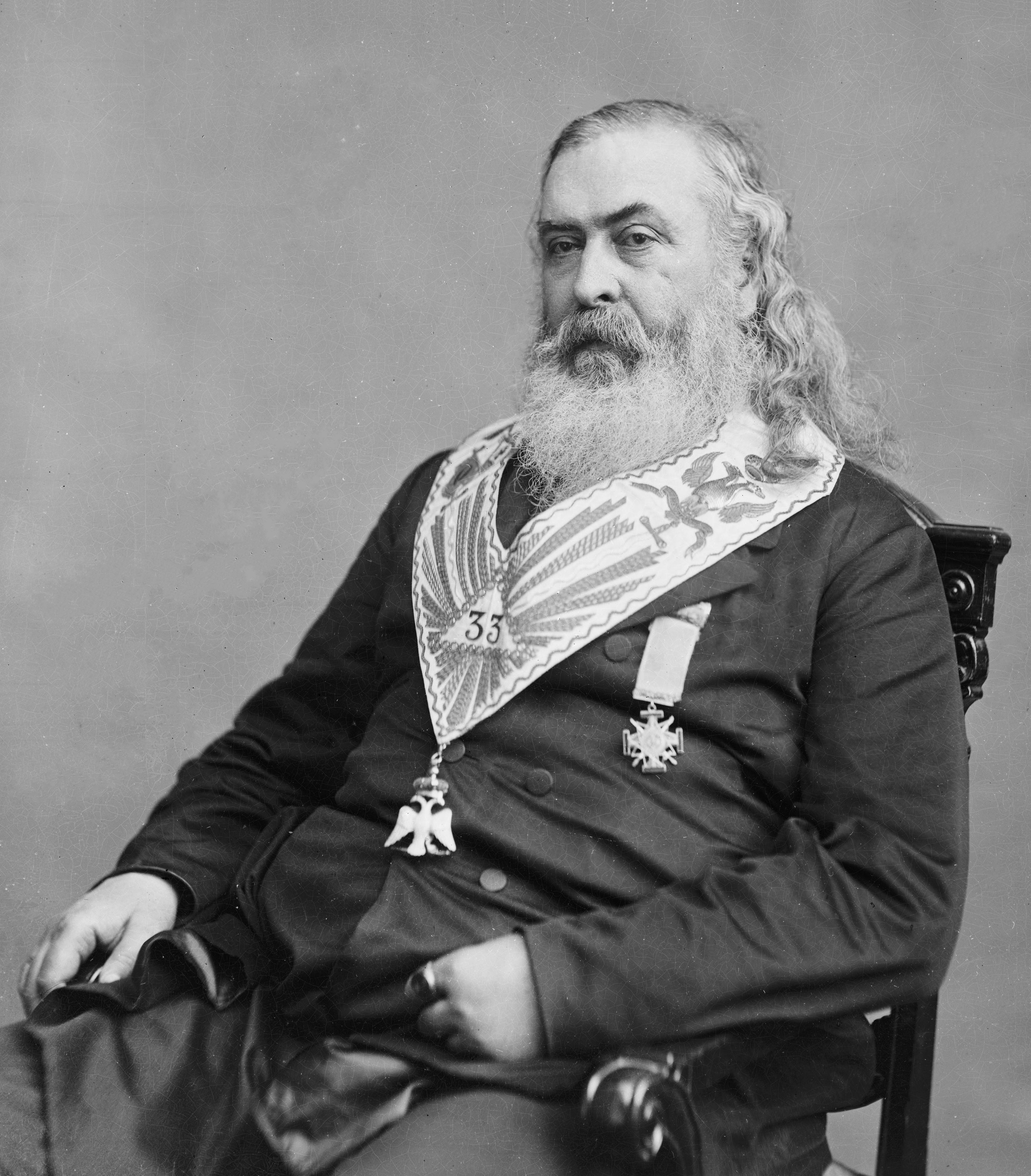
Albert Pike
American author, Freemason, and soldier (1809–1891)
Albert Pike (December 29, 1809 – April 2, 1891) was an American author, poet, orator, editor, lawyer, jurist and Confederate States Army general who served as an associate justice of the Arkansas Supreme Court in exile from 1864 to 1865. He had previously served as a senior officer of the Confederate States Army, commanding the District of Indian Territory in the Trans-Mississippi Theater. A prominent member of the Freemasons, Pike served as the Sovereign Grand Commander of the Supreme Council, Scottish Rite, Southern Jurisdiction from 1859 to 1891.
Early life and education
Albert Pike was born in Boston, Massachusetts, on December 29, 1809, the son of Benjamin and Sarah (Andrews) Pike. He grew up in Byfield and Newburyport, Massachusetts. His colonial ancestors had settled in the area in 1635, and included John Pike (1613–1688/1689), the founder of Woodbridge, New Jersey.
He attended school in Newburyport and Framingham until he was 15. In August 1825, he passed entrance exams at Harvard University, though when the college requested payment of tuition fees for the first two years, he chose not to attend. He began a program of self-education, later teaching school in Gloucester, North Bedford, Fairhaven and Newburyport.
Pike was an imposing figure; 6 feet (1.83 m) tall and 300 pounds (140 kg) with hair that reached his shoulders and a long beard. In 1831, he left Massachusetts to travel west, first stopping in Nashville, Tennessee.
He later moved to St. Louis, Missouri, where he joined a hunting and trading expedition to Taos, New Mexico. En route his horse broke and ran, forcing Pike to walk the remaining 500 miles (800 km) to Taos. After this, he joined a trapping expedition to the Llano Estacado in New Mexico and Texas. Trapping was minimal and, after traveling about 1,300 miles (2,100 km), half of it on foot, he finally arrived at Fort Smith, Arkansas.
Career
Settling in Arkansas in 1833, Pike taught in a school and wrote a series of articles for the Little Rock Arkansas Advocate under the pen name of "Casca." The articles were sufficiently well received for him to be asked to join the newspaper's staff. Under Pike's administration, the Advocate promoted the viewpoint of the Whig Party in a politically volatile and divided Arkansas in December 1832. After marrying Mary Ann Hamilton in 1834, he purchased the newspaper.
He was the first reporter for the Arkansas Supreme Court. He wrote a book (published anonymously), titled The Arkansas Form Book, which was a guidebook for lawyers. Pike began to study law and was admitted to the bar in 1837, selling the Advocate the same year. (At least one source indicates that Pike read Kent and Blackstone and was admitted to the bar in 1834 by Superior Court judge Thomas J. Lacy, after a perfunctory examination.)
He proved to be a highly effective lawyer, representing clients in courts at every level. This continued after he received permission in 1849 to practice before the United States Supreme Court.
He also made several contacts among the Native American tribes in the area. He specialized in claims on behalf of Native Americans against the federal government. In 1852, he represented the Creek Nation before the Supreme Court in a claim regarding ceded tribal land. In 1854 he advocated for the Choctaw and Chickasaw, although compensation later awarded to the tribes in 1856 and 1857 was insufficient. These relationships were to influence the course of his Civil War service.
Pike also began a campaign of newspaper essays urging support for the construction of a transcontinental railroad to extend from New Orleans to the Pacific coast. He moved to New Orleans in 1853 and prepared to pass the state bar in furtherance of his campaign. He ultimately secured a charter from the Louisiana State Legislature for a project, following which he returned to Little Rock in 1857.
He joined the anti-Catholic Know Nothing Party at its founding; in the summer of 1854, he helped introduce the party in Arkansas. He attended the national convention in 1856, but walked out when it failed to adopt a pro-slavery platform.
As part of the Committee of the Citizens of Little Rock and Pulaski County in 1858, Pike joined 11 other men in signing a circular that encouraged the people of Arkansas to expel free Blacks from Arkansas. It said that the "evil is the existence among us of a class of free colored persons".
Additionally, Pike wrote on several legal subjects. He also continued writing poetry, a hobby he had begun in his youth in Massachusetts. His poems were highly regarded in his day, but are now mostly forgotten. Several volumes of his works were privately published posthumously by his daughter. In 1859, he received an honorary Master of Arts degree from Harvard.
Poetry
As a young man of letters, Pike wrote poetry, and he continued to do so for the rest of his life. At 23, he published his first poem, "Hymns to the Gods." Later work was printed in literary journals such as Blackwood's Edinburgh Magazine and local newspapers. His first collection of poetry, Prose Sketches and Poems Written in the Western Country, was published in 1834. He later gathered many of his poems and republished them in Hymns to the Gods and Other Poems (1872). After his death these were published again in Gen. Albert Pike's Poems (1900) and Lyrics and Love Songs (1916).
The authorship of "The Old Canoe" was attributed to Pike. He was suggested as author because about the time of its publication, when it was going the rounds of the press, probably without any credit, a doggerel called "The Old Canoe" was composed about Pike by one of his political foes. The subject was a canoe in which he left Columbia, Tennessee, when a young man practicing law in that place. Pike told Senator Edward W. Carmack that he was not the author of "The Old Canoe," and could not imagine how he ever got the credit for it. The rightful author was Emily Rebecca Page.
Freemasonry
Pike first joined the fraternal Independent Order of Odd Fellows in 1840. He next joined a Masonic Lodge, where he became extremely active in the affairs of the organization. In 1859 he was elected Sovereign Grand Commander of the Scottish Rite's Southern Jurisdiction. He remained Sovereign Grand Commander for the rest of his life, devoting a large amount of his time to developing the rituals of the order.
He published a book called Morals and Dogma of the Ancient and Accepted Scottish Rite of Freemasonry in 1871, the first of several editions. This helped the Order grow during the nineteenth century. He also researched and wrote the seminal treatise Indo-Aryan Deities and Worship as Contained in the Rig-Veda. In the United States, Pike is still considered an eminent and influential Freemason, primarily in the Scottish Rite Southern Jurisdiction.
Pike was also the Provincial Grand Master of the Royal Order of Scotland from 1877 to 1891.
Military service
Mexican–American War
When the Mexican–American War started, Pike joined the Arkansas Mounted Infantry Regiment and was commissioned as a company commander with the rank of captain in June 1846. With his regiment, he fought in the Battle of Buena Vista. Pike was discharged in June 1847. He and his commander, Colonel John Selden Roane, had several differences of opinion. This situation led finally to an "inconclusive" duel between Pike and Roane on July 29, 1847, near Fort Smith, Arkansas. Although several shots were fired in the duel, nobody was injured, and the two were persuaded by their seconds to discontinue it.
After the war, Pike returned to the practice of law, moving to New Orleans for a time beginning in 1853. He wrote another book, Maxims of the Roman Law and Some of the Ancient French Law, as Expounded and Applied in Doctrine and Jurisprudence. Although unpublished, this book increased his reputation among his associates in law. He returned to Arkansas in 1857, gaining some amount of prominence in the legal field.
At the Southern Commercial Convention of 1854, Pike said the South should remain in the Union and seek equality with the North, but if the South "were forced into an inferior status, she would be better out of the Union than in it." His stand was that state's rights superseded national law and he supported the idea of a Southern secession. This stand is made clear in his pamphlet of 1861, "State or Province, Bond or Free?"
American Civil War
In 1861, Pike penned the lyrics to "Dixie to Arms!" At the beginning of the war, Pike was appointed as Confederate envoy to Native American nations. In this capacity he negotiated several treaties, one of the most important being with Cherokee chief John Ross, which was concluded in 1861. At the time, Ross agreed to support the Confederacy, which promised the tribes a Native American state if it won the war. Ross later changed his mind and left Indian Territory, but the succeeding Cherokee government maintained the alliance.
Content sourced from Wikipedia under CC BY-SA 4.0


