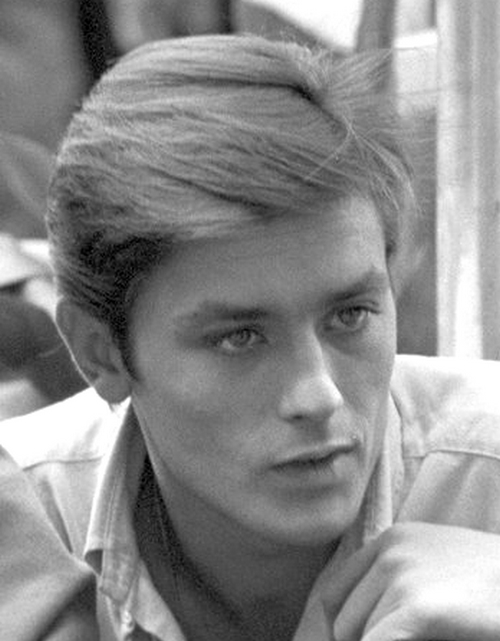
Alain Delon
French actor (1935–2024)
Alain Fabien Maurice Marcel Delon (French: [alɛ̃ dəlɔ̃]; 8 November 1935 – 18 August 2024) was a French actor, film producer, screenwriter, singer, and businessman. Acknowledged as a cultural and cinematic leading man of the 20th century, Delon emerged as one of the foremost European actors of the late 1950s to the late 1980s, and became an international sex symbol. He is regarded as one of the most well-known figures in French cinema. His style, looks, and roles, which made him an international icon, earned him enduring popularity.
Delon achieved critical acclaim for his roles in films such as Women Are Weak (1959), Purple Noon (1960), Rocco and His Brothers (1960), L'Eclisse (1962), The Leopard (1963), Any Number Can Win (1963), The Black Tulip (1964), The Last Adventure (1967), Le Samouraï (1967), The Girl on a Motorcycle (1968), La Piscine (1969), Le Cercle Rouge (1970), Un flic (1972), and Monsieur Klein (1976). Over the course of his career, Delon worked with many directors, including Luchino Visconti, Jean-Luc Godard, Jean-Pierre Melville, Michelangelo Antonioni, Louis Malle, and Agnès Varda.
Delon received many film and entertainment awards throughout his career. In 1985, he won the César Award for Best Actor for his performance in Notre histoire (1984). In 1991, he became a member of France's Legion of Honour. At the 45th Berlin International Film Festival, he won the Honorary Golden Bear. At the 2019 Cannes Film Festival, he received the Honorary Palme d'Or.
In addition to his acting career, Delon also recorded the spoken part in the popular 1973 song "Paroles, paroles", a duet with Dalida as the main singing voice. He acquired Swiss citizenship in 1999.
Family
The Delons are originally from Saint-Vincent-Lespinasse, in Tarn-et-Garonne. Their known genealogy goes back to Jean Delon, born in the fifteenth century. Delon's paternal great-grandfather, Fabien Delon (Saint-Vincent-Lespinasse, 28 December 1829 - Figeac (Lot), 12 December 1909), a civil engineer, was decorated with the Legion of Honour in 1892. His paternal grandmother, Marie-Antoinette Evangelista (born in 1867 in Prunelli-di-Fiumorbo), was Corsican. On 3 December 1888 she married Delon's paternal grandfather, Jean-Marcel Delon (Figeac, 4 November 1856 – L'Haÿ-les-Roses 1926), then a tax collector in Gap, who was appointed in Corsica in 1886. The couple had two children together, a son François Fabien Delon and a daughter Jeanne Lucidora Adele Delon.
Delon's maternal grandfather, Alfred Louis Arnold (1876–1959), was born in Paris and was a rider of the French army, gendarme. His parents were Just Arnold, born in 1847 in Bürglen, Uri, a shoemaker by trade, and Marie-Adéle Lienemann, born in 1849, a cook. He married Maria Minard (1881–1913), a model for Jeanne Lanvin. The couple had two children: a daughter, Édith Marie Suzanne Arnold, and a son, Henri Arnold.
Early life
Childhood and education: 1935–1952
Alain Fabien Maurice Marcel Delon was born in a house located at 99 Houdan Street on 8 November 1935 in Sceaux, a wealthy suburb of Paris in the department of Seine (now Hauts-de-Seine). His father François Fabien Delon (Craponne-sur-Arzon, 12 March 1904 – Le Kremlin-Bicêtre, 17 September 1977), was a projectionist and later the director of the cinema Le Régina in Bourg-la-Reine, his mother Édith Marie Suzanne Arnold (19 April 1911 – Jouy-en-Josas, 20 June 1995), was an assistant employed in a pharmacy and a theater usher at the cinema where both his parents met, he was born into a petit-bourgeois family.
Delon's parents divorced in 1939 when he was four years old . Both of his parents remarried, as a result he had two half brothers and an adopted sister on his father's side, and two half siblings on his mother's side. He was then entrusted to a foster family called Nero, who lived on Rue de la Terasse. This would remain for him a childhood wound that never healed. The father of the family was a prison guard in Fresnes Prison, Val-de-Marne. Delon, who lived next door, heard the salvo that executed the wartime collaborator Pierre Laval in the prison courtyard in 1945, the details of which he was told. While living with the foster family, Delon became passionate about bicycle racing and hoped to become a bicycle racer like Fausto Coppi.
When his foster parents died in 1946, Delon was sent back to his birth parents, who took shared custody of him. Growing up, he spent time living with his father and his second family in L'Haÿ-les-Roses and with his mother and her second family in Bourg-la-Reine. However his parents not wanting to take care of him decided to place him in the Catholic boarding school of Saint-Nicolas d'Igny (Essonne), where he spent his entire youth with one of his best friends, Gérard Salomé. There he developed his passion for music; he joined the school choir and was chosen to sing as a soloist. He was congratulated on a performance by the Apostolic Nuncio to France Cardinal Angelo Roncalli, the later Pope John XXIII.
Due to the lack of attention from his parents, Delon became unruly, constantly misbehaving in the classroom and getting into fights with other children. He was expelled from the school after he beat up one of his classmates. The priests recommended he be sent to Saint Gabriel de Bagneaux. During his four years there, Delon constantly misbehaved and was disrespectful to his teachers. He then stole the director's motorcycle which resulted in him being expelled once more. Delon was expelled from a few more schools which were Jesuit, Benedictine, Franciscan and lay schools, until the age of 13, when he entered Saint Nicolas d'Igny Institute. There he had the opportunity to perform the role of a thug in Le Rapt, a 22-second silent short film directed by Olivier Bourguignon, a friend of his father. At age 14, Delon decided he did not want to stay in the school and wished to leave France. He decided to run away to Chicago with his friend Daniel Salwadet who had an uncle living there. They left the school, determined to hitchhike to Bordeaux. When they arrived in Châtellerault, a passerby took them to the local police station. Due to Delon's temper, he and his friend were put in jail and were sent back to their families. Because of his actions, Delon was expelled from the school. His parents then decided that studies were not for him and made Delon abandon them.
His mother took him into her home and decided to make him join the business of her husband, Paul Boulogne, a butcher and delicatessen owner from Bourg-la-Reine. He later said he never really found a place in that family and never felt safe there. Delon took courses at the Au Jambon de Paris, while working part time as his stepfather's delicatessen where he would go the central markets in the morning to buy 40 kilograms of sausages. He eventually obtained a Certificate of Professional Aptitude (Certificat d'Aptitude Professionnelle or CAP) in charcuterie. For three years he worked at his stepfather's delicatessen, which had sixteen employees, he also worked at other delicatessens as well. His family had plans for him to take over the delicatessen in the future. However, during those three years, Delon developed a very bad reputation in the community. He partied constantly, got into bar fights, and was at one point a member of a gang.
Military service and Indochina War: 1952–1956
Anticipating the call up for military service, he joined the French Navy at age 17. After a stint at the Pont-Réan Maritime Training Centre, he continued his service in 1953 at the Bormette Signals School. After he was caught stealing equipment, the Navy gave him a choice of leaving it or extending his commitment from three to five years.
As a first-class seaman, he was then assigned to the protection company of the Saigon arsenal, in what was still French Indochina. Towards the end of the Indochina War, he was arrested for stealing a jeep and going on a trip during which the vehicle fell into a stream. His radio licence was revoked and he was given a dishonorable discharge from the Navy. He celebrated his 20th birthday in a prison cell. This period made a deep impression on him: he discovered military discipline, a sense of honour and respect for the values represented by the flag of France. He developed a passion for weapons and was captivated by the performance of French actor Jean Gabin in Touchez pas au grisbi, a film he saw in the Indochinese capital.
Content sourced from Wikipedia under CC BY-SA 4.0


