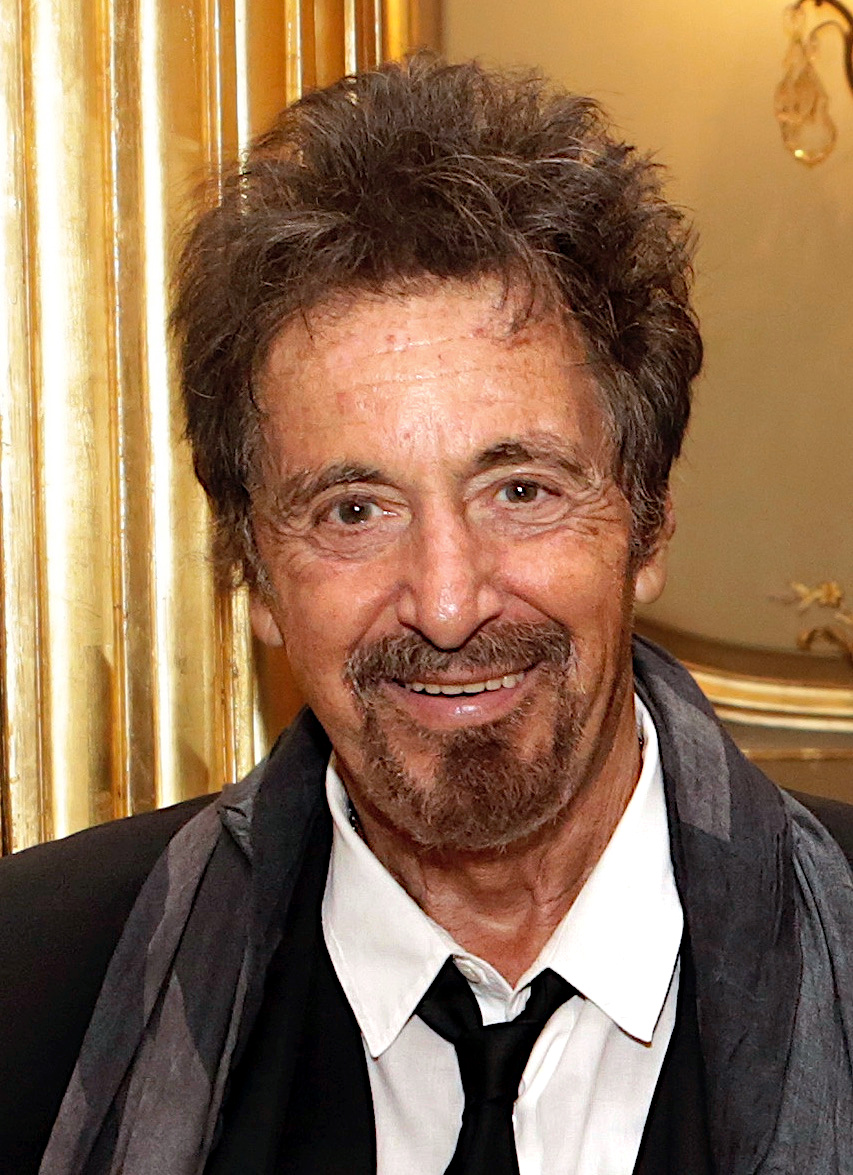
Al Pacino
American actor (born 1940)
Alfredo James Pacino ( pə-CHEE-noh; Italian: [paˈtʃiːno]; born April 25, 1940) is an American actor. Known for his intense performances on stage and screen, Pacino is widely regarded as one of the greatest actors of all time. His career spans more than five decades, during which he has earned many accolades, including an Academy Award, two Tony Awards, and two Primetime Emmy Awards, achieving the Triple Crown of Acting. He has also received four Golden Globe Awards, a BAFTA, two Actor Awards, and was honored with the Cecil B. DeMille Award in 2001, the AFI Life Achievement Award in 2007, the National Medal of Arts in 2011, and the Kennedy Center Honors in 2016. Films in which he has appeared have grossed over $3 billion worldwide.
A method actor, Pacino studied at HB Studio and the Actors Studio where he was taught by Charlie Laughton and Lee Strasberg. Pacino went on to receive the Academy Award for Best Actor for his role in Scent of a Woman (1992). His other Oscar-nominated roles were in The Godfather (1972), Serpico (1973), The Godfather Part II (1974), Dog Day Afternoon (1975), ...And Justice for All (1979), Dick Tracy (1990), Glengarry Glen Ross (1992), and The Irishman (2019). Pacino has starred in many other notable films, including The Panic in Needle Park (1971), Scarecrow (1973), Scarface (1983), Sea of Love (1989), The Godfather Part III (1990), Frankie and Johnny (1991), Carlito's Way (1993), Heat (1995), Donnie Brasco, The Devil's Advocate (both 1997), The Insider, Any Given Sunday (both 1999), Insomnia (2002), The Recruit (2003), Ocean's Thirteen (2007), Once Upon a Time in Hollywood (2019), and House of Gucci (2021).
On television, Pacino has acted in multiple productions for HBO, including Angels in America (2003) and the Jack Kevorkian biopic You Don't Know Jack (2010), winning a Primetime Emmy Award for Outstanding Lead Actor in a Miniseries or a Movie for each. Pacino starred in the Amazon Prime Video series Hunters (2020–23). He has also had an extensive career on stage. He is a two-time Tony Award winner, winning Best Featured Actor in a Play in Does a Tiger Wear a Necktie? (1969) and Best Actor in a Play for The Basic Training of Pavlo Hummel (1977). He has also acted as Shylock in a 2004 feature film adaptation and 2010 stage production of The Merchant of Venice.
Pacino made his directorial debut with the documentary Looking for Richard (1996). He directed and starred in Chinese Coffee (2000), Wilde Salomé (2011), and Salomé (2013). In 2006, he allowed for his likeness to be used in the video game Scarface: The World Is Yours. Since 1994, he has been the joint president of the Actors Studio.
Early life and education
Alfredo James Pacino was born in the East Harlem neighborhood of Manhattan, New York City, on April 25, 1940, the only child of Sicilian Italian-American parents Rose (née Gerardi) and Salvatore Pacino. His father had emigrated from San Fratello. His parents divorced when he was two years old. Following the separation, his mother took him to the South Bronx and they lived with his maternal grandparents, Kate and James Gerardi. They had emigrated from Corleone when young. Pacino's father moved to California to work as an insurance salesman and restaurateur in Covina, California.
In his teenage years, Pacino was known as "Sonny" to his friends. He had ambitions to become a baseball player and was also nicknamed "The Actor". Pacino began smoking and drinking at age nine and used marijuana casually at age 13, but he abstained from hard drugs. His two closest friends died from drug abuse at the ages of 19 and 30. Growing up in the South Bronx, Pacino got into occasional fights and was considered something of a troublemaker at school. Pacino said that his mother saved his life and kept him off drugs.
He attended Herman Ridder Junior High School, but soon dropped out of most of his classes except for English. Blanche Rothstein, who was his junior high school teacher, saw his acting potential at a young age, casting him in school plays and having him read the Bible passages at their student assemblies. She notably visited their family's tenement apartment to speak with his grandmother that he was "made to do this," which Pacino credited as the turning point in his life. He subsequently attended the High School of Performing Arts, after gaining admission by audition. His mother disagreed with his decision, believing that "poor people don't do acting" and wanting him to have a secure life. After an argument, he left home. To finance his acting studies, Pacino took low-paying jobs as a messenger, busboy, janitor, switchboard operator, usher, and postal clerk, as well as once working in the mailroom for Commentary. He acted in basement plays in New York's theatrical underground. As a teenager he tried to join the membership organization Actors Studio but was rejected.. Instead, Pacino joined HB Studio, where he met acting teacher Charlie Laughton, who became his mentor and best friend. In this period, he was often unemployed or homeless, and sometimes slept on the street, in theaters, or at a friend's home.
In 1962, Pacino's mother died at the age of 43. The following year, his maternal grandfather also died. Pacino recalled it as the lowest point of his life and said, "I was 22 and the two most influential people in my life had gone, so that sent me into a tailspin."
After four years at HB Studio, Pacino successfully auditioned for the Actors Studio. Pacino studied "method acting" under acting coach Lee Strasberg, who appeared with Pacino in the films The Godfather Part II and in ...And Justice for All. During later interviews, he spoke about Strasberg and the Studio's effect on his career. "The Actors Studio meant so much to me in my life. Lee Strasberg hasn't been given the credit he deserves ... Next to Charlie, it sort of launched me. It really did. That was a remarkable turning point in my life. It was directly responsible for getting me to quit all those jobs and just stay acting." In another interview, he added, "It was exciting to work for him [Lee Strasberg] because he was so interesting when he talked about a scene or talked about people. One would just want to hear him talk, because things he would say, you'd never heard before ... He had such a great understanding ... he loved actors so much."
Career
1967–1971: Theater roles and film debut
In 1967, Pacino spent a season at the Charles Playhouse in Boston, performing in Clifford Odets' Awake and Sing! (his first major paycheck: US$125 a week); and in Jean-Claude Van Itallie's America Hurrah. He met actress Jill Clayburgh on this play. They had a five-year romance and moved back to New York City. In 1968, Pacino starred in Israel Horovitz's The Indian Wants the Bronx at the Astor Place Theatre, playing Murph, a street punk. The play opened January 17, 1968, and ran for 177 performances; it was staged in a double bill with Horovitz's It's Called the Sugar Plum, starring Clayburgh. Pacino won an Obie Award for Best Actor for his role, with John Cazale winning for Best Supporting Actor and Horowitz for Best New Play. Martin Bregman saw the play and became Pacino's manager, a partnership that became fruitful in the years to come, as Bregman encouraged Pacino to do The Godfather, Serpico, and Dog Day Afternoon. About his stage career, Pacino said, "Martin Bregman discovered me ... I was 26, 25 ... he discovered me and became my manager. And that's why I'm here. I owe it to Marty, I really do".
Pacino took the production of The Indian Wants the Bronx to Italy for a performance at the Festival dei Due Mondi in Spoleto. It was Pacino's first journey to Italy; he later recalled that "performing for an Italian audience was a marvelous experience". Pacino and Clayburgh were cast in "Deadly Circle of Violence", an episode of the ABC television series NYPD, premiering November 12, 1968. Clayburgh at the time was also appearing on the soap opera Search for Tomorrow, playing the role of Grace Bolton. Her father would send the couple money each month to help with finances.
Content sourced from Wikipedia under CC BY-SA 4.0


