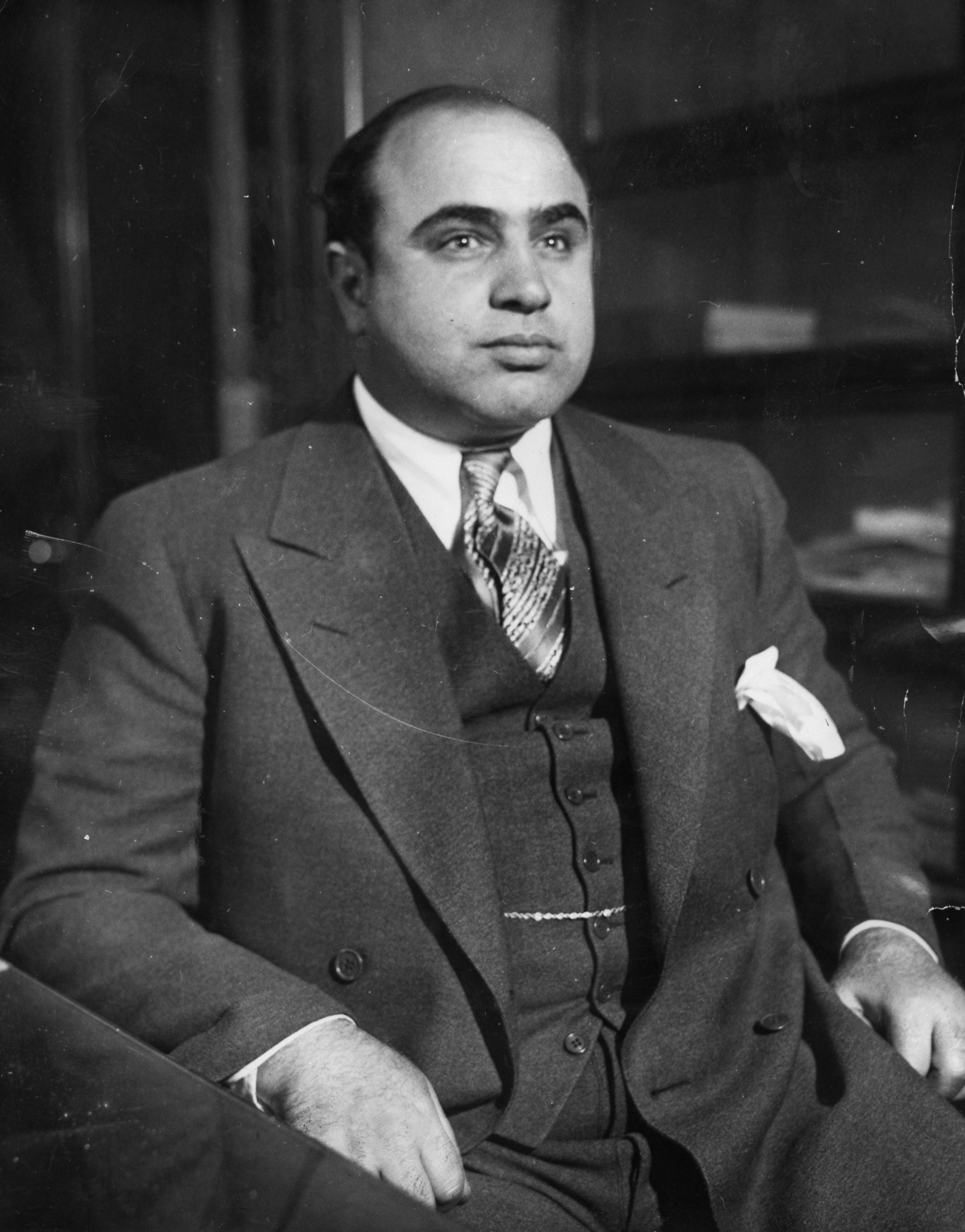
Al Capone
American gangster and businessman (1899–1947)
Alphonse Gabriel Capone ( kə-POHN; Italian: [kaˈpoːne]; January 17, 1899 – January 25, 1947), sometimes known by the nickname "Scarface", was an American gangster and businessman who attained notoriety during the Prohibition era as the co-founder and boss of the Chicago Outfit from 1925 to 1931. His seven-year reign as a crime boss ended when he was imprisoned at the age of 33.
Capone was born in New York City in 1899 to Italian immigrants. He joined the Five Points Gang as a teenager and became a bouncer in organized crime premises such as brothels. In his early twenties, Capone moved to Chicago and became a bodyguard of Johnny Torrio, head of a criminal syndicate that illegally supplied alcohol—the forerunner of the Outfit—and was politically protected through the Unione Siciliana.
A conflict with the North Side Gang was instrumental in Capone's rise and fall. Torrio went into retirement after North Side gunmen almost killed him, handing control to Capone. Although Capone expanded the bootlegging business through increasingly violent means, his mutually profitable relationships with Mayor William Hale Thompson and the Chicago Police Department meant he seemed safe from law enforcement.
Capone apparently reveled in attention, such as the cheers from spectators when he appeared at baseball games. He made donations to various charities and was viewed by many as a "modern-day Robin Hood". The Saint Valentine's Day Massacre, in which seven people from rival gangs were murdered in broad daylight, damaged the public image of Chicago and Capone, leading influential citizens to demand government action and newspapers to dub Capone "Public Enemy No. 1".
Federal authorities became intent on jailing Capone and charged him with twenty-two counts of tax evasion. He was convicted of five counts in 1931. During a highly publicized case, the judge admitted as evidence Capone's admissions of his income and unpaid taxes, made during prior and ultimately abortive negotiations to pay the government taxes he owed. He was convicted and sentenced to eleven years in federal prison. After conviction, he replaced his defense team with experts in tax law, and his grounds for appeal were strengthened by a U.S. Supreme Court ruling, although his appeal ultimately failed. Capone showed signs of neurosyphilis early in his sentence and became increasingly debilitated before being released after almost eight years of incarceration. In 1947, he died of cardiac arrest after a stroke.
Early life
Alphonse Gabriel Capone was born in Brooklyn, a borough of New York City, on January 17, 1899. His parents were Italian immigrants Teresa (née Raiola; 1867–1952) and Gabriele Capone (1865–1920), both born in Angri, a small municipality outside of Naples in the province of Salerno. His father was a barber and his mother was a seamstress. Capone's family had immigrated to the United States in 1893 by ship, first going through the port city of Fiume, Austria-Hungary (modern-day Rijeka, Croatia). The family settled at 95 Navy Street, in the Brooklyn Navy Yard. When Capone was aged 11, he and his family moved to 38 Garfield Place in Park Slope, Brooklyn.
Capone's parents had eight other children: James Vincenzo Capone, who later changed his name to Richard Hart and became a Prohibition agent in Homer, Nebraska; Raffaele James Capone, also known as Ralph Capone or "Bottles", who took charge of his brother's beverage industry; Salvatore "Frank" Capone; Ermina Capone, who died at the age of one; Ermino "John" Capone; Albert Capone; Matthew Capone and Mafalda Capone. Ralph and Frank worked with Al in his criminal empire. Frank did so until his death on April 1, 1924. Ralph ran Al's bottling companies (both legal and illegal) early on and was also the front man for the Chicago Outfit until he was imprisoned for tax evasion in 1932.
Capone showed promise as a student but had trouble with the rules at his strict parochial Catholic school. His schooling ended at the age of 14 after he was expelled for hitting a female teacher in the face. Capone worked at odd jobs around Brooklyn, including a candy store and a bowling alley. From 1916 to 1918, he played semi-professional baseball. Following this, Capone was influenced by gangster Johnny Torrio, whom he came to regard as a mentor.
Capone married Mae Josephine Coughlin at age 19, on December 30, 1918. She was Irish Catholic and earlier that month had given birth to their son Albert Francis "Sonny" Capone (1918–2004). Albert lost most of his hearing in his left ear as a child. Capone was under the age of 21, and his parents had to consent in writing to the marriage. By all accounts, the two had a happy marriage.
Career
New York City
Capone initially became involved with small-time gangs that included the Junior Forty Thieves and the Bowery Boys. He then joined the Brooklyn Rippers, and then the powerful Five Points Gang based in Lower Manhattan. During this time he was employed and mentored by fellow racketeer Frankie Yale, a bartender in a Coney Island dance hall and saloon called the Harvard Inn. Capone inadvertently insulted a woman while working the door, and he was slashed with a knife three times on the left side of his face by her brother, Frank Galluccio; the wounds led to the nickname "Scarface", which Capone loathed. The date when this occurred has been reported with inconsistencies. When Capone was photographed, he hid the scarred left side of his face, saying that the injuries were war wounds. He was called "Snorky" by his closest friends, a term for a sharp dresser.
Move to Chicago
In 1919, Capone left New York City for Chicago at the invitation of Torrio, who was imported by crime boss James "Big Jim" Colosimo as an enforcer. Capone began in Chicago as a bouncer in a brothel, which is thought to be most likely where he contracted syphilis. Capone was aware of being infected at an early stage and timely use of Salvarsan probably could have cured the infection, but he apparently never sought treatment.
In 1920 or 1921 or 1923, Capone purchased a two-storey two-flat six-bedroom building, on a 68-foot-wide double lot, built in 1905, and moved in on August 8, 1923, at 7244 South Prairie Avenue in the Park Manor neighborhood in Greater Grand Crossing, Chicago for $5,500.
As originally reported in the Chicago Tribune, hijacker Joe Howard was killed on May 8, 1924, after he tried to interfere with the Capone-Torrio bootlegging business. In a 1936 article highlighting Capone's criminal career, the Tribune erroneously reported the date as May 7, 1923. In the early years of the decade, Capone's name began appearing in newspaper sports pages where he was described as a boxing promoter. Torrio took over Colosimo's criminal empire after the latter's murder on May 11, 1920, in which Capone was suspected of being involved.
Torrio headed an essentially Italian organized crime group that was the biggest in Chicago, with Capone as his right-hand man. Torrio was wary of being drawn into gang wars and tried to negotiate agreements over territory between rival crime groups. The smaller North Side Gang, led by Dean O'Banion, came under pressure from the Genna brothers who were allied with Torrio. O'Banion found that Torrio was unhelpful with the Gennas' encroachment, despite his pretensions to be a settler of disputes. In a fateful step, Torrio arranged the murder of O'Banion at his flower shop on November 10, 1924. This placed Hymie Weiss at the head of the gang, backed by Vincent Drucci and Bugs Moran. Weiss had been a close friend of O'Banion, and the North Siders made it a priority to get revenge on his killers.
During Prohibition, Capone was involved with Canadian bootleggers who helped him smuggle liquor into the U.S. When Capone was asked if he knew Rocco Perri, billed as Canada's "King of the Bootleggers", he replied: "Why, I don't even know which street Canada is on." Other sources claim that Capone had certainly visited Canada, where he maintained some hideaways, although the Royal Canadian Mounted Police states that there is no "evidence that he ever set foot on Canadian soil".
Boss
An ambush in January 1925 left Capone shaken, but unhurt. Twelve days later, Torrio was returning from a shopping trip when he was shot several times. After recovering, he effectively resigned and handed control over to Capone, aged 26, who became the new boss of an organization that took in illegal breweries and a transportation network that reached to Canada, with political and law-enforcement protection. In turn, he was able to use more violence to increase revenue. Any establishment that refused to purchase liquor from Capone often got blown up, and as many as 100 people were killed in such bombings during the 1920s. Rivals saw Capone as responsible for the proliferation of brothels in the city.
Capone often enlisted the help of local members of the black community into his operations; jazz musicians Milt Hinton and Lionel Hampton had uncles who worked for Capone on Chicago's South Side. A fan of jazz as well, Capone once asked clarinetist Johnny Dodds to play a number that Dodds did not know; Capone split a $100 bill in half and told Dodds that he would get the other half when he learned it. Capone also sent two bodyguards to accompany jazz pianist Earl Hines on a road trip.
Content sourced from Wikipedia under CC BY-SA 4.0


