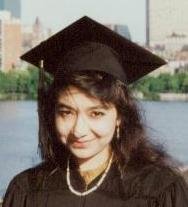
Aafia Siddiqui
Pakistani-American neuroscientist convicted of attempted murder (born 1972)
Aafia Siddiqui (also spelled Afiya; Urdu: عافیہ صدیقی; born 2 March 1972) is a Pakistani neuroscientist and educator who gained international attention following her conviction in the United States and is currently serving an 86-year sentence for attempted murder and other felonies at the Federal Medical Center, Carswell, in Fort Worth, Texas.
Siddiqui was born in Pakistan to a Sunni Muslim family. For a period from 1990, she studied in the United States and obtained from the Massachusetts Institute of Technology a BS in biology, and a Ph.D. in neuroscience from Brandeis University in 2001. She returned to Pakistan for a time following the 9/11 attacks and again in 2003 during the war in Afghanistan. Khalid Sheikh Mohammad named her a courier and financier for al-Qaeda, and she was placed on the Federal Bureau of Investigations's Seeking Information – Terrorism list; she was the first woman to have been featured on the list. Around this time, she and her three children were allegedly kidnapped in Pakistan.
Five years later, she reappeared in Ghazni, Afghanistan, and was arrested by Afghan police and held for questioning by the FBI. While in custody, Siddiqui allegedly told the FBI she had gone into hiding but later disavowed her testimony and stated she had been abducted and imprisoned. Supporters believe she was held captive at Bagram Air Force Base as a ghost detainee, an allegation the US government denies. During her second day in custody, she shot at visiting U.S. FBI and Army personnel with an M4 carbine an interrogator had placed on the floor by his feet. She was shot in the torso when a warrant officer returned fire. She was hospitalized, treated and then extradited to the US, where in September 2008 she was indicted on charges of assault and attempted murder of a US soldier in the police station in Ghazni, charges she denies. She was convicted on 3 February 2010 and later sentenced to 86 years in prison.
In Pakistan, her arrest and conviction was caused large protests throughout the country; while in the US, she was considered by some to be especially dangerous as "one of the few alleged Al Qaeda associates with the ability to move about the United States undetected, and the scientific expertise to carry out a sophisticated attack". She has been termed "Lady al-Qaeda" by a number of media organizations due to her alleged affiliation with Islamists. Islamic State have offered to trade her for prisoners on two occasions: once for James Foley and once for Kayla Mueller. Pakistani news media called the trial a "farce", while other Pakistanis labeled this reaction "knee-jerk Pakistani nationalism". Yusuf Raza Gilani, who was the Pakistani prime minister at that time, and opposition leader Nawaz Sharif promised to push for her release.
Biography
Family and early life
Aafia Siddiqui was born in Karachi, Pakistan, to Muhammad Salay Siddiqui, a British-trained neurosurgeon, and Ismet (née Faroochi), an Islamic teacher, social worker and charity volunteer. She belongs to the Urdu-speaking Muhajir family, and was raised in an observant Muslim household. Her parents combined devotional Islam with their resolve to understand and use technological advances in science. Aafia attended school in Zambia until the age of eight and finished her primary and secondary schooling in Karachi.
Ismet Siddiqui was prominent in political and religious circles, teaching classes on Islam wherever she lived, founding a United Islamic Organization, and serving as a member of Pakistan's parliament. Her support for strict Islam in the face of feminist opposition to his Hudood Ordinances drew the attention of General Muhammad Zia-ul-Haq who appointed her to a Zakat Council. Siddiqui is the youngest of three siblings. Her brother, Muhammad, studied to become an architect in Houston, Texas, while her sister, Fowzia, is a Harvard-trained neurologist who worked at Sinai Hospital in Baltimore and taught at Johns Hopkins University before she returned to Pakistan.
Undergraduate education
Aafia Siddiqui moved to Houston, Texas, US on a student visa in 1990, joining her brother who was studying architecture. She attended the University of Houston where friends and family described her interests as limited to religion and schoolwork. She avoided movies, novels and television, except for the news. After three semesters, she transferred to the Massachusetts Institute of Technology.
In 1992, as a sophomore, Siddiqui won a $5,000 Carroll L. Wilson Award for her research proposal "Islamization in Pakistan and its Effects on Women". She returned to Pakistan to interview architects of the Islamization and the Hudood Laws, including Taqi Usmani, the spiritual adviser to her family. As a junior, she received a $1,200 City Days fellowship through MIT's program to help clean up Cambridge elementary school playgrounds. While she initially had a triple major in biology, anthropology, and archaeology at MIT, she graduated in 1995 with a BS in biology.
At MIT, Siddiqui lived in the all-female McCormick Hall. She remained active in charity work and proselytising. Her fellow MIT students described her as being religious, which was not unusual at the time, but not a fundamentalist, one of them saying that she was "just nice and soft-spoken". She joined the Muslim Students' Association, and a fellow Pakistani recalls her recruiting for association meetings and distributing pamphlets. Siddiqui began doing volunteer work for the Al Kifah Refugee Center after returning from Pakistan. Al Kifah included members who assassinated Jewish ultranationalist Meir Kahane and helped Ramzi Yousef with the 1993 World Trade Center bombing. She was known for her effectiveness in shaming audiences into contributing to jihad and the only woman known to have regularly raised money for Al-Kifah. Through the student association she met several committed Islamists, including Suheil Laher, its imam, who had publicly advocated Islamization and jihad before 9/11. Journalist Deborah Scroggins suggested that through the association's contacts Siddiqui may have been drawn into the world of terrorism:
At MIT, several of the MSA's most active members had fallen under the spell of Abdullah Azzam, a Muslim Brother who was Osama bin Laden's mentor .... [Azzam] had established the Al Kifah Refugee Center [Brooklyn, New York] to function as its worldwide recruiting post, propaganda office, and fund-raising center for the mujahideen fighting in Afghanistan ... It would become the nucleus of the al-Qaeda organization.
Aafia's commitment to al-Kifah showed no sign of dimming when the connection between its Jersey City branch and the World Trade Center bombing became apparent. When the Pakistani government helped the US arrest and extradite Ramzi Yousef for his role in the bombing (where Yousef hoped to kill 250,000 Americans by knocking one WTC tower over into the other) an outraged Siddiqui circulated the announcement with a scornful note deriding Pakistan for "officially" joining "the typical gang of our contemporary Muslim governments", closing her email with a quote from the Quran warning Muslims not to take Jews and Christians as friends. She wrote three guides for teaching Islam, expressing the hope in one: "that our humble effort continues ... and more and more people come to the [religion] of Allah until America becomes a Muslim land." She also took a 12-hour pistol training course at the Braintree Rifle and Pistol Club, mailed US military manuals to Pakistan and moved from her apartment after the FBI agents visited the university looking for her.
Marriage, graduate school, and work
In 1995, she agreed to a marriage arranged by her mother to Karachi-born anesthesiologist Amjad Mohammed Khan just out of medical school and whom she had never seen. The marriage ceremony was conducted over the telephone. Khan then came to the US, and the couple lived first in Lexington, Massachusetts, and then in the Mission Hill neighbourhood of Roxbury, Boston, where he worked as an anesthesiologist at Brigham and Women's Hospital. She gave birth to a son, Muhammad Ahmed, in 1996, and to a daughter, Mariam Bint-e Muhammad, in 1998.
Siddiqui studied cognitive neuroscience at Brandeis University. In early 1999, while she was a graduate student, she taught the General Biology Laboratory course. She received her PhD in 2001 after completing her dissertation on learning through imitation titled Separating the Components of Imitation. She co-authored a journal article on selective learning that was published in 2003. One incident that caused controversy was her presentation of a paper on fetal alcohol syndrome where she concluded that science showed why God had forbidden alcohol in the Quran. When told by some teachers this was inappropriate, she complained bitterly of discrimination to the associate dean of graduate studies, threatening to "open a can of worms".
Content sourced from Wikipedia under CC BY-SA 4.0


