2024 United States presidential election
Presidential elections were held in the United States on November 5, 2024. The Republican Party's ticket—Donald Trump, who served as the 45th president of the United States from 2017 to 2021, and JD Vance, the junior U.S. senator from Ohio—defeated the Democratic Party's ticket—Kamala Harris, the incumbent U.S. vice president, and Tim Walz, the incumbent governor of Minnesota.
The incumbent president, Joe Biden of the Democratic Party, initially ran for re-election as its presumptive nominee, facing little opposition and easily defeating Dean Phillips, a U.S. representative, during the Democratic primaries; however, what was broadly considered a poor debate performance in June 2024 intensified concerns about his age and health, and led to calls within his party for him to leave the race. After initially declining to do so, Biden ultimately withdrew from the race on July 21, 2024, becoming the first eligible incumbent president to withdraw since Lyndon B. Johnson in 1968. Biden immediately endorsed Harris, who officially became the party's presidential nominee on August 5 and became the first presidential nominee who did not participate in the primaries since Vice President Hubert Humphrey in 1968. Harris selected Walz as her running mate.
Trump, who lost the 2020 presidential election to Biden, ran for reelection to a nonconsecutive second term. He was shot in the ear in an assassination attempt on July 13, 2024. Trump was nominated as the Republican Party's presidential candidate during the 2024 Republican National Convention alongside his running mate, Vance. The Trump campaign ticket supported mass deportation of undocumented immigrants; an isolationist "America First" foreign policy agenda with support of Israel in the Gaza war and skepticism of Ukraine in its war with Russia; policies hostile to transgender Americans; and tariffs. The campaign also made false and misleading statements, including claims of electoral fraud in 2020. Trump's political movement was seen by some historians and some former Trump administrators as authoritarian.
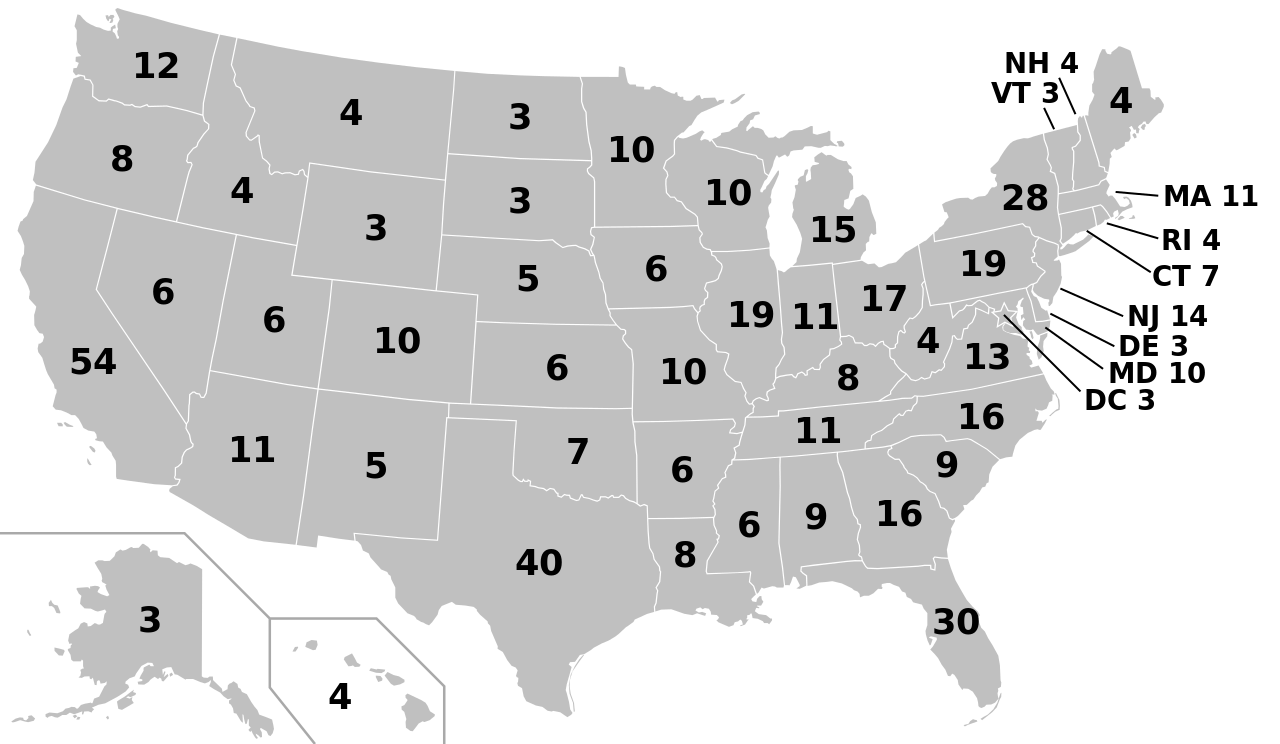
Trump won the election over Harris, winning 312 Electoral College votes to Harris' 226. Trump won all of the seven swing states, including the first win of Nevada by a Republican since 2004. Trump won the national popular vote with a plurality of 49.8%, making him the first Republican to win the popular vote since George W. Bush in 2004 (unlike his 2016 victory and 2020 defeat). Trump's victory made him the second U.S. president to be elected to a nonconsecutive second term, after Grover Cleveland in 1892. Surveys of 2024 election voters, nationally and in key states, found that many viewed economic conditions negatively and were motivated by the issue when they voted. Other issues that motivated voters include immigration, the state of democracy, and abortion.
Background
In 2020, incumbent Republican President Donald Trump sought re-election, but was defeated by Democratic challenger Joe Biden. Democratic U.S. Senator Kamala Harris of California was elected vice president in 2020 as Biden's running mate.
Trump is the first president in American history to be impeached twice, and the first to run for president again after impeachment. As Trump was acquitted by the Senate in both cases, he was not barred from seeking reelection to the presidency in 2024.
Election interference
Several state courts and officials, including the Colorado Supreme Court, a state Circuit Court in Illinois, and the Secretary of State of Maine, ruled that Trump was ineligible to hold office under Section 3 of the Fourteenth Amendment to the United States Constitution for his role in the January 6 Capitol attack, and thus attempted to disqualify him from appearing on the ballot. These attempts were unsuccessful. On March 4, 2024, the U.S. Supreme Court unanimously ruled in Trump v. Anderson that states cannot determine eligibility for a national election under Section 3. The Court held that only Congress has the authority to disqualify candidates, or to pass legislation that allows courts to do so.
Donald Trump's false claims of interference
Trump made false claims of voter fraud in the 2020 presidential election and denied the validity of the election results. In July 2024, The New York Times reported that "the Republican Party and its conservative allies are engaged in an unprecedented legal campaign targeting the American voting system", by restricting voting for partisan advantage ahead of Election Day and preparing to mount "legally dubious" challenges against the certification process if Trump were to lose.
In the lead-up to the 2024 election, the Republican Party made false claims of massive "noncitizen voting" by immigrants in an attempt to delegitimize the election in the event of a Trump defeat. The claims were made as part of larger efforts within the Republican Party to disrupt the 2024 election and promote election denial. Trump and several other Republicans stated that they would not accept the results of the 2024 election if they believed they were "unfair".
Trump's previous comments suggesting he could "terminate" the Constitution to reverse his election loss, his claim that he would only be a dictator on "day one" of his presidency and not afterwards, his promise to use the Justice Department to go after his political enemies, his plan to use the Insurrection Act of 1807 to deploy the military for law enforcement in primarily Democratic cities and states, attempts to overturn the 2020 United States presidential election, his baseless predictions of voter fraud in the 2024 election, and his public embrace and celebration of the January 6 United States Capitol attack, raised concerns over the state of democracy in the United States. Trump's political operation said that it planned to deploy more than 100,000 attorneys and volunteers to polling places across battleground states, with an "election integrity hotline" for poll watchers and voters to report alleged voting irregularities.
Interference by foreign nations
Before the election, U.S. officials and former officials stated that foreign interference in the 2024 election was likely. Three major factors cited were "America's deepening domestic political crises, the collapse of controversial attempts to control political speech on social media, and the rise of generative AI". China, Russia, and Iran were identified as mounting influence operations and attempts to interfere with the 2024 election. U.S. intelligence officials described the efforts as part of broader efforts by authoritarian nations to use the internet to erode support for democracy.
China
China was identified as interfering with the 2024 election through propaganda and disinformation campaigns linked to its Spamouflage operation. U.S. intelligence agencies described the effort as not targeting any particular candidate but focusing on issues important to the Chinese government, such as Taiwan, and "undermining confidence in elections, voting, and the U.S. in general". As early as April 1, 2024, The New York Times reported that the Chinese government had created fake pro-Trump accounts on social media "promoting conspiracy theories, stoking domestic divisions and attacking President Biden ahead of the election in November".
Russia
According to disinformation experts and intelligence agencies, Russia spread disinformation ahead of the 2024 election to damage Biden and Democrats, boost candidates supporting isolationism, and undercut support for Ukraine aid and NATO. On September 4, 2024, the United States publicly accused Russia of interfering in the 2024 election and announced several steps to combat Russian influence including sanctions, indictments, and seizing of web domains used to spread propaganda and disinformation. U.S. intelligence agencies assessed that Russia preferred Trump to win the election, viewing him as more critical of American support for Ukraine.
Iran
Iran was identified as interfering with the 2024 presidential election through front companies connected to the Islamic Revolutionary Guard Corps and hacking attempts against the Trump, Biden, and Harris campaigns starting as early as May 2024. Iran launched propaganda and disinformation campaigns through fake news websites and accounts on social media to tip the election against former president Trump. The New York Times stated the efforts were an attempt at "sowing internal discord and discrediting the democratic system in the United States more broadly in the eyes of the world".
Voter roll purges
Multiple Republican-led administrations removed voters from their states' voter rolls in the lead up to the election, which critics argued violates the National Voter Registration Act. In July 2024, 160,000 inactive or infrequent voters were removed from Ohio's voter rolls. The Ohio chapters of Common Cause and the League of Women Voters threatened lawsuits against the state over the purge.
Content sourced from Wikipedia under CC BY-SA 4.0


