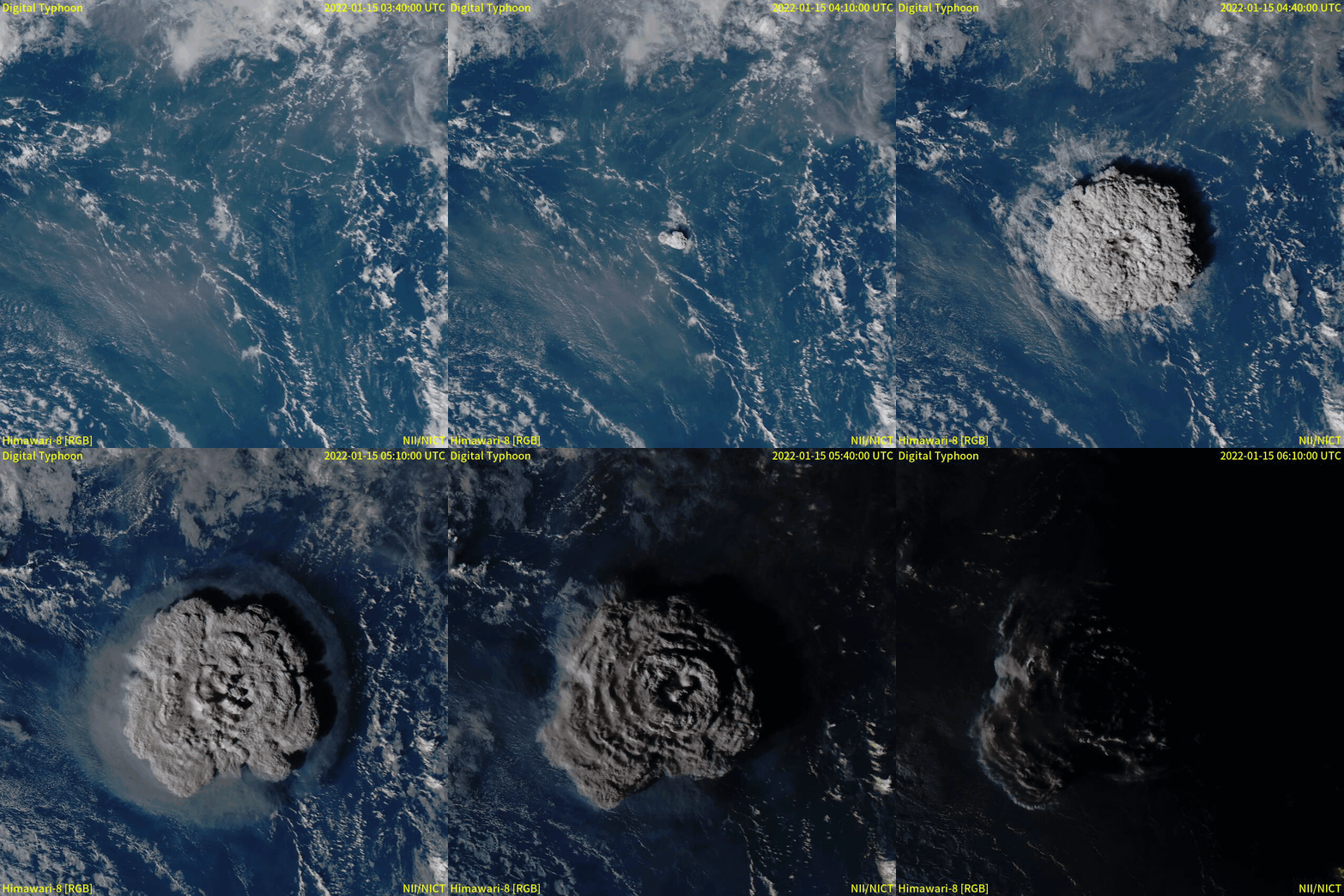
2022 Hunga Tonga–Hunga Haʻapai eruption and tsunami
Volcanic event in the South Pacific Ocean
In December 2021, an eruption began on Hunga Tonga–Hunga Haʻapai, a submarine volcano in the Tongan archipelago in the southern Pacific Ocean. The eruption reached a very large and powerful climax nearly four weeks later, on 15 January 2022. Hunga Tonga–Hunga Haʻapai is 65 kilometres (40 mi) north of Tongatapu, the country's main island, and is part of the highly active Tonga–Kermadec Islands volcanic arc, a subduction zone extending from New Zealand to Fiji. On the Volcanic Explosivity Index scale, the eruption was rated at least a VEI-5. Described by scientists as a "magma hammer", the volcano at its height produced a series of four underwater thrusts, displaced 10 cubic kilometres (2.4 cu mi) of rock, ash and sediment, and generated the largest atmospheric explosion recorded by modern instrumentation.
The eruption produced a volcanic tsunami that affected Tonga, Fiji, American Samoa, Samoa, Vanuatu, New Zealand, Japan, the United States, the Russian Far East, Chile and Peru. At least four people were killed, some were injured, and some remain possibly missing in Tonga from tsunami waves up to 20 m (66 ft) high. Tsunami waves with run-up heights up to 45 m (148 ft) struck the uninhabited island of Tofua. Two people drowned in Peru when 2 m (6 ft 7 in) waves struck the coast, while another died of indirect causes in Fiji. It was the largest volcanic eruption since the 1991 eruption of Mount Pinatubo. NASA determined that the eruption was "hundreds of times more powerful" than Little Boy. The eruption was the largest explosion recorded in the atmosphere by modern instrumentation, far larger than any 20th-century volcanic event or nuclear bomb test. It is thought that in recent centuries, only the Krakatoa eruption of 1883 rivalled the atmospheric disturbance produced.
Volcanic activity
December 2021
After staying relatively inactive since 2014, the Hunga Tonga–Hunga Haʻapai volcano erupted on 20 December 2021, sending particulates into the stratosphere. A large plume of ash was visible from Nukuʻalofa, the capital city of Tonga, about 70 km (43 mi) from the volcano. The Volcanic Ash Advisory Center (VAAC) in Wellington, New Zealand, issued an advisory notice to airlines. This initial eruption ended at 02:00 on 21 December 2021.
On 22 and 23 December 2021, 8-to-14-kilometre-high (5.0 to 8.7 mi) plumes containing sulfur dioxide drifted to the north-north-east and spread over the Niuatoputapu, Haʻapai and Vavaʻu island groups. Surtseyan explosions, steam plumes and steam bursts were recorded by a Tonga Navy crew on 23 December 2021, during which time the first ground-based images of the eruption were created.
Between 24 and 27 December 2021, steam and gas emissions reached altitudes of 10.3–12.2 kilometres (6.4–7.6 mi). Ash plumes reached heights of only 3 km (1.9 mi), depositing ash only adjacent to the volcano. On 25 December 2021, satellite imagery revealed that the island had increased in size by 300–600 metres (980–1,970 ft) on its eastern side. During 29–30 December 2021, several surges of Surtseyan activity occurred, some of which were witnessed by passengers on a small South Seas Charters boat. Eruption plumes during the second half of December 2021 interrupted air travel to Tonga multiple times.
January 2022
As activity on the island decreased, it was declared dormant by the Tonga Geological Services on 11 January 2022. However, a large eruption commenced on 14 January 2022 at 04:20 local time (15:20 UTC, 13 January), sending clouds of ash 20 km (12 mi) into the atmosphere. The government of Tonga issued a tsunami warning to residents, and waves of 30 cm (12 in) were observed in Nuku'alofa. Later in the afternoon, Tongan geologists near the volcano observed explosions and a 5-kilometre-wide (3.1 mi) ash column between 17:00 and 18:30 local time. A much larger Plinian eruption started the following day (15 January 2022) at 17:14 local time (04:14:45 UTC, 15 January). The eruption column from this eruption rose 58 km (36 mi) into the mesosphere. The VAAC again issued an advisory notice to airlines. Ash from the eruption made landfall on the main island of Tongatapu, blotting out the sun. Loud explosions were heard 65 km (40 mi) away in Nukuʻalofa, and small stones and ash rained down from the sky. Many residents in Tonga were stuck in traffic whilst attempting to flee to higher ground.
The explosion was heard in Samoa, roughly 840 km (520 mi) away before the sound travelled to more distant countries. Residents in Fiji, more than 700 km (430 mi) away, described the sounds of thunder, while the "thump" of the eruption was also reported in Niue and Vanuatu. Tremors and shaking buildings were reported by residents in south-western Niue, around Alofi and Avatele. The United States Geological Survey estimated the eruption at a surface-wave magnitude of 5.8. The eruption was heard more than 2,000 km (1,200 mi) away in New Zealand, where the sound arrived two hours later. A series of bangs were heard around 3:30 a.m. local time in and around Anchorage, Alaska, approximately 9,300 km (5,800 mi) away from the volcano, lasting about 30 minutes. Low-frequency noise persisted for approximately two hours. Booms were heard as far away as Yukon in Canada, 9,700 km (6,000 mi) away.
The volcanic explosion caused atmospheric shockwaves to propagate around the globe. Satellites visually captured shockwaves propagating across the Pacific Ocean and a very wide eruption column. The pressure wave was measured by weather stations in many locations, including New Zealand to a maximum amplitude of about 7 hPa, and Australia to 6.9 hPa at Lord Howe Island and 3.3 hPa at Perth. Even in Europe, a pressure fluctuation of 2.5 hPa was measured in Switzerland, and of just over 2 hPa when it reached the United Kingdom. Shockwaves were reported as having gone around the Earth as many as four times in Japan and Utah, and at least twice at the Blue Hill Meteorological Observatory in Massachusetts. The pressure shockwave was also observed in Chennai, India, which is 12,000 km from the eruption site.
Intense lightning activity was recorded during the eruption phase. The Vaisala Global Lightning Dataset GLD360 detected lightning in the form of radio waves. Several hundred to a thousand flashes of lightning were recorded by the system during the two weeks before the eruption. From 14 to 15 January 2022, tens of thousands of lightning flashes occurred. Between 05:00 and 06:00 UTC on 15 January 2022, 200,000 flashes were recorded.
Preliminary observations showed that the eruption column ejected a large amount of volcanic material into the stratosphere, leading to speculation that it would cause a temporary climate cooling effect. Later calculations showed it injected an estimated 400,000 tonnes of sulfur dioxide into the stratosphere and was unlikely to have any global cooling effect. Despite this, the eruption had a cooling effect in the Southern Hemisphere, causing slight cooling of winters and spectacular sunsets. People living in the Southern Hemisphere experienced purple sunsets for a few months after the eruption. A cooling effect of 0.1–0.5 °C (0.18–0.90 °F) was expected to last until spring (September–November) 2022. The eruption was described as a once-in-a-thousand-year event for the Hunga caldera.
NASA satellite Aura detected the eruption using its microwave limb sounder. It measures ozone, water vapor and other atmospheric gases, and can penetrate obstacles such as ash clouds. The underwater explosion also sent 146 million tons of water from the South Pacific Ocean into the stratosphere. The amount of water vapor ejected was 10 percent of the stratosphere's typical stock. It was enough to temporarily warm the surface of Earth. It is estimated that an excess of water vapour should remain for 5–10 years.
Academic research
According to a March 2022 paper in the journal Earthquake Research Advances (ERA), Hunga Tonga–Hunga Haʻapai's plume reached a peak height of 58 kilometres (36 mi) into the atmosphere and sustained heights greater than 30 km (19 mi). The initial explosive event was possibly more powerful than the Hatepe eruption, even though Hatepe ejected over ten times the volume of material in a longer eruption. Hunga Tonga–Hunga Haʻapai erupted over a span of 12 hours, releasing 1.9 km3 (0.46 cu mi) of ejecta with an estimated mass of 2,900 teragrams.
Although the eruption energy was soon estimated from the acoustic waves and the ash cloud, its ranking on the Volcanic Explosivity Index (VEI) is still debated. The ERA paper says the eruption correlated to a VEI of 5–6. An April 2022 research paper led by Poli and Shapiro and published by the American Geophysical Union indicates that the eruption is the largest ever observed with modern instrumentation and estimates its VEI to be approximately 6. Meanwhile, Vergoz and others estimate the blast yield to be 100–200 megatons of TNT and place the corresponding VEI at 5.8. Likewise, a study by Diaz and Rigby estimates the energetic output of the eruption to be equivalent to 61 megatons of TNT, making the event more powerful than the largest nuclear bomb ever detonated (Tsar Bomba). The Smithsonian Institution Global Volcanism Program rated the eruption at VEI-5, while others have rated the eruption at VEI-4.
Content sourced from Wikipedia under CC BY-SA 4.0


