2020 United States presidential election
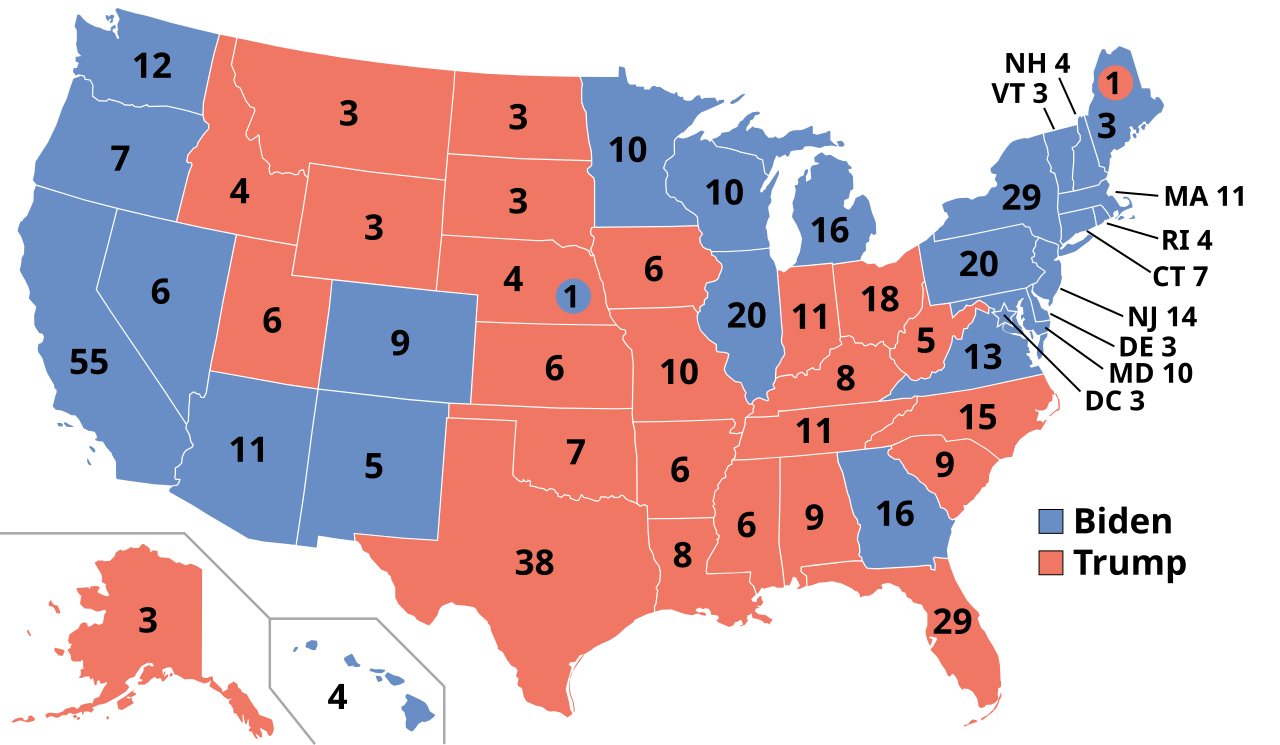
Presidential elections were held in the United States on November 3, 2020. The Democratic ticket of former vice president Joe Biden and California junior senator Kamala Harris defeated the incumbent Republican president Donald Trump and vice president Mike Pence. The election saw the highest voter turnout by percentage since 1900. Biden received more than 81 million votes, the most votes ever cast for a presidential candidate in U.S. history.
In a competitive primary that featured the most candidates for any political party in the modern era of American politics, Biden secured the Democratic presidential nomination. Biden's running mate, Harris, became the first African American, first Asian American, and third female vice presidential nominee on a major party ticket. Trump easily secured re-nomination with only minor opposition in the Republican primaries. Jo Jorgensen secured the Libertarian presidential nomination with Spike Cohen as her running mate, and Howie Hawkins secured the Green presidential nomination with Angela Nicole Walker as his running mate.
The central issues of the election included the public health and economic impacts of the COVID-19 pandemic; civil unrest in reaction to the police murder of George Floyd, the Supreme Court following the death of Ruth Bader Ginsburg and confirmation of Amy Coney Barrett, and the future of the Affordable Care Act. Due to the ongoing pandemic, a record number of ballots were cast early and by mail. Thirty-eight states had over half of all votes cast using these methods, and only three states had fewer than 25%. As a result of a large number of mail-in ballots, some swing states saw delays in vote counting and reporting; this led to major news outlets delaying their projection of Biden and Harris as the president-elect and vice president-elect until the morning of November 7, 2020.
Biden defeated Trump, winning 306 Electoral College votes and 51.3% of the popular vote to Trump's 232 electoral votes and 46.8% of the popular vote. Trump was the first president to lose re-election since George H. W. Bush in 1992. Key to Biden's pivotal victory were his wins in the Democratic-leaning Rust Belt states of Michigan, Pennsylvania, and Wisconsin, which Trump narrowly carried in 2016 and whose combined 46 electoral votes were enough to swing the election to either candidate. This election marked the first time since 1948 that the Democratic Party won the popular vote in four consecutive elections.
Trump refused to accept the results; he and his allies made disproven claims of fraud, pressured elections officials, filed several unsuccessful lawsuits, and directly attempted to overturn the results at the county, state, and federal level. This culminated in the attack on the United States Capitol, on January 6, 2021, for which Trump was impeached a second time. The day after the attack, Trump stated that a "new administration" would be succeeding his, without mentioning president-elect Biden by name, in a video posted on Twitter.
Background
The Maine Legislature passed a bill in August 2019 adopting ranked-choice voting (RCV) both for presidential primaries and for the general election. Governor Janet Mills allowed the bill to become law without her signature, which delayed its taking effect until after the 2020 Democratic primary in March and made Maine the first state to use RCV for a presidential general election. The Maine Republican Party filed signatures for a veto referendum to preclude the use of RCV for the 2020 election, but Secretary of State Matthew Dunlap found there were insufficient valid signatures to qualify for the ballot. A challenge in Maine Superior Court was successful for the Maine Republican Party, but the Maine Supreme Judicial Court stayed the ruling pending appeal on September 8, 2020. Nevertheless, ballots began being printed later that day without the veto referendum and including RCV for the presidential election, and the Court ruled in favor of the secretary of state on September 22, allowing RCV to be used. An emergency appeal to the Supreme Court was denied on October 6. The law continues the use of the congressional district method for the allocation of Maine's electors (Nebraska is the only other state that apportions its electoral votes this way). While multiple rounds of vote counting were not needed due to a single candidate receiving a majority of first-choice votes statewide and in each district, use of RCV complicates interpretation of the national popular vote because voters are more likely to vote for third-party or independent candidates.
On December 14, 2020, pledged electors for each candidate, known collectively as the United States Electoral College, gathered in their states' capitols to cast their official votes. Pursuant to the processes laid out by the Electoral Count Act of 1887, certificates of ascertainment listing the names of the electors and separate certificates recording their votes are distributed to various officials across the branches of government. The newly elected Congress, with the vice president in his role as Senate president presiding, met in a joint session to formally open the certificates and count the votes, which began on January 6, 2021, was interrupted by the January 6 United States Capitol attack, and finished the following day.
Nominations
Democratic Party
The Democratic Party chose its nominee in the 2020 Democratic Party presidential primaries. Joe Biden became the presumptive nominee of the Democratic Party on April 8, 2020, after senator Bernie Sanders of Vermont withdrew from the race. On June 5, 2020, Biden secured enough delegates to ensure his nomination at the national convention. Biden picked Kamala Harris as his vice-presidential nominee, and the ticket was formally nominated at the convention on August 18.
Republican Party
Incumbent president Donald Trump and incumbent vice president Mike Pence were able to easily secure the nomination against former governor of Massachusetts Bill Weld after Trump received enough delegates in the 2020 Republican presidential primaries. They were formally nominated at the Republican National Convention on August 24, 2020. Trump won 2,549 delegates (out of 2,550), one of the most in presidential primary history.
Libertarian Party
Jo Jorgensen, who was the running mate of author Harry Browne in 1996, received the Libertarian nomination at the national convention on May 23, 2020. She achieved ballot access in all 50 states and the District of Columbia.
Green Party
Howie Hawkins became the presumptive nominee of the Green Party on June 21, 2020, and was officially nominated by the party on July 11, 2020. Hawkins secured ballot access in 29 states and the District of Columbia, representing 381 electoral votes, and write-in access in 16 more states, representing 130 electoral votes.
General election campaigns
Ballot access
Party conventions
The 2020 Democratic National Convention was originally scheduled for July 13–16 in Milwaukee, Wisconsin, but was delayed to August 17–20 due to the effects of the COVID-19 pandemic. On June 24, 2020, it was announced that the convention would be held in a mixed online in-person format, with most delegates attending remotely but a few still attending the physical convention site. On August 5, the in-person portion of the convention was scaled down even further; major speeches, including Biden's, were switched to a virtual format.
The 2020 Republican National Convention took place from August 24–27 in Charlotte, North Carolina, and various remote locations. Originally, a three-day convention was planned to be held in North Carolina, but due to North Carolina's insistence that the convention follow COVID-19 social distancing rules, the speeches and celebrations were moved to Jacksonville, Florida (official convention business was still contractually obligated to be conducted in Charlotte). Due to the worsening situation with regards to COVID-19 in Florida, the plans there were cancelled, and the convention was moved back to Charlotte in a scaled-down capacity.
The 2020 Libertarian National Convention was originally scheduled to be held in Austin, Texas, over Memorial Day weekend from May 22 to 25, but all reservations at the JW Marriott Downtown Austin for the convention were cancelled on April 26 due to the COVID-19 pandemic. The Libertarian National Committee eventually decided the party would hold two conventions, one online from May 22–24 to select the presidential and vice-presidential nominees and one at a physical convention in Orlando, Florida, from July 8–12 for other business.
The 2020 Green National Convention was originally to be held in Detroit, Michigan, from July 9 to 12. Due to the COVID-19 pandemic, the convention was instead held online, without a change in date.
Issues unique to the election
Impeachment
The House of Representatives voted to impeach Trump on two counts on December 18, 2019. The trial in the Senate began on January 21, 2020, and ended on February 5, resulting in acquittal by the United States Senate.
Content sourced from Wikipedia under CC BY-SA 4.0


